
Started reading the Anglo American Grosvenor board of inquiry on the weekend.
Will post some extracts over time:
· Within Glencore at the time, the seriousness of the potential outcome drove which investigation and reporting level was used
· A 5 point potential consequence rating, ranging from 1 (negligible) to 5 (catastrophic) was used
· The inquiry notes, “An extract of the Glencore Risk Management Matrix describing levels 4 and 5 is set out below … As with the Anglo Risk Matrix, these potential consequence ratings do not align with the legislative definition of an HPI”
· The Glencore standard called a rating of 4 or 5 as the ‘potential maximum consequence’, being the most plausible worst case and “arising from a risk where all active risk controls…are assumed to be ineffective. It does not consider the likelihood of the event occurring”

· The board notes that a methane exceedance “would be classified as a ‘High Risk’ (H) event if: its PMC was 4 or 5; and it was an event that ‘has occurred at least once in broader worldwide industry’ (D-Unlikely) or ‘has occurred at least once in the mining…industries’ (C-Possible)”
· “History is littered with disastrous events involving disabling injury or fatality from methane related incidents in coal mines”
· “It follows that either ‘D’ or ‘C’ classifications would apply to elevate the classification of risk from a methane exceedance to High (H). Accordingly, as with Anglo’s method of incident classification, the Board finds it difficult to see how a reportable methane exceedance could be classified as anything other than a high potential risk event”
· Nevertheless, “A methane exceedance HPI which was not classified as a 4 or 5 on the scale would result in an investigation conducted at site level”
· “It appears that the classification is based on the actual methane concentration that occurred and not on the premise that critical controls had failed and methane concentrations could have reached the explosive range. In the Board’s view, this is suggestive of an approach that looks to the actual consequence of the incident rather than its true potential under the Risk Management Matrix”

Next they explore ventilation and gas drainage as critical controls. Noting:
· “This section also suggests that methane exceedances should be viewed as an indicator that these critical controls are not, or may not be, operating effectively”
· Some witnesses agreed that “methane drainage is a form of critical control of the hazard of methane, but stated that he believed that methane drainage did not necessarily satisfy Anglo’s definition of what constitutes a critical control”
· Moreover, some investigation reports “did not identify the failure of the goaf drainage plant as a failure of a critical control”
· They briefly discuss the ICMM’s definitions of critical controls, and then contrast against methane drainage (images 3 & 4)
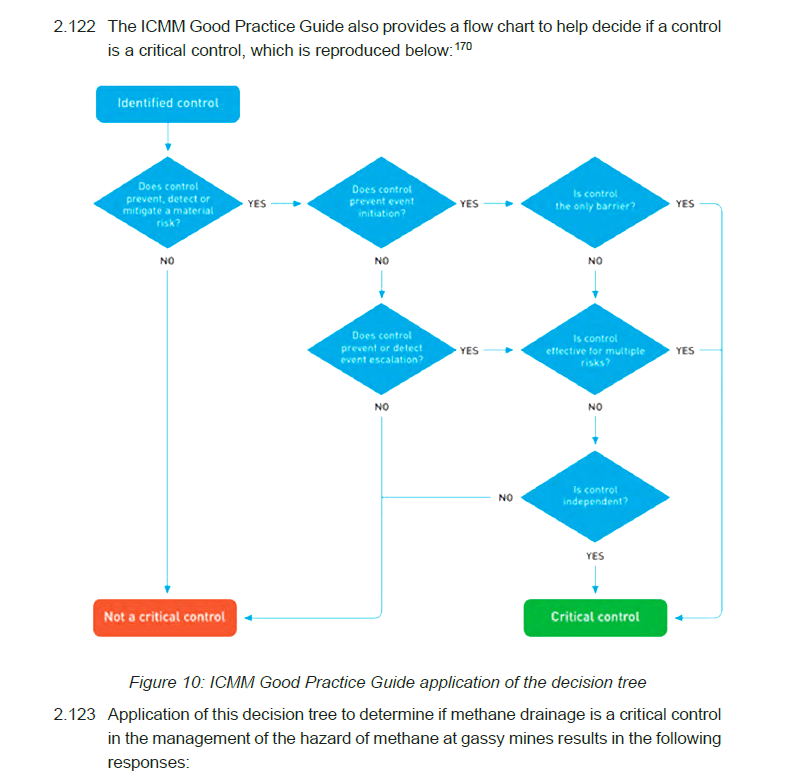
· “The conclusion is that for the management of the hazard of methane at gassy mines, which include all of the mines the subject of this Inquiry, methane drainage meets the definition of a critical control as per the ICMM Good Practice Guide
· “Moreover, methane exceedances at such mines may be an indication that the gas drainage system and/or the ventilation system have failed to keep methane concentrations below pre-determined limits”
· “In the Board’s view, methane exceedances ought to be viewed as an indication of an ineffective critical control and deserve special attention at a corporate level”



 SafetyInsights.org