
This quickisode discusses Dawson & McCulloch’s structured defences in depth approach to navigate occupational fatigue at different levels. Today’s paper: Dawson, D., & McCulloch, K. (2005). Managing fatigue: it’s about sleep. Sleep medicine reviews, 9(5), 365-380. Spotify: https://open.spotify.com/episode/4zz1pg3u3j8NayH6dTQTXH?si=JeSVlaUEQEK5IxfH2tSVEQ Apple: https://podcasts.apple.com/us/podcast/ep32-navigating-fatigue-risk-with-the-defences-in/id1819811788?i=1000725535912 Make sure to subscribe to Safe As on Spotify/Apple, and if you find it useful then please… Continue reading Safe As 32: Navigating fatigue with defences in depth (quickisode)
Year: 2025
Principles of human performance and the claim of 80% accidents due to human error
I found this an interesting juxtaposition of conventional and progressive views of human performance from the DOE Human Performance Improvement Handbook 2009, vol 1. Not a criticism or commentary – just found it interesting. I’m probably making too much of it. But, whatever. Extracts: · They refer to the oft-quoted statement that “About 80 percent of all… Continue reading Principles of human performance and the claim of 80% accidents due to human error
Safe As 31: Do individual mental health interventions work? Maybe not
Do individual level mental health interventions, like personal resilience training, yoga, fruit bowls and training actually improve measures of mental health? Today’s paper is: Fleming, W. J. (2024). Employee well‐being outcomes from individual‐level mental health interventions: Cross‐sectional evidence from the United Kingdom. Industrial Relations Journal, 55(2), 162-182. Spotify: https://open.spotify.com/episode/6voys15y2VU0leio9tREoQ?si=39ZZ3AQ-QQGwry6vc6p7QQ Apple: https://podcasts.apple.com/us/podcast/ep31-do-individual-mental-health-interventions-work/id1819811788?i=1000725381012 Make sure to subscribe to Safe… Continue reading Safe As 31: Do individual mental health interventions work? Maybe not
Safe As week in review: Investigation language, restorative just culture, model 1 / 2 procedures
Safe As week in review: 28 Agentive language in investigations: This ep discusses Vesel’s article, which unpacks the role of language in investigations. · People naturally want to know who or what was responsible for an action and particularly something undesirable. The assignment of action is called agency, where an agent is a person or… Continue reading Safe As week in review: Investigation language, restorative just culture, model 1 / 2 procedures

How do barriers/risk control systems fail due to systemic issues?
How are barriers/risk control systems undermined by systemic issues? This 2004 study unpacks a few mechanisms of how barriers are designed without a deep understanding of work constraints etc. ** Parts 2/3 in comments ** Not a summary – but a few cherry-picked extracts: · “Because engineered systems increasingly incorporate forms of self-protection, operators have to… Continue reading How do barriers/risk control systems fail due to systemic issues?
Procedures: concrete and inflexible actions or flexible resources to guide work? Or Both?
What are better ways to design procedure systems? And how do we balance between concrete action-required steps vs more flexible steps? Check out yesterday’s pod which unpacked a model 1 (top-down, more set in stone and less flexible) vs model 2 (more adaptable and requiring interpretation from workers) perspective on procedures. They found the best… Continue reading Procedures: concrete and inflexible actions or flexible resources to guide work? Or Both?
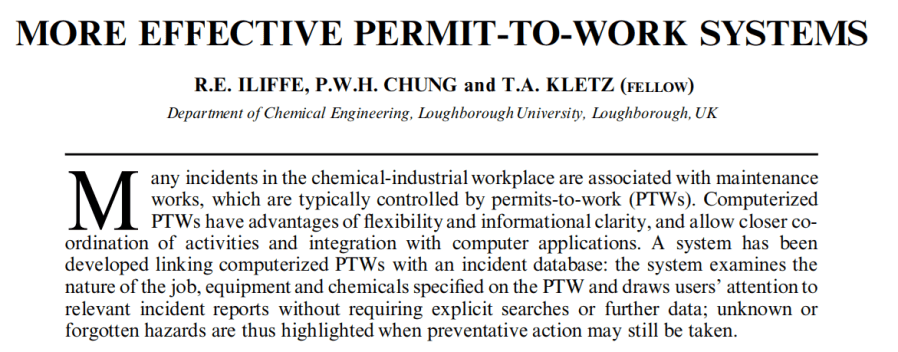
More Effective Permit-to-Work Systems
Kletz and colleagues in 1998 discussing follies of permit to work (PTW) systems, and some improvements. Was meant to be a mini-post, but couldn’t be bothered cutting it back. Extracts: · “A quick check of the Institution of Chemical Engineers’ Accident Database reveals that over 700 accidents of the 5000 listed were maintenance-related” · Some… Continue reading More Effective Permit-to-Work Systems
Signing JSAs not the same as understanding and using JSAs
An apt post from Robert Allan (see below image: link below) about collecting signatures. We found similar findings in our study of HSE audits (image below: link below) Signatures were conflated with the issues of interest – e.g., sigs were mistaken as literal representations of worker understanding or acceptance of issues, hazards or plans; despite… Continue reading Signing JSAs not the same as understanding and using JSAs
Safe As 30: A better way to think about procedures – resources for action
Do you see procedures as concrete actions that specify the one correct way of working, or more as resources to shape work and sensitise people to risk? Let’s unpack the model 1 / model 2 perspective of rules and see which resonates best with workers. Today’s paper is Hendricks, J. W., & Peres, S. C.… Continue reading Safe As 30: A better way to think about procedures – resources for action
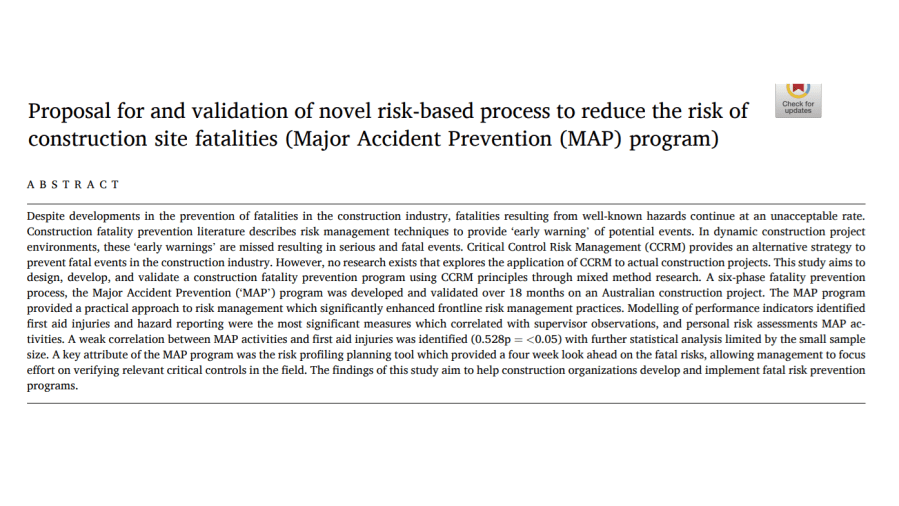
Proposal for and validation of novel risk-based process to reduce the risk of construction site fatalities (Major Accident Prevention (MAP) program)
This study from Selleck and colleagues developed a novel Major Accident Prevention program for construction, leveraging the ICMM’s critical control management (CCM) framework. Way too much to cover – so a few points I found interesting. Background / methods: · Their prior review argued that “the construction industry “would benefit by adopting a shift in… Continue reading Proposal for and validation of novel risk-based process to reduce the risk of construction site fatalities (Major Accident Prevention (MAP) program)
 SafetyInsights.org