
Can LLMs be persuaded to act like d*cks? A really interesting study from Meincke et al. found human persuasion techniques also worked on LLMs. They tested how “classic persuasion principles like authority, commitment, and unity can dramatically increase an AI’s likelihood to comply with requests they are designed to refuse”. I’m drawing from their study… Continue reading Call Me A Jerk: Persuading AI to Comply with Objectionable Requests
Year: 2025
In safety law: is risk & safety the same? What role of injury causation needs to be proven?
In law, is safety & risk the same? Is causation a factor? I knocked this quickly up over the weekend (so expect mistakes…). It’s a legal appeal case – they explore whether, in the legal sense, safety and risk are different, if the Crown has to prove the causative agents, and the extent to which… Continue reading In safety law: is risk & safety the same? What role of injury causation needs to be proven?
Safe As podcast e18: When emotion leads risk – risk as feelings and not just numbers
Risk in safety is often framed in matrices as likelihood x consequences. It holds an allure of (semi)objectivity – the numbers are the numbers. But what is the role of emotion and feelings within our risk judgements? Today’s article argues that what we ‘feel’ about risk precedes and influences what we ‘think’ about risk. This… Continue reading Safe As podcast e18: When emotion leads risk – risk as feelings and not just numbers
Safety audits and major disasters: are they connected?
Are audits implicated in major accidents? My second audit paper reviewed thousands of major accident reports, exploring how investigators framed the role of audits prior to the accident. Surprisingly, very few investigations mentioned the role of audits – positively, negatively or neutrally (just 44 reports out of thousands). Check out the full paper below. We… Continue reading Safety audits and major disasters: are they connected?
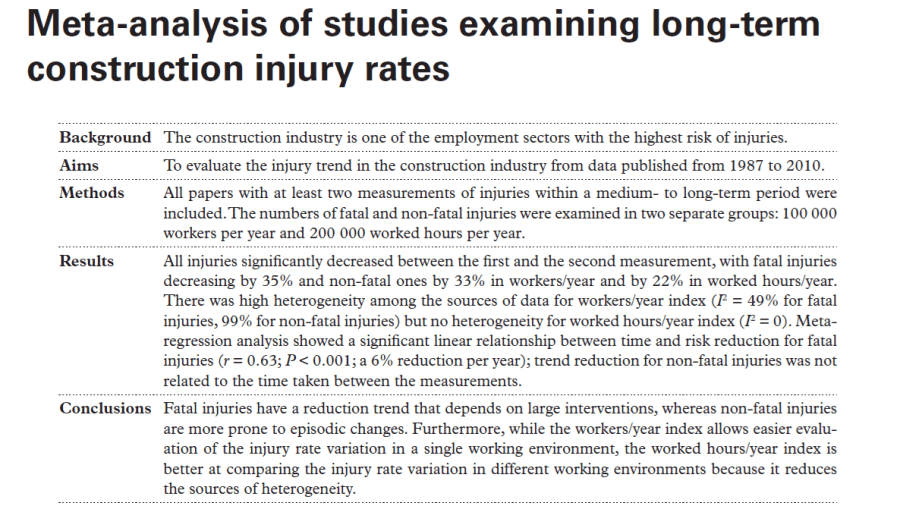
Meta-analysis of studies examining long-term construction injury rates
This 2012 meta-analysis evaluated global construction injuries and fatalities. 55 studies were included, having at least two measurements of injuries with a medium to long-term period (eg longitudinal). Data is a little dated compared to some other research, since it included studies from 1987 – 2010. Key findings: · “All injuries significantly decreased between the first… Continue reading Meta-analysis of studies examining long-term construction injury rates
Bullshit vs Botshit: what’s the difference?
A couple more extracts from Hannigan et al.’s paper on ‘botshit. Bullshit is “Human-generated content that has no regard for the truth, which a human then uses in communication and decision-making tasks”. Botshit is “Chatbot generated content that is not grounded in truth (i.e., hallucinations) and is then uncritically used by a human in communication… Continue reading Bullshit vs Botshit: what’s the difference?
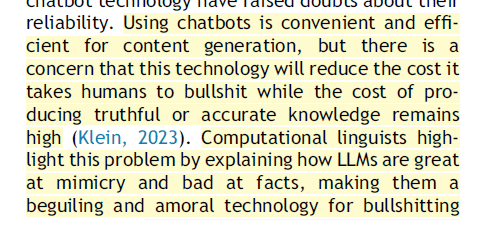
AI, bullshitting and botshit
“LLMs are great at mimicry and bad at facts, making them a beguiling and amoral technology for bullshitting” From a paper about ‘botshit’ – summary in a couple of weeks. Source: Hannigan, T. R., McCarthy, I. P., & Spicer, A. (2024). Beware of botshit: How to manage the epistemic risks of generative chatbots. Business Horizons, 67(5), 471-486.… Continue reading AI, bullshitting and botshit
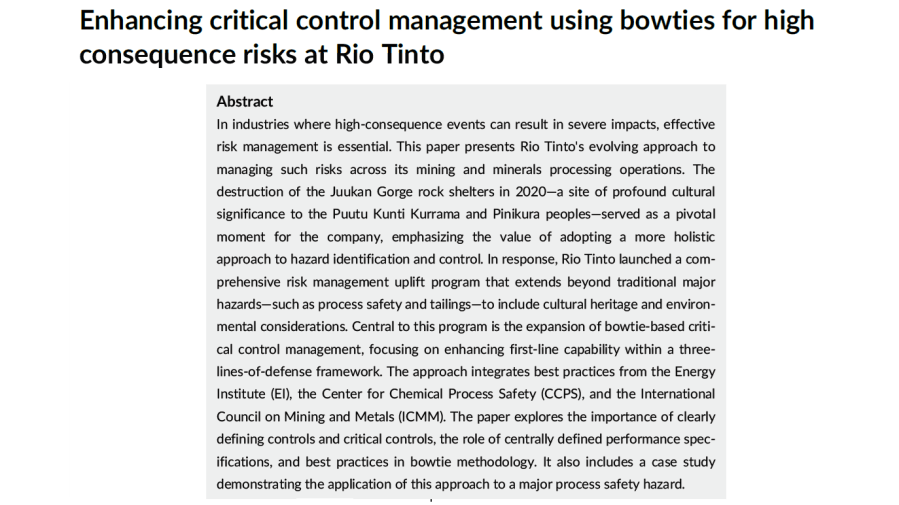
Enhancing critical control management using bowties for high consequence risks at Rio Tinto
This paper explores Rio Tinto’s evolving approach and adaptation of their Critical Control Framework. They integrated the most useful parts from ICMM, Energy Institute, & CCPS. The paper was motivated by an ‘uplift program’ at Rio, involving a complete review and alignment of their approach to controls and critical control management, including definitions and improved… Continue reading Enhancing critical control management using bowties for high consequence risks at Rio Tinto
Barrier indicators for assessing barrier/control availability
Means to observe, assess and validate barrier availability are numerous. You find them everywhere, in different domains and informed by different frameworks (e.g. via bow tie approaches, energy models, ICMM’s CCM, barrier approaches in oil & gas and more). Here’s one of many. This study tested an approach in construction. Not going into detail about… Continue reading Barrier indicators for assessing barrier/control availability

E17: Critical Decisions & Local Rationality: Tools for making sense of situations
Why did they do that, what an idiot! What if our inability to understand the apparent stupidity of an action, after the fact, is more an issue with us, than with the decisions or actions of the person you’re judging? What are better ways–specific tools–to unpack the critical decisions and actions, and make sense of… Continue reading E17: Critical Decisions & Local Rationality: Tools for making sense of situations
 SafetyInsights.org