Just recorded a pod exploring the “alluring first stories”. That is, explaining incidents and performance focused on the actions and behaviour of people, rather than contextualising within the environment they operate (second stories). I worked in this beautiful quote from Russel Ackoff (who was quoting Peter Drucker), see image 1, in describing how we get… Continue reading Doing the right things wronger and moving on from first stories to second stories in investigations
Year: 2025

Implications of sleep loss or sleep deprivation on muscle strength: a systematic review
Does sleep deprivation (SD) affect various indices of muscle strength? To Jack’s complete lack of surprise: probably yes. This systematic review investigated 13 studies on the links. Tl;dr: Drop setting those Z’s may be eating into sick gainz bro For background: · 7-9 hrs sleep per night is recommended for most people · Poor quality and duration… Continue reading Implications of sleep loss or sleep deprivation on muscle strength: a systematic review
Safe As pod eps 10 & 11: How safety myths hold back progress and the flaws in our injury measures
This week on Safe As podcast (yes, a minor name tweak) we unpacked the role of safety myths from Besnard & Hollnagel in holding back progress and learning, and our misplaced faith in injury measures from Hallowell and colleagues. Links to both eps below. Safe As ep 10 explored the below safety myths – and… Continue reading Safe As pod eps 10 & 11: How safety myths hold back progress and the flaws in our injury measures
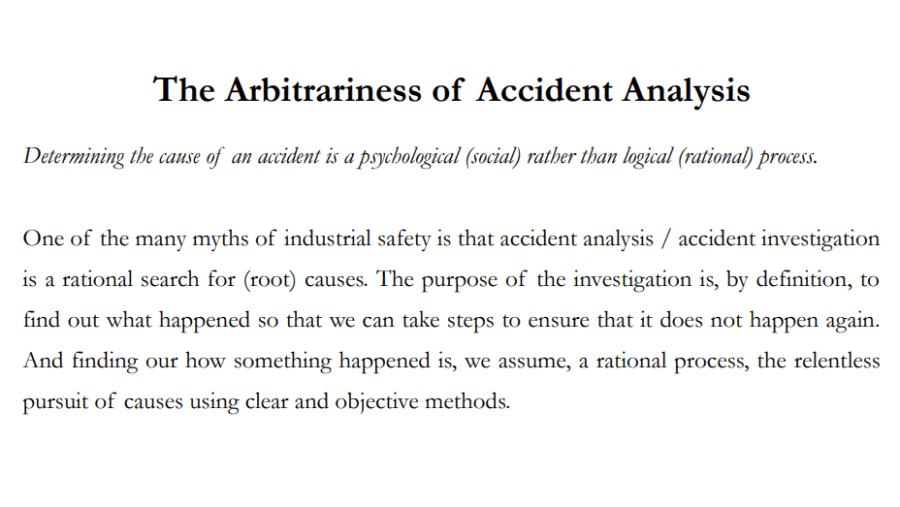
The Arbitrariness of Accident Analysis
A brief article from Hollnagel on the ‘arbitrariness’ of accident analyses. Relying on a lot of direct quotes. First it’s argued that one of the many myths within safety is that accident analysis / investigation “is a rational search for (root) causes”. By this logic, the purpose of an investigation is to found out what… Continue reading The Arbitrariness of Accident Analysis
Safe As podcast #11: The fault in our stats (injury measures)
Are our use of reported injury measures, like TRIFR or LTIFR, ‘good enough’ representations, or beset with foundational statistical flaws? Today’s report is from Hallowell et al., 2020, titled ‘The Statistical Invalidity of TRIR as a Measure of Safety Performance’. From the CSRA. Make sure to subscribe to Safe AF on Spotify/Apple, and if you… Continue reading Safe As podcast #11: The fault in our stats (injury measures)

A webinar I’m presenting with HSI Donesafe: Getting started with Evidence-Based Practice, a practical guide
If you want to learn all of my secret squirrel research techniques – e.g. how I find it, access full text articles, interpret and more, then this webinar is for you. We’ll discuss how practitioners can turn the body of scientific research into a force for good, rather than an elephant’s graveyard of great insights… Continue reading A webinar I’m presenting with HSI Donesafe: Getting started with Evidence-Based Practice, a practical guide
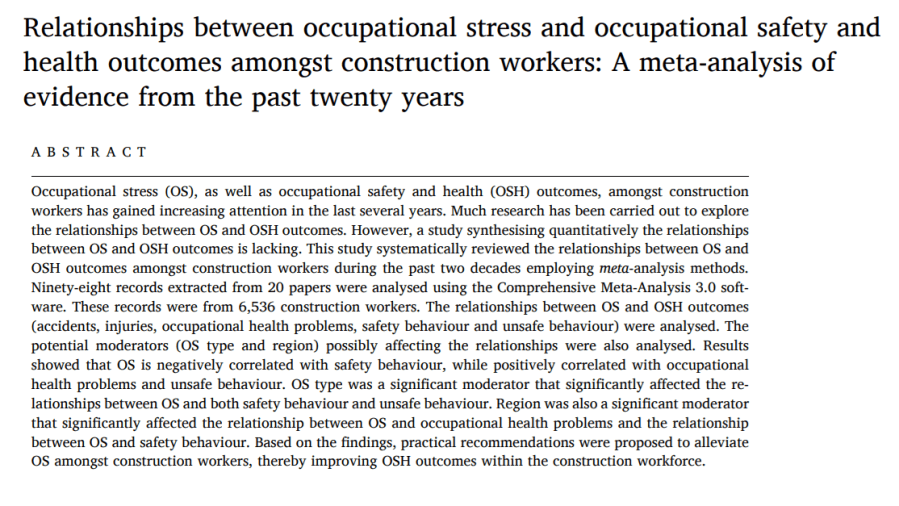
Relationships between occupational stress and occupational safety and health outcomes amongst construction workers: A meta-analysis of evidence from the past twenty years
This meta-analysis investigated the effects of occupational stress (OS) on safety and health outcomes in construction. 20 studies over 20 years, including >6k construction workers was included (not such a big sample given all of the research in construction safety, indicative of the relatively poorer quality of research that didn’t meet their inclusion criteria). [Trigger… Continue reading Relationships between occupational stress and occupational safety and health outcomes amongst construction workers: A meta-analysis of evidence from the past twenty years
Most viewed articles over three years: people love adaptive philosophies and have a bone to pick with investigations
Since people occasionally ask, here’s the most popular articles on my blog from over the past three years and 1200 posts. The earlier research compendiums rank at the top (which is interesting, since I later discontinued them due to lack of interest from the community). By a decent margin, a collection of articles on the… Continue reading Most viewed articles over three years: people love adaptive philosophies and have a bone to pick with investigations
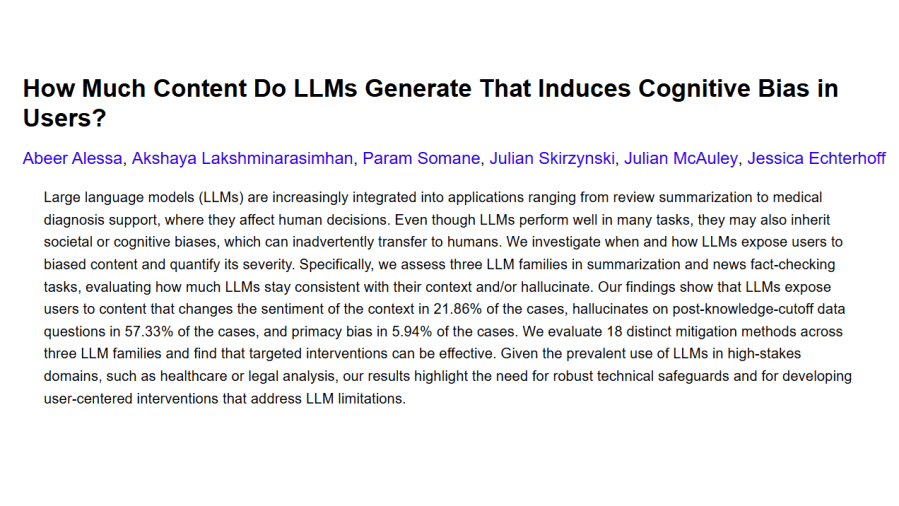
How Much Content Do LLMs Generate That Induces Cognitive Bias in Users?
This study explored when and how Large Language Models (LLMs) expose the human user to biased content, and quantified the extent of biased information. E.g. they fed the LLMs prompts and asked it to summarise, and then compared how the LLMs changed the content, context, hallucinated, or changed the sentiment. Providing context: · LLMs “are… Continue reading How Much Content Do LLMs Generate That Induces Cognitive Bias in Users?

Safe AF #10: Are safety myths –like most accidents due to human error –holding us back?
Are our safety myths–like most accidents being the result of human error–holding back genuine improvement within safety? Can myths like these actually hamper learning, and increase operational risk? Today’s article is from Besnard, D., & Hollnagel, E. (2014). I want to believe: some myths about the management of industrial safety. Cognition, Technology & Work, 16, 13-23. Make… Continue reading Safe AF #10: Are safety myths –like most accidents due to human error –holding us back?
 SafetyInsights.org