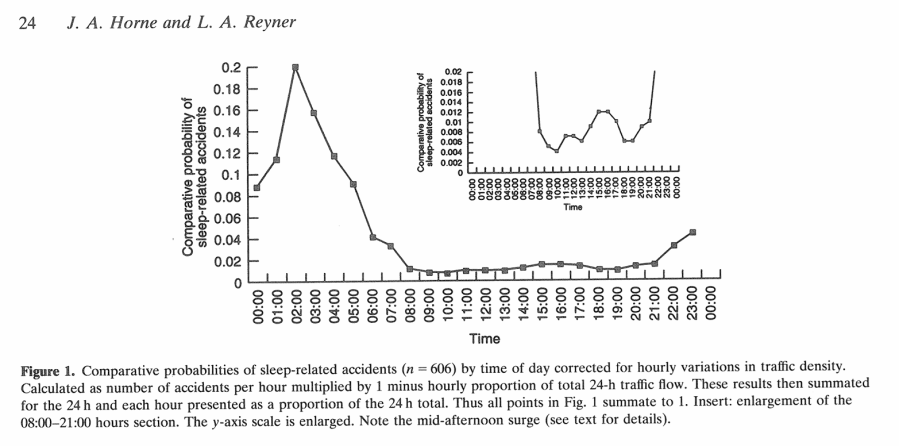
What is your chance of having a sleep-related vehicle crash per time of day?
This older article (Horne & Reyner, 1995, J Sleep Res, 4(2)) shows the probabilities of vehicle crashes (controlled for traffic density, which is important).
Clear time-of-day effects peaks are visible – particularly accidents around 2 – 6 am, and 3-4 pm.
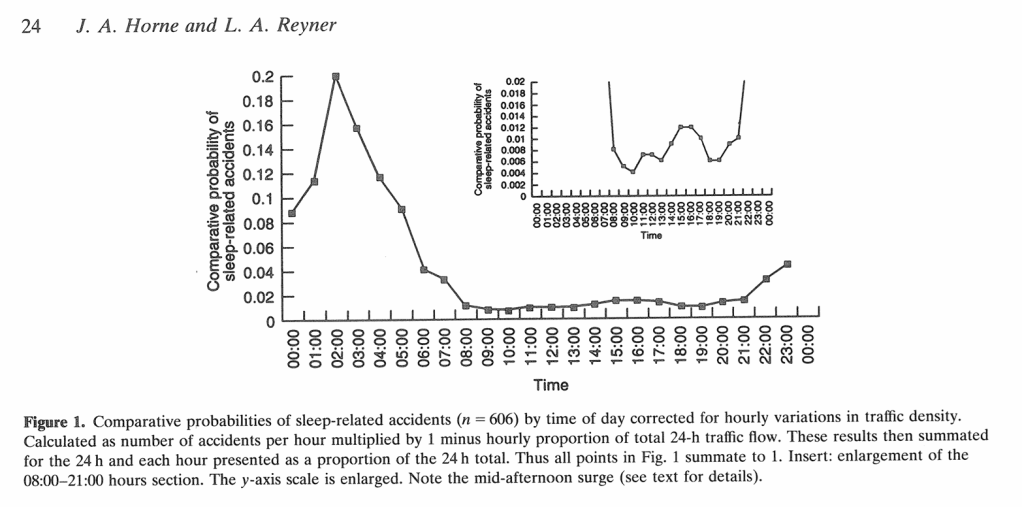
The incidence of early morning crashes is staggering considering the much lighter traffic density – e.g. UK traffic flow rate at 2am was said to be 15% of that compared to 6am, and 5% of that at 4pm.
With traffic held constant, “drivers are 50 times more likely to fall asleep at 02.00 hours than at 10.00 hours”.
And accidents at 3-4pm are “three times more likely when compared with 10.00 hours, and twice more likely when compared with 10.00 hours, and twice as likely than at 18.00 hours”.
They note that, as of circa 1995, the peak sleep-related crash incidence rates are different to the total UK crash data (since you need to control for different factors).
Despite its age, it’s a solid paper and worth checking out – I’ll cover their findings about how well people can predict sleepiness and microsleeps in the near future.
PS. I’ve recorded a two-part fatigue management YT video, the first looks at the negative links between fatigue/sleep disruption and shift scheduling on safety and risk, whereas part 2 focuses on practical guidelines to improve scheduling and address fatigue risks.
Make sure to Subscribe to my YT so you know when these are posted (link in comments).
(PS. And yes, the age of the data is a limitation – newer data exists and likely influenced by newer vehicle tech. But it’s still a cool paper, so fight me.)
Study link: https://onlinelibrary.wiley.com/doi/pdf/10.1111/j.1365-2869.1995.tb00222.x
My YouTube: https://www.youtube.com/@safe_as_pod

 SafetyInsights.org