Are Participatory Organizational Interventions (POIs) to improve working conditions effective at improving workers’ mental health and work performance?
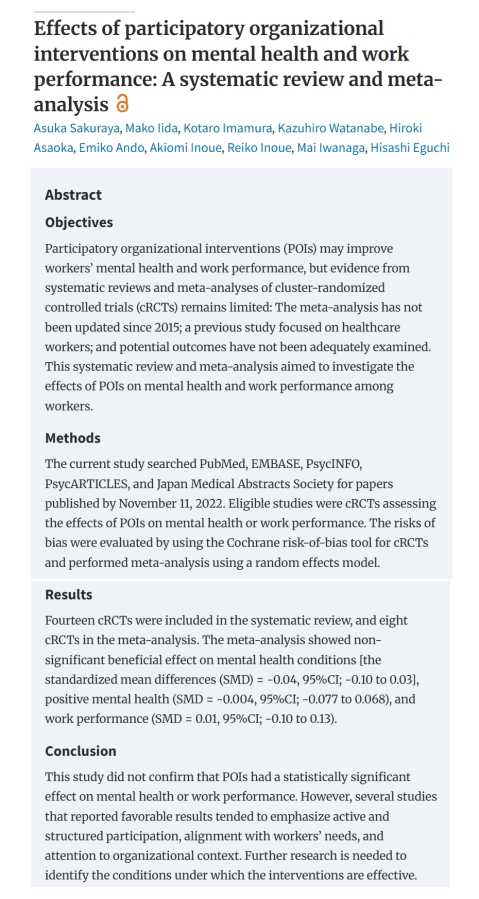
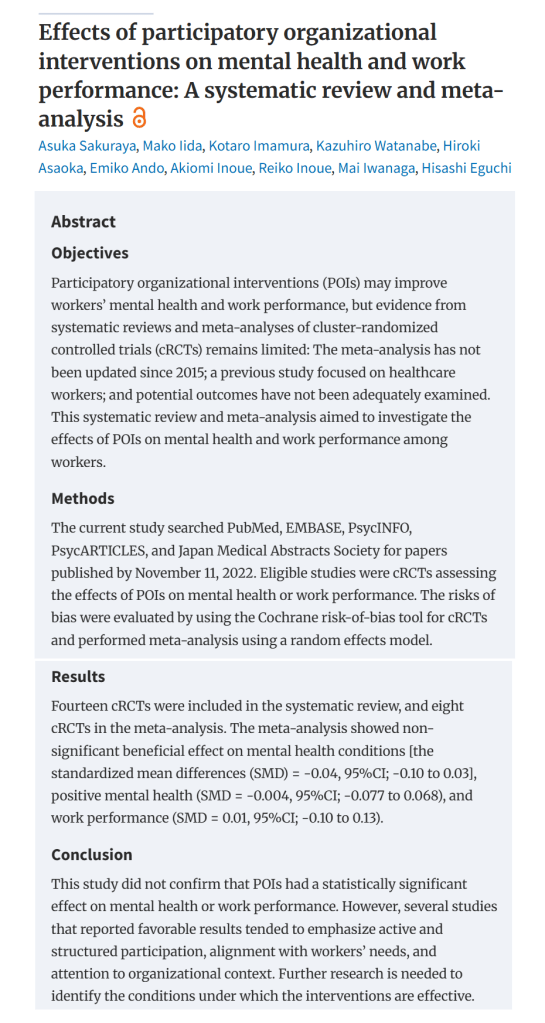
This systematic review & meta-analysis explored just 14 studies that met inclusion to find out.
Evaluated outcome measures were negative mental health (burnout, depression, anxiety), positive mental health (job satisfaction, well-being, work engagement) & work performance (work ability, absenteeism).
PS. Check out my YouTube: https://www.youtube.com/@safe_as_pod
Background:
· POIs are those that typically “involve workers participating in the steps of an intervention, such as action planning, implementing, evaluating, and reviewing the intervention”
· POIs are used to target the working conditions that influence physical, mental and social well-being
· Prior work has suggested beneficial effects on depressive symptoms, burnout, absenteeism and sickness absence, whereas other work has suggested no significant effects on outcomes like burnout or psychological distress
Results:
· “This study did not confirm that POIs had a statistically significant effect on mental health or work performance”
· “However, several studies that reported favorable results tended to emphasize active and structured participation, alignment with workers’ needs, and attention to organizational context”
· “The heterogeneity of these interventions, together with inconsistencies in process reporting, emerged as a key challenge, making it difficult to evaluate their effectiveness”
· POIs did not show statistically significant improvements in mental health conditions, positive mental health, or work performance
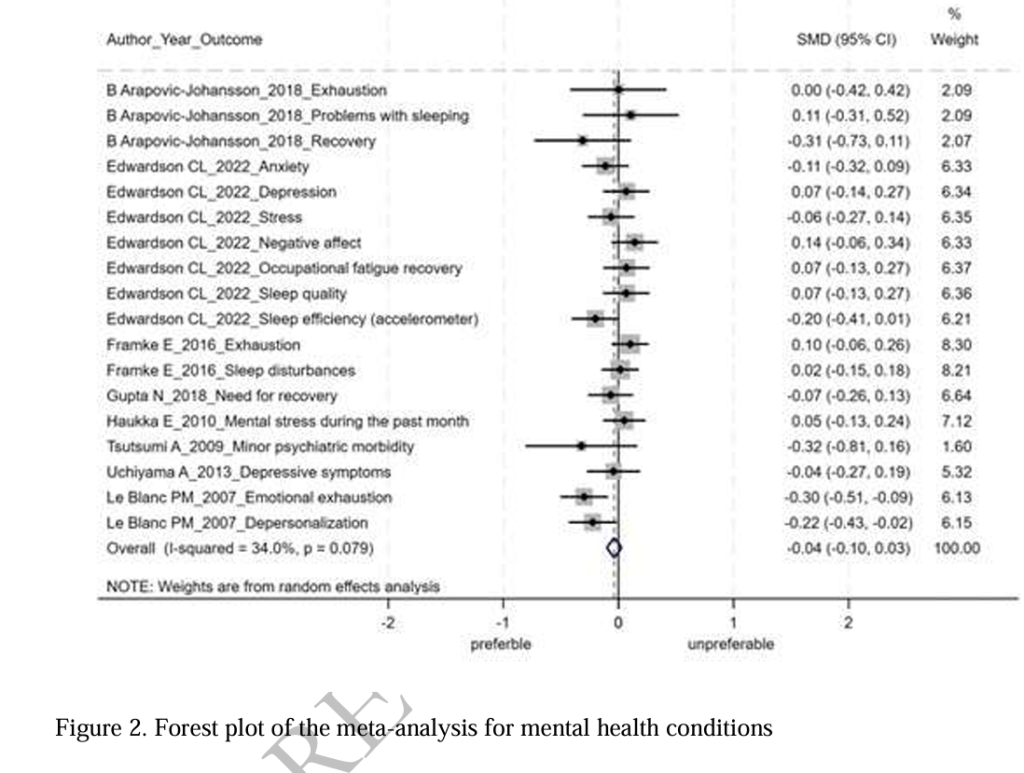
· No significant effects were found for interventions focused on stress-related outcomes, like depression and anxiety but “This lack of effect may partly reflect implementation challenges inherent to POIs”
· Interestingly, “Several studies suggested that participation itself could impose additional demands on workers, as participatory processes—such as attending workshops, engaging in action planning, and implementing agreed changes”, as a form of work demand
· Other studies reported adverse effects of POI, including increased emotional exhaustion and psychological stress, but “these adverse impacts were sometimes due to concurrent organizational reforms rather than intervention itself”
· “organizationally anchored interventions may fail to improve stress-related outcomes with insufficient leader support, low degree of role clarity, or concurrent organizational changes”
· “these findings suggest that POIs do not automatically improve mental health and may even be counterproductive if insufficiently resourced, poorly integrated into daily work, or implemented without adequate organizational support”
· Only a small number of studies met inclusion and while they didn’t find statistically significant effects, they do report a high risk of bias of all the studies
Study link: https://doi.org/10.1093/joccuh/uiag024
#mentalhealth #wellbeing #psychosocial

 SafetyInsights.org