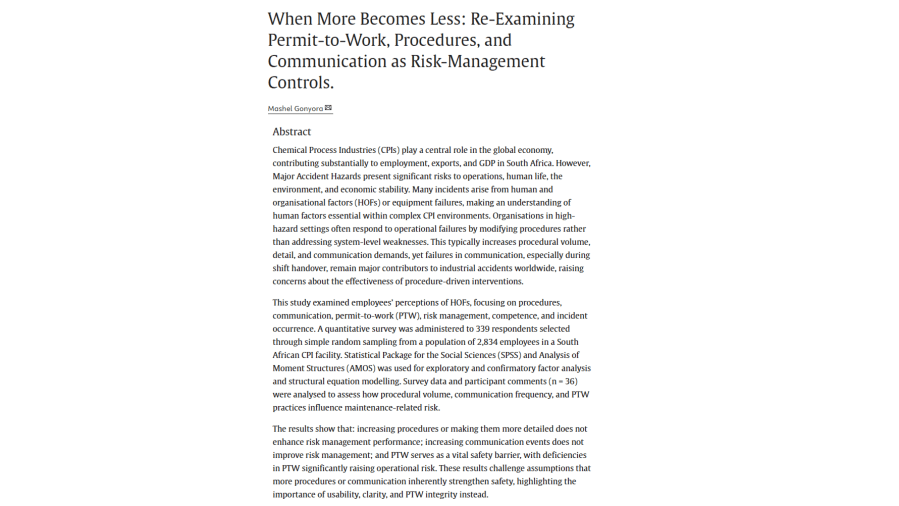
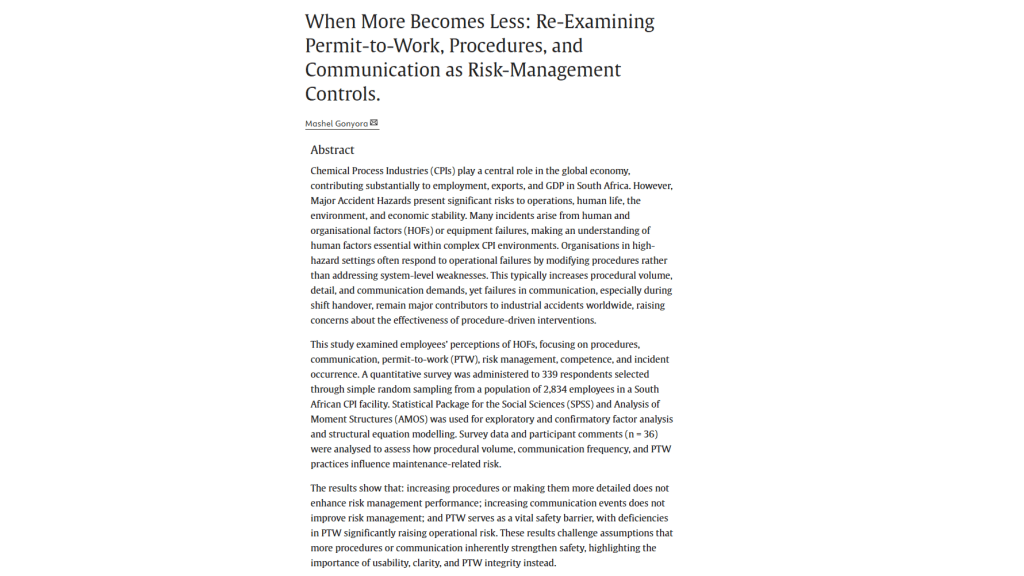
This study evaluated employee perceptions of Human & Organizational Factors (HOF), procedures, PTW and more.
339 respondents from a South African chemical processing facility.
I liked this quote:
“Management creates more procedures” while providing “less supervision and support”
PS. This article was…overwhelming.
PPS. Check out my YouTube: https://youtube.com/@safe_as_pod?si=iUaDPJynPemQRZhY
Extracts:
· “More procedures and more detailed procedures do not produce better risk-management outcomes”
· Many participants viewed procedures as clear and up-to-date, but many reported them to be “impractical, difficult to follow, or not aligned with real operating conditions”
· “overly complex procedures increased cognitive load and encouraged workarounds, demonstrating that usability, not volume, drives safety outcomes”
· No “positive relationship between procedural volume/detail and risk-management outcomes [were found]”
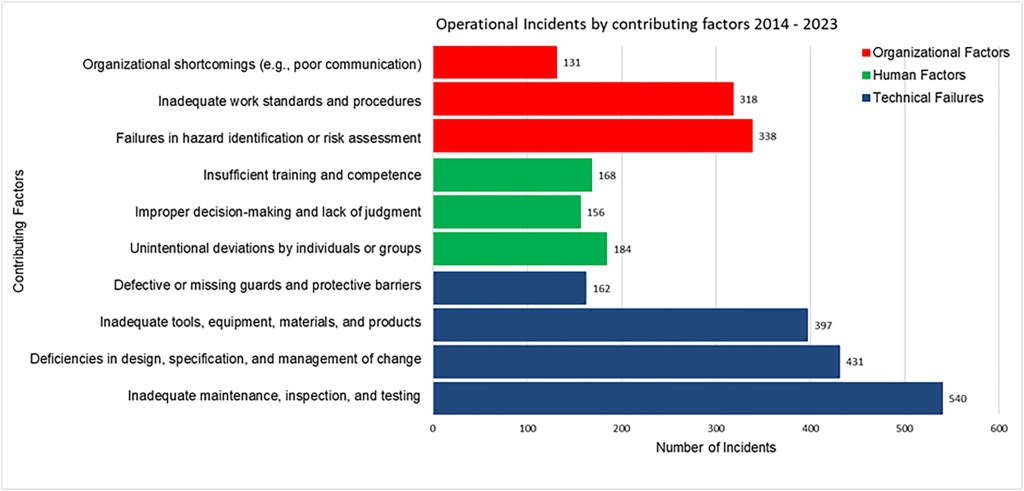
· Hence “procedural usability, not procedural quantity, drives safe maintenance performance”
· More ‘communication events’ (the number of comms/dialogues undertaken or sent out I assume) also “do not improve risk-management outcomes”, but rather the “timing, accuracy, and clarity of communication”
· “PTW operates as a critical safety barrier; deficiencies materially elevate operational risk”
· Some issues with PTW included inconsistent shift PTW continuity, tickboxing, lack of field verification (no ‘touch and tag’), and “Symbolic compliance in risk assessments”
· “failures within PTW processes do not simply reflect weak documentation but represent a breakdown of the final line of defence before hazardous tasks commence”
· “Preserving PTW integrity, therefore, requires genuine dialogue, robust field verification, cross-shift continuity, and engaged worker participation”
· A strong theme was, of course, workers believe the ‘artisans’ should be deeply involved in writing procedures, and “those who perform the work possess the deepest practical understanding of it”
· “Engaging those directly involved in the work prior to implementing new procedures helps align procedural requirements with operational realities, reducing the likelihood of impractical or overly complex instructions that may compromise safety or effectiveness”
· “complex, prescriptive procedures may create a false sense of security while stifling proactive hazard identification through adaptive communication and shared situational awareness”
· Operators pointed to the “need for adaptive judgement” rather than trying to “capture all risks”, and “Failures occur despite comprehensive procedures”
· “Accident investigations reveal that procedural proliferation does not eliminate systemic vulnerabilities”
· “Integrated control systems, effective training, and continuous feedback loops are more effective in mitigating risk”
· “Management creates more procedures” while providing “less supervision and support”
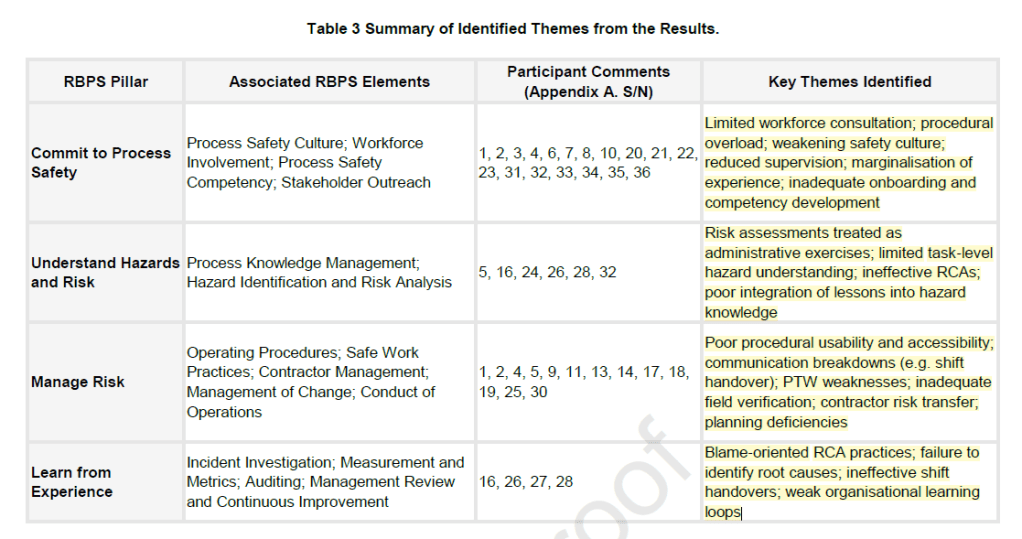
· Shift handover was a weak area based on survey, where ~56% agreed or strongly agreed that handover communication was effective
· Permit issuers should “always do touch and tag,” reinforcing that verification must involve physical checks rather than solely documentary confirmation”
· “Verification is not merely documentary, but evidentiary, grounded in tactile checks, lock/label confirmation, and sign-off under direct supervision”
Study: https://doi.org/10.1016/j.jsasus.2026.04.003
Shout a coffee: https://buymeacoffee.com/benhutchinson


