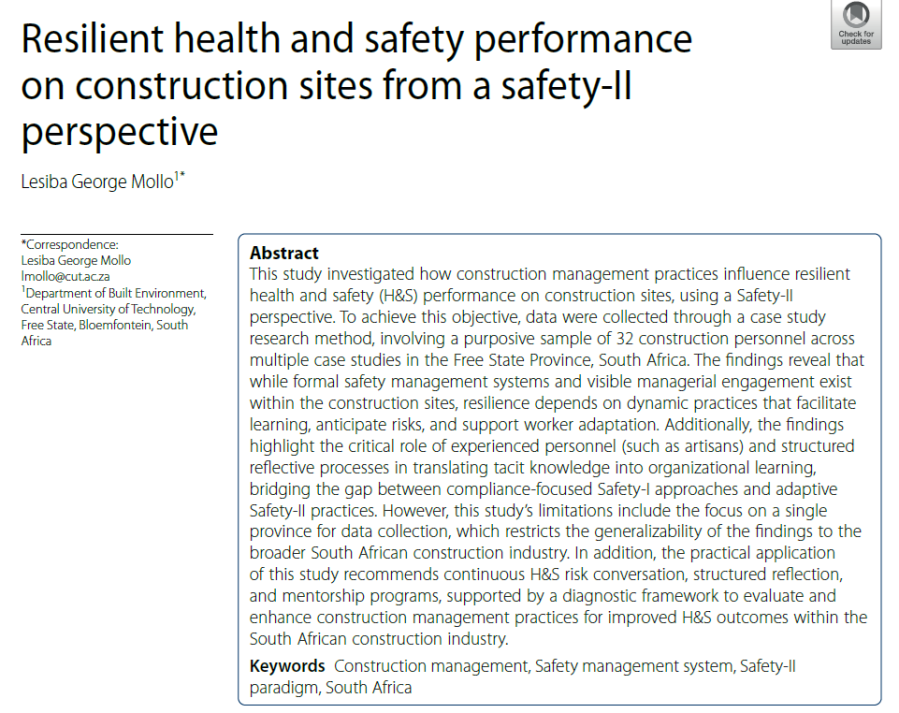
“These findings .. emphasizes that resilience stems from dynamic, iterative practices that foster adaptive capacity”
How do construction management practices influence resilient health and safety performance?
Shared under an open access licence.
PS. Check out my YouTube: https://youtube.com/@safe_as_pod?si=iUaDPJynPemQRZhY
Extracts:
· “Instead of implementing proactive interventions that address planning deficiencies, poor coordination, and organizational decision-making under dynamic project conditions, contractors typically resort to reactive measures, such as disciplinary action, toolbox talks, and procedural revisions, to address safety issues after incidents have occurred”
· “This reactive mindset hinders the effectiveness of continuous safety initiatives in an industry characterized by complexity, unpredictability, and severe time and cost constraints, as safety is managed as the absence of failure rather than the development of resilient work practices”
· “A compliance-centric mindset may inadvertently promote a complex, reactive culture that is ill-prepared to understand and support the everyday adjustments”
· “While managers were accessible, their involvement often occurred in specific events rather than continuously … ‘Managers are mostly around during safety meetings or when there is an inspection’”
· “most construction managers acknowledged that production demands and financial pressures affected how work was performed [and] workers’ decision-making”
· “work … is influenced by competing demands beyond formal safety procedures. The managers … recognized that formal safety protocols alone cannot address the conflicting pressures of time, cost, and productivity in construction”
· “workers described how contextual factors impacted their daily tasks … eg site conditions, task sequencing, and coordination with subcontractors often necessitated adjustments to planned methods”
· “This … highlights a Safety-I perspective, which focuses on formal procedures and documentation to ensure compliance, rather than understanding the on-site work processes”
· “shortcomings in training, meeting reviews, and risk assessment documentation suggest that CSC’s safety management prioritizes enforcing rules and preventing failures rather than fostering adaptive practices or resilience in construction activities”
· “the absence of structured, reflective, and anticipatory practices at some sites impedes the institutionalization of learning and limits the organization’s ability to translate worker adaptations into collective knowledge”
· “experienced personnel proved crucial for resilience. Their systems thinking and practical knowledge allowed managers to anticipate risks, mentor less experienced staff, and refine procedures to address real-world complexities”
Shout a coffee: https://buymeacoffee.com/benhutchinson


