Do construction accidents peak near the end of the project?
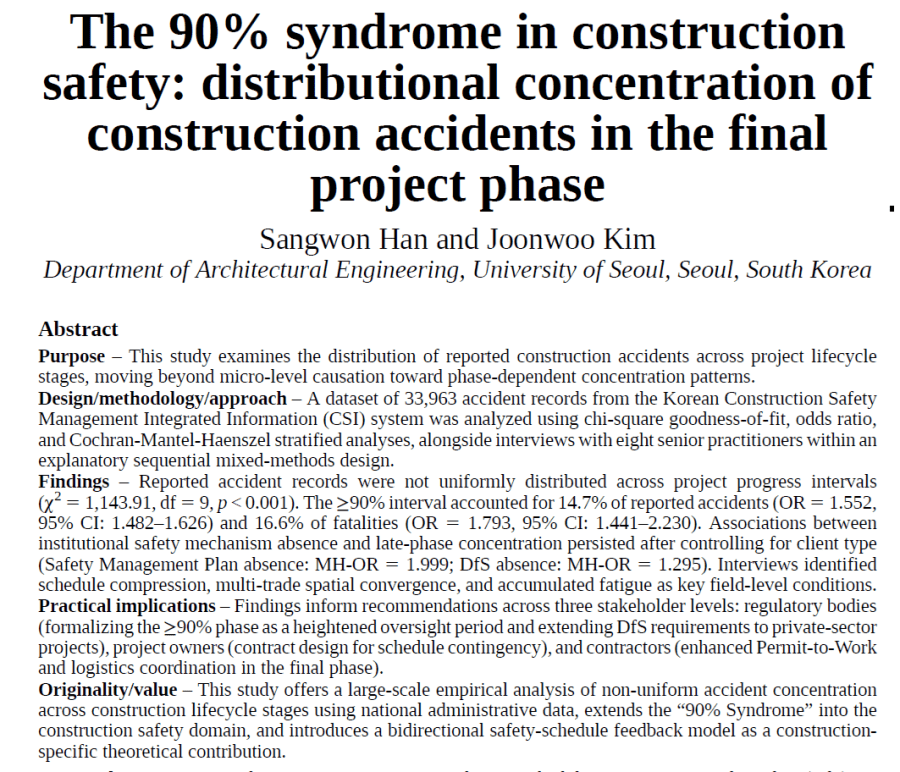
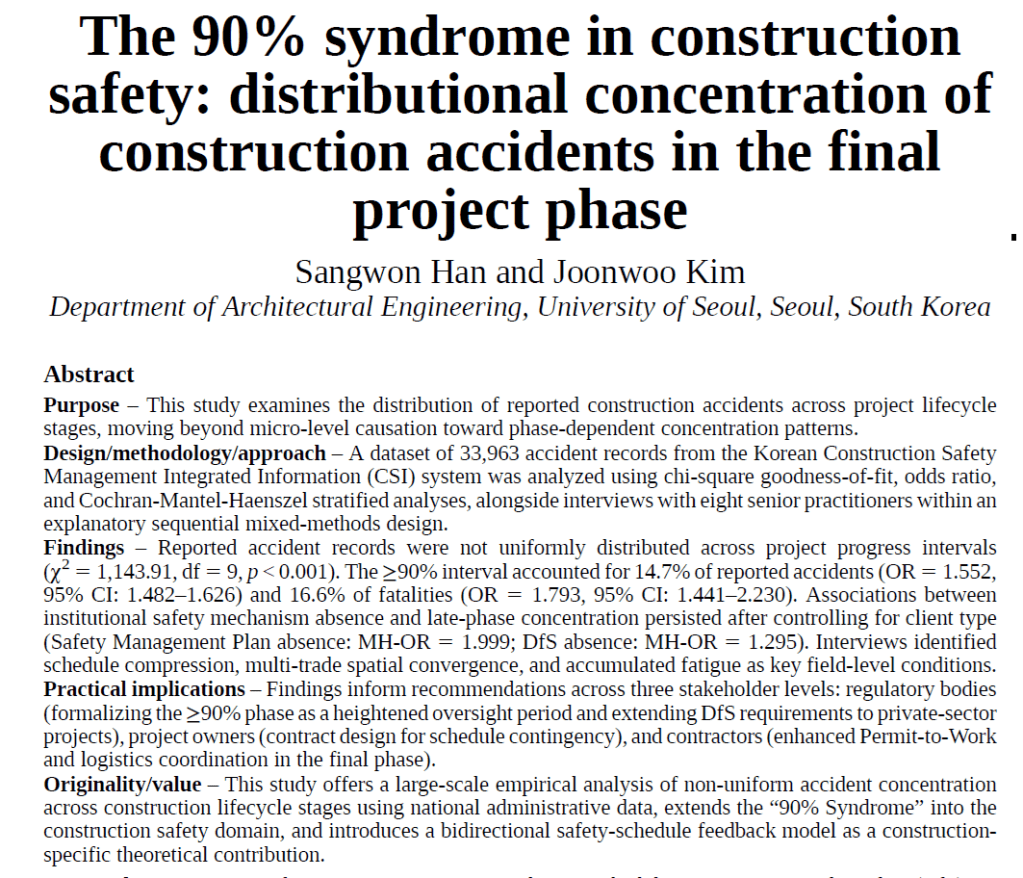
This analysis of >33k Korean construction accidents examined when accidents occurred during the project phases.
They describe the ‘90% Syndrome’, borrowing from the 90-90 rule in software engineering: the first 90% of code accounts for the first 90% of development time, while the remaining 10% accounts for the other 90%.
Similarly, the near completion construction phase may account for a disproportionate complexity, hazard accumulation or injury toll.
PS. Check out my YouTube and recent Critical Control / barrier vid: https://youtube.com/@safe_as_pod?si=iUaDPJynPemQRZhY
Shout a coffee: https://buymeacoffee.com/benhutchinson
Extracts:
· “findings suggest that reported accident records are non-uniformly distributed across the project lifecycle and exhibit a systematic concentration in the final phase”
· “The 90% mark doesn’t create problems. It reveals them”
· “Most of the late-stage problems I diagnose were created in the first half of the project”
· “You can post all the rules you want. The physical reality makes it very hard to control”
· “What’s needed is not more forms — it’s physically reorganizing how the work is sequenced and separated in space”
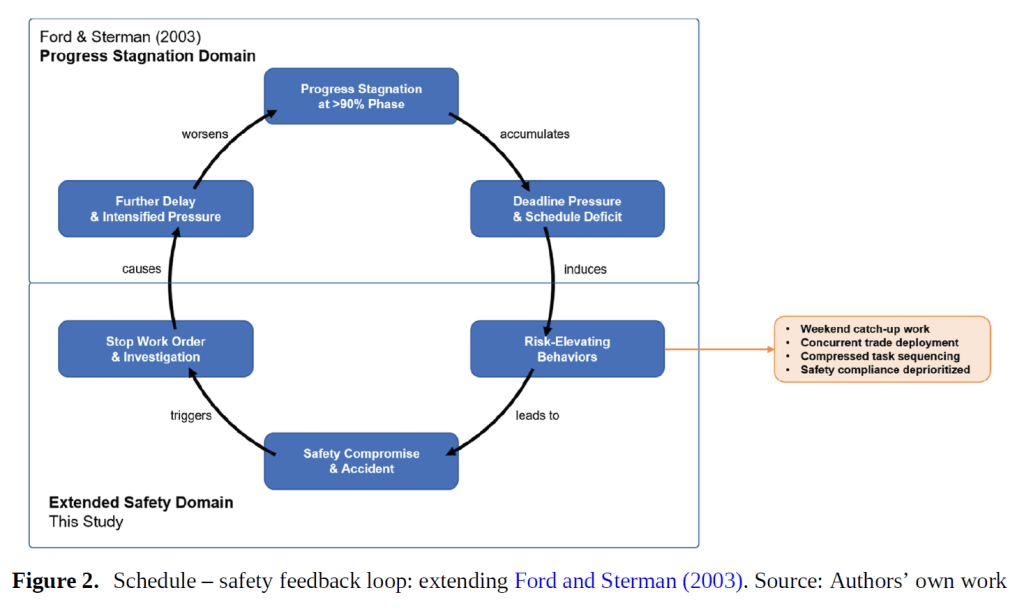
· “Schedule compression in the early and middle phases doesn’t disappear — it transfers forward”
· “The schedule problem becomes a safety problem by the time you reach 90%”
· “No safety budget solves a fundamentally compressed schedule”
· “The ≥90% interval accounts for 14.7% of reported accidents and 16.6% of fatalities”
· “Compared with the preceding 80–89% interval, the ≥90% interval shows a 56.3% increase in reported accident counts”
· “Sites with both DfS and a Safety Management Plan…show a ≥90% proportion of 11.5%, compared to 23.1% for sites with neither”
· “Without DfS, you’re managing risks that were never anticipated. Without the plan, the DfS analysis sits in a drawer”
· ““Safety management approaches focused exclusively on terminal-phase controls may have limited effectiveness if upstream schedule and coordination conditions remain insufficiently managed”
· “The ≥90% interval accounted for 14.7% of reported accidents (OR 5 1.552, 95% CI: 1.482–1.626) and 16.6% of fatalities (OR 5 1.793, 95% CI: 1.441–2.230)”
· “Findings inform recommendations … [like] formalizing the ≥90% phase as a heightened oversight period”


