What is a system?
Post 1 of 3 extracts from Nancy Leveson’s book ‘An introduction to Systems Engineering’.
Not reproducing everything from the images – just a few points. This is from a systems engineering perspective.
For Leveson, systems engineering considers a system more by its goal or objective, rather than the connected sum of parts.
PS. Check out my YouTube and recent Critical Control / barrier vid: https://youtube.com/@safe_as_pod?si=iUaDPJynPemQRZhY
Shout a coffee: https://buymeacoffee.com/benhutchinson
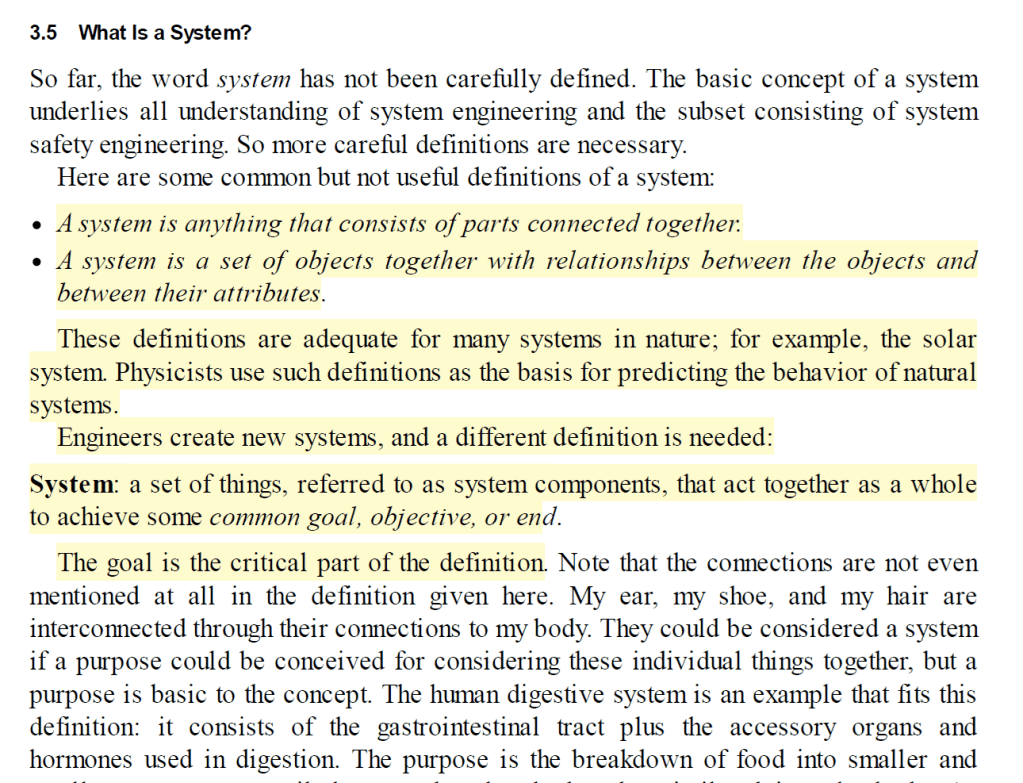
A system is “an abstraction: that is, a model conceived by the viewer”.
Hence, they don’t exist ‘out there’ in the world, but are “a construction of the human mind”.
The physical parts may be real, but we “impose a purpose on those components”.
“When talking about a system, it is always necessary to specify the purpose of the system that is being considered”.
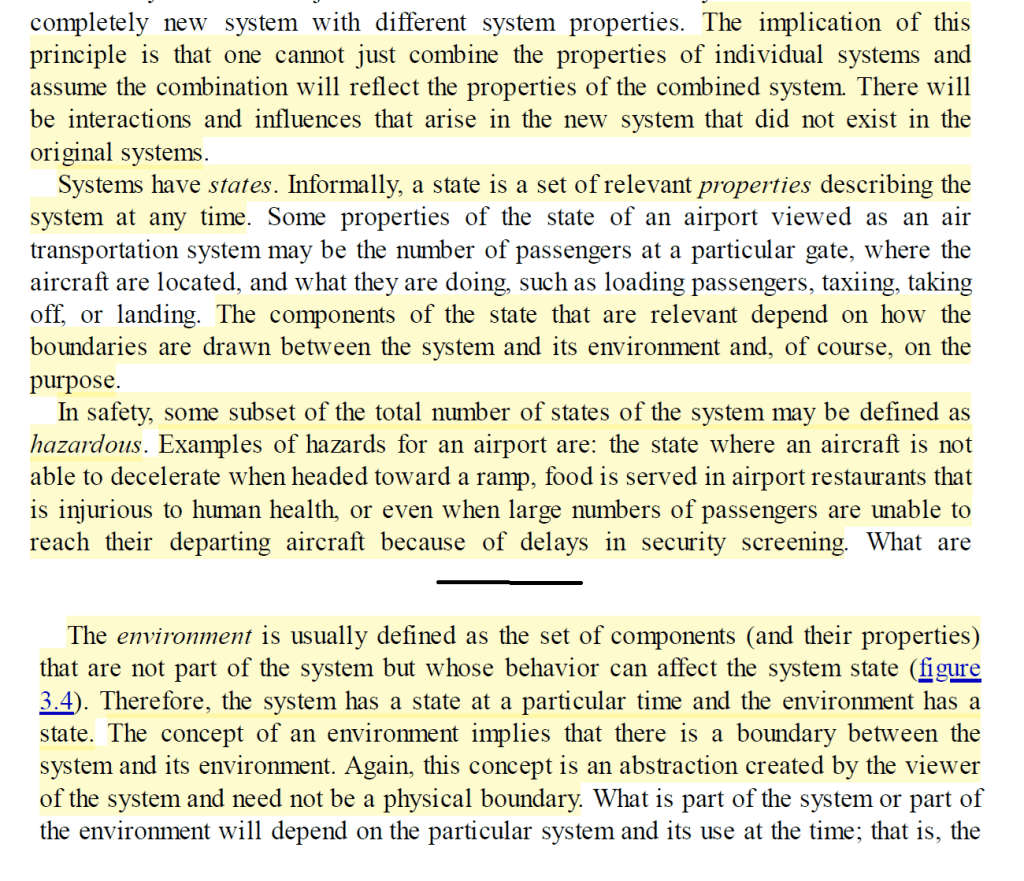
Systems have states, which are relevant properties describing the system at any time. In safety, “some subset of the total number of states of the system may be defined as hazardous”.
And the environment is usually “defined as the set of components (and their properties) that are not part of the system but whose behavior can affect the system state”.
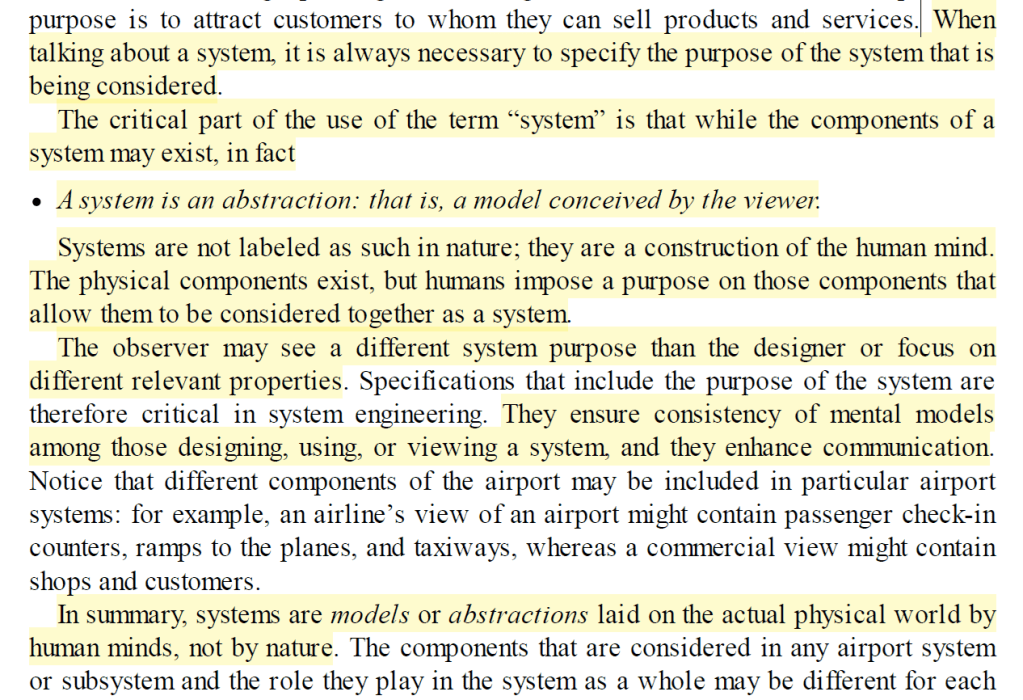
It’s said the system and environment both have a state. And the “concept of an environment implies that there is a boundary between the system and its environment”.
This, as before, is an “abstraction created by the viewer of the system and need not be a physical boundary”.
Post 2 will cover a few extracts into sociotechnical systems, underpinning assumptions (which may not be true) and elements of systems thinking.

 SafetyInsights.org