What do you mean by a sociotechnical system?
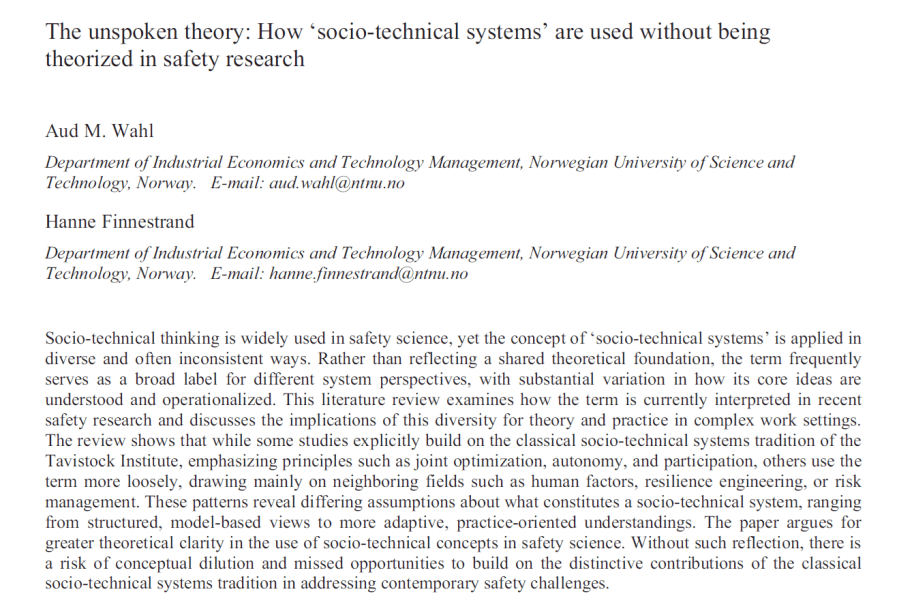
This article explores how sociotechnical system (STS) thinking is interpreted in safety research.
PS. Check out my YouTube and recent Critical Control / barrier vid: https://youtube.com/@safe_as_pod?si=iUaDPJynPemQRZhY
Shout a coffee: https://buymeacoffee.com/benhutchinson
Extracts:
· Safety is “not the outcome of isolated human or technical failures, but an emergent property of dynamic interactions among people, technologies and organisational structures”
· “the term ‘socio-technical systems’ is often used without reference to its theoretical foundations and as shorthand for complexity, rather than as a coherent analytical perspective”
· “the term frequently serves as a broad label for different system perspectives”
· “These patterns reveal differing assumptions about what constitutes a socio-technical system, ranging from structured, model-based views to more adaptive, practice-oriented understandings”
· From the STS view “people are not treated as extensions of machines, but as active contributors who shape and complement technological systems.”
· “The difference between fixed systems and changing, evolving systems is not merely philosophical”, and it matters how safety is understood, managed, and designed
· And STS remains productive only when applied “with attention to its underlying assumptions and design principles”
· Variation is “not a problem to be eliminated but as an inherent condition of real work”
· Many articles use the term ‘socio-technical system’ to denote a research context rather than a theoretical perspective
· Near miss reporting systems may “fall short in supporting feedback, learning, or redesign, areas where STS perspectives might offer additional value”
· The STS concept “risks losing its effectiveness as an analytical tool when used without reference to its theoretical foundations”
· “The original STS tradition “emphasized that work systems are open, flexible, and shaped by the people within them”
· And they’re not something “to be optimized from the outside, but rather something that evolves through participation, judgment, and shared reflection”
· STS emphasises self-regulating teams, functional redundancy and group autonomy, but few of the included studies directly engage with these ideas
· Future research would benefit from…stronger alignment between theory and method, and deeper engagement with the participatory ethos at the heart of STS theory
· Without reflection, there’s a “risk of conceptual dilution and missed opportunities to build on the distinctive contributions of the classical socio-technical systems tradition”
Study link: https://cmsweb.com.sg/rps2prod/esrel2026/epro/pdf/esrel26-p27703.pdf
#safety #systemsthinking #sociotechnicalsystem #resilienceengineering #complexity

 SafetyInsights.org