When are warning signs seen as signs, or just noise?
I love this quote (and article) from Carl Macrae discussing how warning signs are so readily constructed in hindsight, but difficult for organisations to construct at the time.
I’ve referenced it a few times.
PS. Check out my YouTube and recent Critical Control / barrier vid: https://youtube.com/@safe_as_pod?si=iUaDPJynPemQRZhY
Shout a coffee: https://buymeacoffee.com/benhutchinson
He argues that:
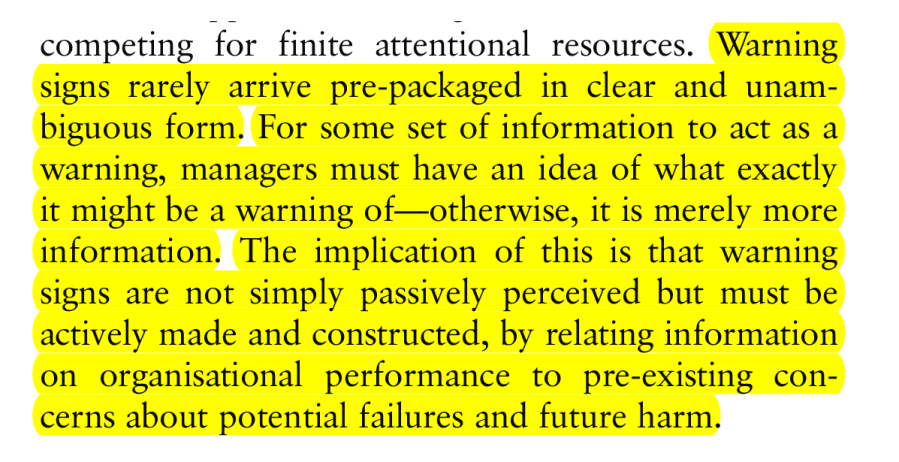
“Warning signs rarely arrive pre-packaged in clear and unambiguous form. For some set of information to act as a warning, managers must have an idea of what exactly it might be a warning of—otherwise, it is merely more information”.
Warnings aren’t passively perceived but must be “actively made and constructed, by relating [organisational intel to pre-existing concerns]”.
It’s argued that “shared beliefs, collective assumptions, cultural norms and patterns of communication across organisations” shape what info is perceived, how its interpreted, and “what is overlooked, discounted and ignored”.
“Organisations can be defined by what—and whom—they choose to ignore”.
Problematically, disasters incubate due to systematic distortions in collecting, interpreting, communicating and understanding information, which then decouple from “operational realities”; the failure of foresight.
Finally, it’s noted that a practical irony of increasing the info shared is that it creates “noise, spread attentional resources thinner—and therefore render weak warning signals weaker and harder to spot”.
Ref: Macrae, C. (2014). Early warnings, weak signals and learning from healthcare disasters. BMJ quality & safety, 23(6), 440-445.

 SafetyInsights.org