Did HROs succeed by **not** managing the unexpected?
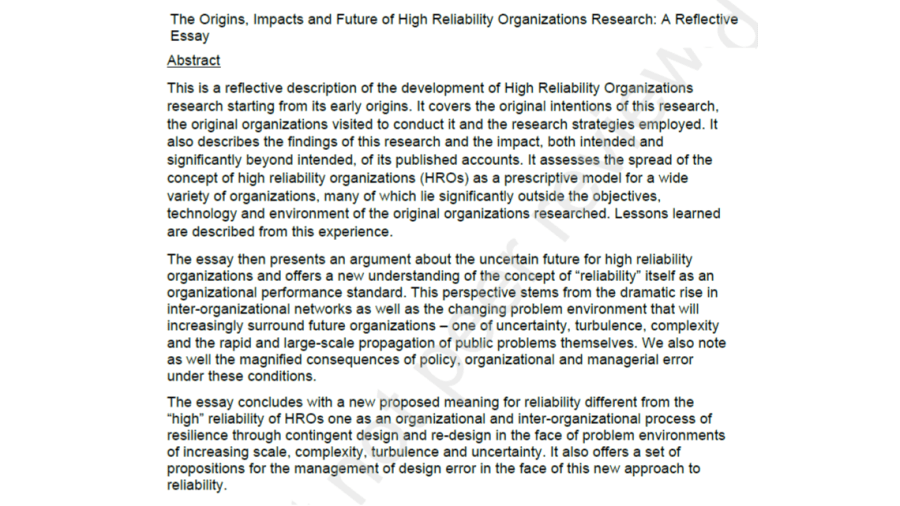
An interesting article from two of the original HRO researchers discussing its origins and potential future.
And they mildly clarify a misconception from Weick & alternative streams of HRO theory, saying HROs didn’t actually focus on managing the unexpected.
PS. Check out my YouTube and recent Critical Control / barrier vid: https://youtu.be/Ly1mEn_KCLQ?si=yG3yRVOM0r2eyyKI
Shout a coffee: https://buymeacoffee.com/benhutchinson
Extracts – slightly modified for conciseness:
· “In the organizations that were researched, safety management was organized around worst-case hazards and accidents they wanted to make ‘never events’”
· “HROs formalized and continually enlarged and enhanced an identified ‘precursor zone’”
· “These precursors could range from operating equipment outside of design-basis temperature and pressures to having too many people or too much noise in a control room”
· “One major precursor was operating under uncertainty, including conditions that hadn’t been analyzed or experienced before”
· “The HROs developed the ability to monitor by sensors or human reporting across all levels and departments a drift toward a precursor zone or a slippage into one”
· “They could quickly detect and correct the condition”
· “HRO researchers came to term this process ‘precursor resilience’”
· “If an HRO couldn’t correct the condition, they would very likely shut down operations rather than operate in a precursor zone”
· “There are also verbal signals that can be sent by a variety of personnel that highlight a drift into precursor conditions”
· “The key to high reliability and safety is not operational and organizational invariance but rather the management of fluctuations”
· “Important organizational factors such as active and shared communications…can erode over time and must be continuously monitored and refreshed”
· “Reliability and safety…are not achieved once and for all but are ongoing processes of careful bandwidth management”
· “Watchfulness…is widely distributed among employees across departments and levels”
· “In HROs, reliability with respect to safety from precluded events is not a fungible value”
· “It is not traded-off with respect to speed, efficiency, cost and output”
· “The HROs could not have achieved the reliable performance they had if they had been routinely managing the unexpected”
· “It was a common practice in the HROs to enlarge expectancies”
· “HRO’s also conducted simulations of unlikely emergency events”
· “Researchers never found people ignoring formal procedures at any level of the HROs”
· “Procedures were a living document of the current operational knowledge base of the organization”
· “Also at the core of HRO operations is a mature, well-understood technical system”
· “HROs are not and cannot be experimental R&D-type organizations, with surprises and uncertainty surrounding their activities and outputs”
· “Their reliability rests on and produces highly repetitive outputs.”
· “Researchers used the term ‘high reliability’ more as a nominal category than a scaled property”
· “The idea became one of the latest fads in a series of fads that periodically sweep through the world of management”
· “Increasingly writers about ‘high reliability organizations’ were eager to sell HRO as a product to potential clients”
· “The lack of specificity in the definition of ‘high’ reliability itself as a concept allowed it to be interpreted to apply generally to any type of improvement in organizational management”
· “Many AI systems have now been adopted with little exploration of the likely effects of their implementation process”
· “Another challenge to HRO-type reliability is that increasingly organizations and their operations are now more embedded in the operations of networks of other organizations”


