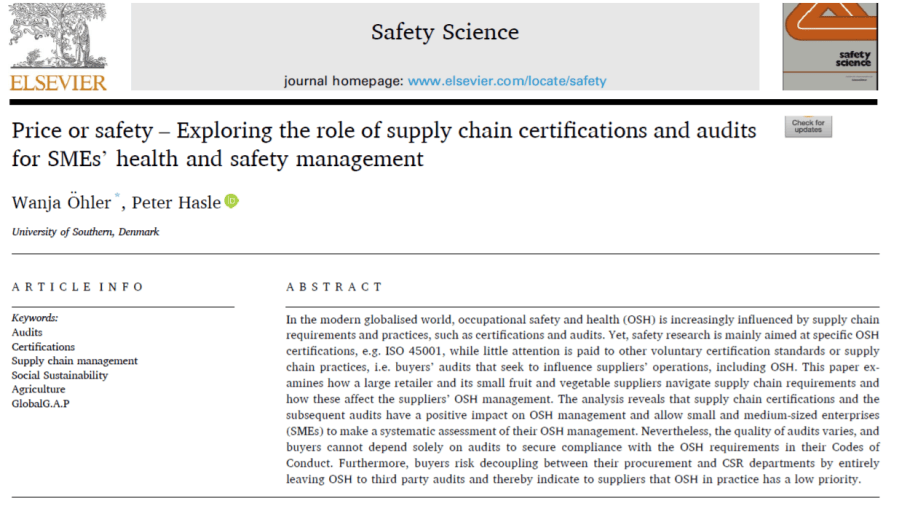
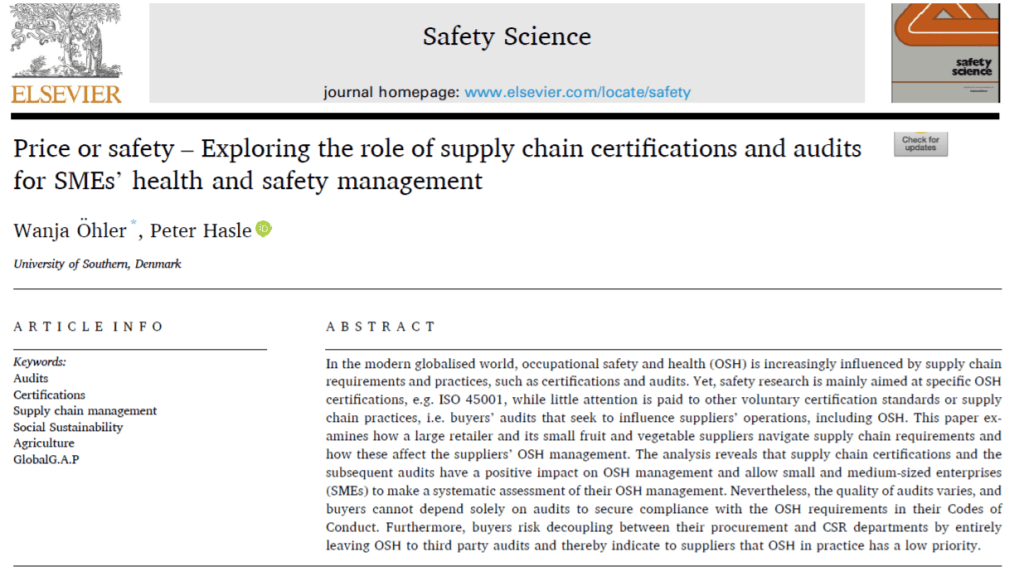
Are supply chain certification audits adding value for small-to-medium businesses (SMEs)?
This explored the value of these audits among a large retailer and its small fruit & veggie suppliers.
PS. Check out my YouTube and recent Critical Control / barrier vid: https://youtu.be/Ly1mEn_KCLQ?si=yG3yRVOM0r2eyyKI
Shout a coffee: https://buymeacoffee.com/benhutchinson
Extracts:
· “analysis reveals that supply chain certifications and the subsequent audits have a positive impact on OSH management and allow small and medium-sized enterprises (SMEs) to make a systematic assessment of their OSH management”
· “Having an annual audit that, together with food issues, also considers OSH, helps to uphold a focus. By being forced to pay particular attention to OSH, the supplier may detect a number of relevant health and safety issues that otherwise may not have surfaced due to the hectic nature of the work”
· “Especially small participating SMEs, who do not have staff assigned to OSH, use the certifications to secure basic OSH compliance”
· “An often- mentioned critique of third-party audits on OSH and working conditions is that audits are an inadequate methodology to uncover poor health and safety practices … This critique is partly echoed in our data, where we found considerable variations in the quality of the audits, ranging from high to low quality, with an auditor just rushing through to be able to conduct multiple audits on the same day”
· “A major structural concern often raised is the customer relationship between auditor and supplier … With the suppler choosing and paying the auditing company, a dependency is created”
· “Subsequently, the auditor has an incentive to conduct the audit in a way that increases the likelihood of being rehired by the supplier for future audits”
· “further constraint for the positive impact of audits is the experience of certification and audits as a bureaucratic burden. The visited suppliers all referred to the bureaucratic paperwork – in particular when they need to have several parallel certificates”
· “This burden may lead to audit fatigue … by causing suppliers to pay less attention to the audits and attempt to minimise the resources for the related tasks”
· “Even with the introduction of audits and certifications, broader issues related to working conditions in Northern Europe are overlooked, particularly those relating to ergonomics, mental well-being, and other psychosocial dimensions of work”
· Hence, these “persistent ‘wicked problems’ (Jespersen et al., 2016) highlight the need for more comprehensive and context-sensitive governance approaches that move beyond compliance checklists”
Study link: https://doi.org/10.1016/j.ssci.2026.107214

 SafetyInsights.org