When your injury rates improve, are people safer or risks better managed, or are people simply better at managing the number?
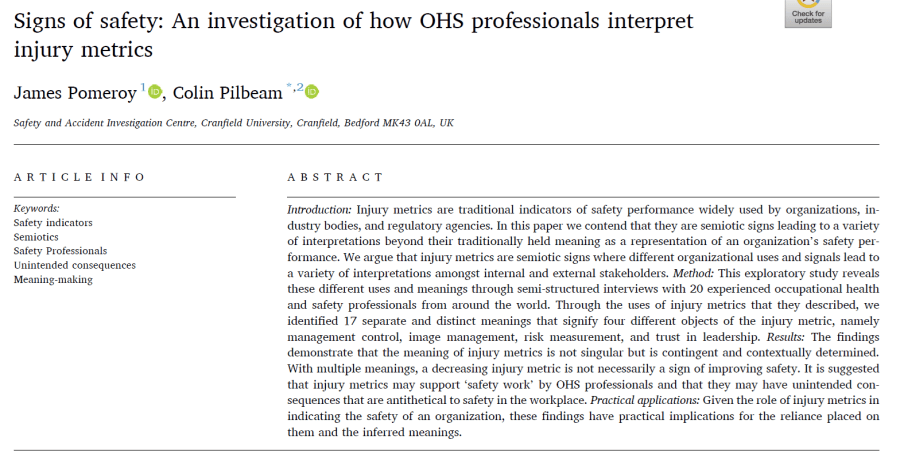
An interesting interview study from James Pomeroy & colleague exploring the uses and meanings of injury metrics from 20 OHS professionals.
Shared under an open access licence.
PS. Check out my YouTube and recent Critical Control / barrier vid: https://youtube.com/@safe_as_pod?si=V2dbdmW–WbnhzA9
Shout a coffee: https://buymeacoffee.com/benhutchinson
Extracts:
· “The meaning of injury metrics is neither fixed nor singular, but contingent and contextually determined”
· “a decreasing injury metric is necessarily a sign of safety in the workplace”
· Injury metrics “are not simply an indicator of how frequently an injury has occurred and therefore how safe the organization is, they are more than that”
· Metrics can “provide organizations with the ‘illusion of control’” … and “false assurance” about fatality, serious-injury or major-hazard risk
· The study identified 17 meanings which were grouped around management control, image management, risk & trust in leadership
· “When injuries are incentivised, people manipulate reporting. When incident rates are celebrated, there is always under-reporting”
· “The injury rate has become a budgetary line… hitting the target and achieving the bonus is the overriding goal”
· “The monthly league table for the key metrics creates a toxic culture of secrecy… competition is a blocker to collaboration”, leading teams to withhold practices & lessons from incidents
· “Your numbers define you and how you’re judged. Managers have been previously let go because it was felt that they were not on-top of their KPIs. They create a palpable sense of failure”
· “Incidents are often grey and there’s a lot of discretion in categorization”, and incident categorisation can become a source of organisational power
· Conflicts were reported with suppressed reporting & the need for resources, e.g. “The metric had to be green for an investment proposal to be considered, but the sites really needing the investment funding are those with the highest injury rates”
· The “slightest improvements [in TRIFR etc.] get spun … it has become a like greenwash”
· “Appropriate professional skepticism needs to be deployed when interpreting these metrics”, where practitioners should explore how the figure was produced, used & incentivised before deciding what it ‘means’
#safety #safetymetrics #kpis #safetyindicators #trifr #ltifr #sif #trir

 SafetyInsights.org