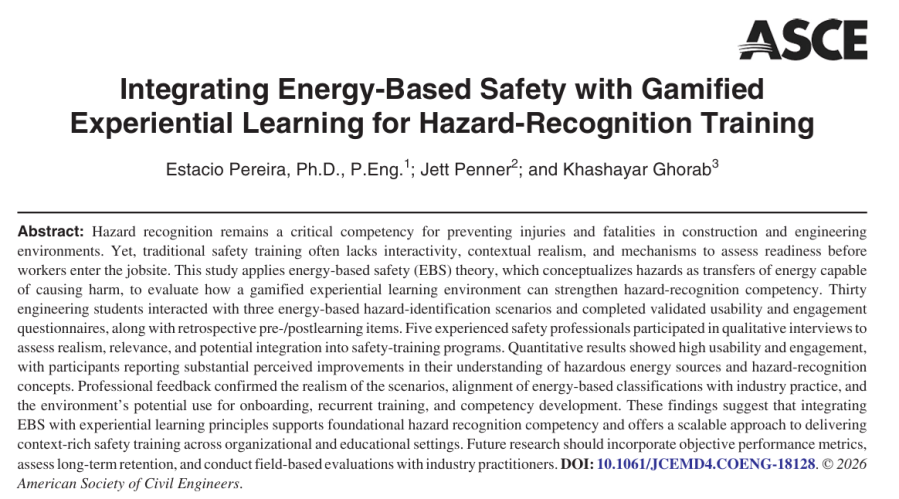
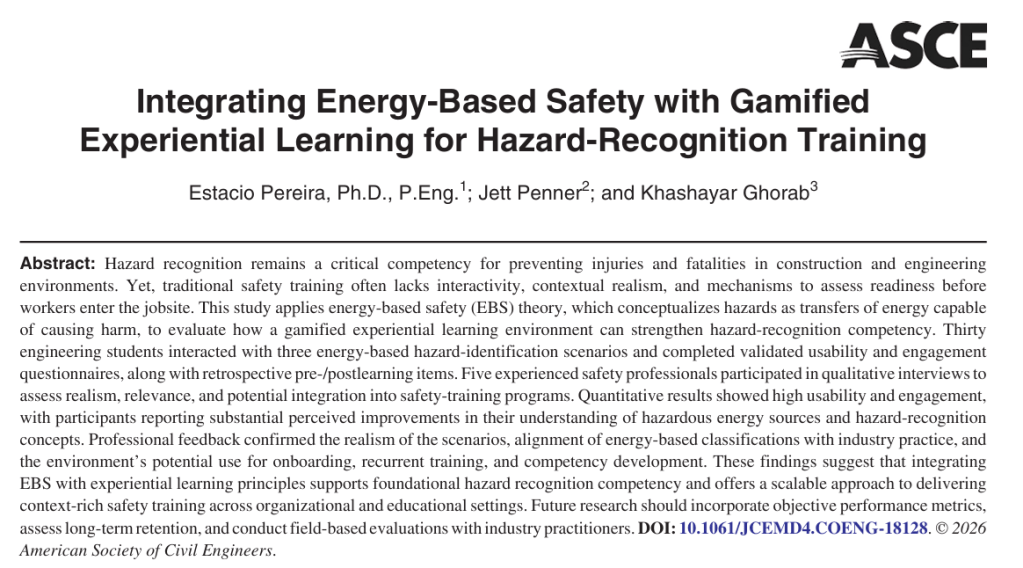
Can experiential, gamified learning enhance Energy-Based Safety hazard recognition?
This tested desktop & VR scenarios using EBS concepts and surveyed students & experienced practitioners pre and post sessions.
PS. Check out my YouTube: https://youtube.com/@safe_as_pod?si=V2dbdmW–WbnhzA9
Shout a coffee: https://buymeacoffee.com/benhutchinson
Extracts:
· “Traditional training approaches”, e.g. lectures & toolboxes “focus primarily on compliance and information recall rather than developing situational awareness or cognitive hazard-recognition skills”
· Whereas traditional methods are cost effective and easy to schedule, they “often encourage passive listening, offer limited hands-on practice, and provide minimal feedback”
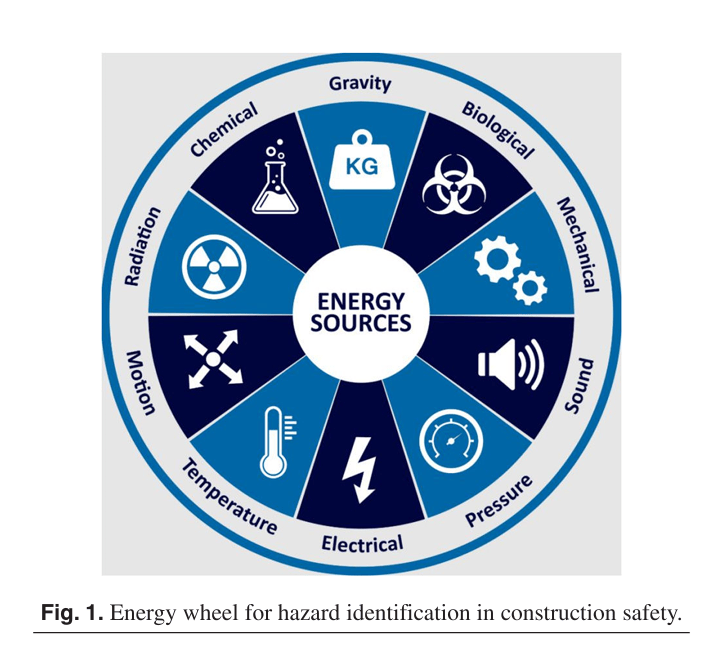
· EBS “provides a causal and cognitive model for hazard identification, framing incidents as outcomes of uncontrolled energy transfers”
· Experiential learning approaches “view learning as an active process in which individuals construct understanding through direct experience, reflection, and feedback, rather than through passive information transfer”
· “Albert et al. (2014a) reported a 56% improvement in student hazard-recognition accuracy, whereas Tixier et al. (2018) reported a 68% increase following EBS-based training”
· This study found that a gamified EBS environment “can effectively enhance hazard-recognition competency while remaining accessible and engaging across both desktop and VR platforms”
· “Students reported significant perceived learning gains in understanding energy sources and identifying hazards, with large effect sizes indicating strong educational impact”
· “Professional evaluations highlighted that organizing site conditions by underlying energy sources reflects real decision-making processes, supporting the conceptual structuring emphasized in EBS theory”
· In all, the findings “confirm that integrating EBS principles with experiential, feedback-driven learning provides a robust framework for improving safety awareness and skill acquisition”
· And “Embedding this model within an interactive, simulation-based format advances learning from passive observation to active experimentation”
· “Participants engaged in repeated cycles of identifying hazards, receiving immediate feedback, and adjusting their cognitive models, reinforcing understanding through application”
· Given the equivalence of effects from desktop & VR applications, latter isn’t essential “for conceptual understanding”
Limitations as always – sample size, self-reported perceptions and learning benefits, and may not necessarily have direct skill transfer to real settings etc.
#SIF #EBS #energybasedsafety #riskperception #hazardawareness


