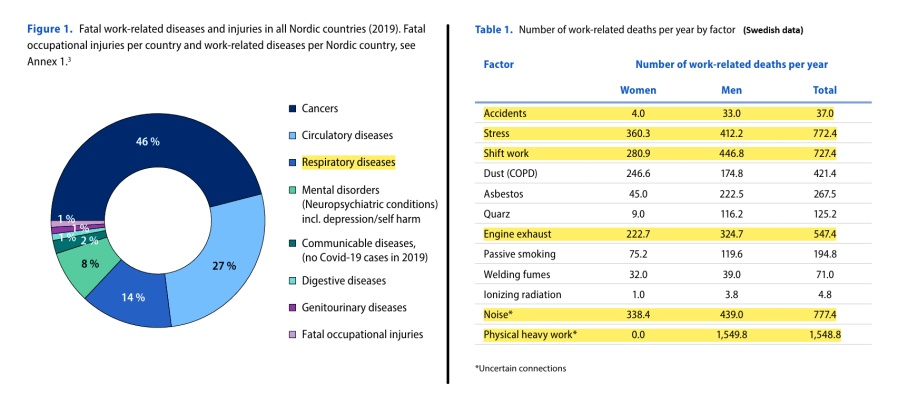
~11k work-related deaths: 1% from accidents but 46% from occupational cancer.
In 2019, an estimated ~11k work-related deaths occurred across the Nordic countries. Only 143, or 1%, were attributed to accidents at work.
This data came from the report ‘Work today and in the future Part three. Work-related fatalities in the Nordic countries’.
It attributes 46% of work-related deaths to cancer, circulatory disease at 27%, & 14% to respiratory disease. A Swedish study suggested stress & shiftwork contributed to the highest number of work-related fatalities, with diesel exhaust “also a significant cause”.
Because people without such exposures also have these diseases, researchers estimate the proportion attributable to work. Generally, 5-20% of cases are linked to occupational factors. It’s 80-95% occupational for mesothelioma.
PS. Check out my YouTube: https://youtube.com/@safe_as_pod?si=V2dbdmW–WbnhzA9
Shout a coffee: https://buymeacoffee.com/benhutchinson
A Finnish study identified showed the top 10 work tasks/occupations where chemical exposures exceeded 50% of occupational limits. This included reinforced plastics, dusty construction work, welding/flame cutting, and bakery work.
The highest lung cancer risk was in metal ore mining & quarrying, “particularly increased by exposure to diesel exhaust gases”.
Psychosocial-related deaths/impairment were also investigated, relating to poor work design, organisation/leadership/management, poor work social contexts and more. Stress, burnout and depression were associated with cardiovascular diseases that may be fatal, e.g. heart attack & stroke.
Interestingly, despite the considerable occupational health-related harm – labour inspections & media focused mainly on traumatic accidents. In Finland, 57% of work-condition inspections targeted accident prevention, compared with 24% for chemical agents, and 17% for psychosocial workload inspections. Nearly 60% of inspections in Norway were accident-related.
On average, about 4% of a country’s GPD is estimated to be lost to poor working conditions (based on lost production). Accidents make up 12% of these costs and cancer 25%. Almost 3/4 of work disability pensions in Finland result from mental health disorders or psychosocial factors.
The report says that a focus on accident prevention via labour inspections etc “appears successful”, reflected in a decreased proportion of fatal occupational injuries.
And while the regulator’s focus on accidents is valid and necessary because of their immediacy and preventability, they raise a “compelling need to gradually adjust the labour inspection resources towards addressing these chronic work-related diseases” – especially because of the significant lag effect of health hazard exposures.
Report link: https://julkaisut.valtioneuvosto.fi/bitstreams/47880f34-2115-4edd-9117-5c3e16de512c/download
#OccupationalHealth #psychosocial #safetyscience #ConstructionSafety #WorkHealthAndSafety #miningsafety


