What is the role of adaptive capacities in creating ‘safety’ & navigating uncertainty?
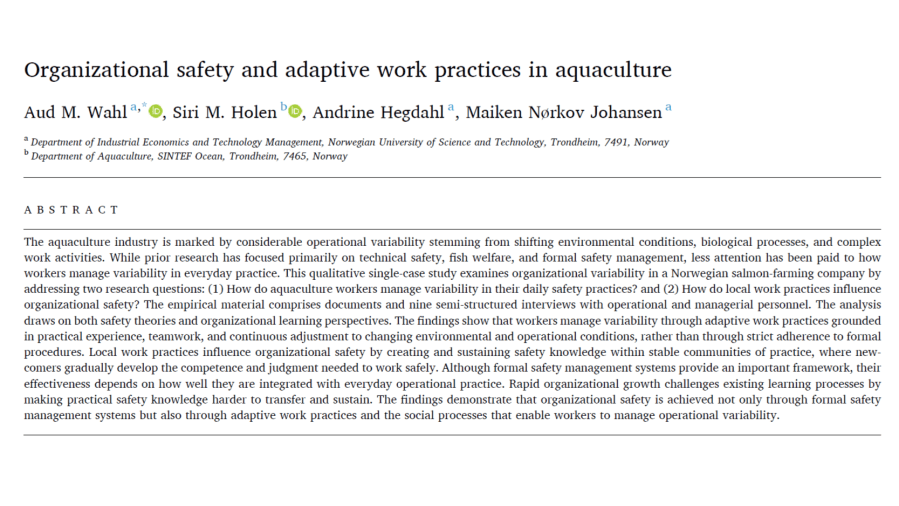
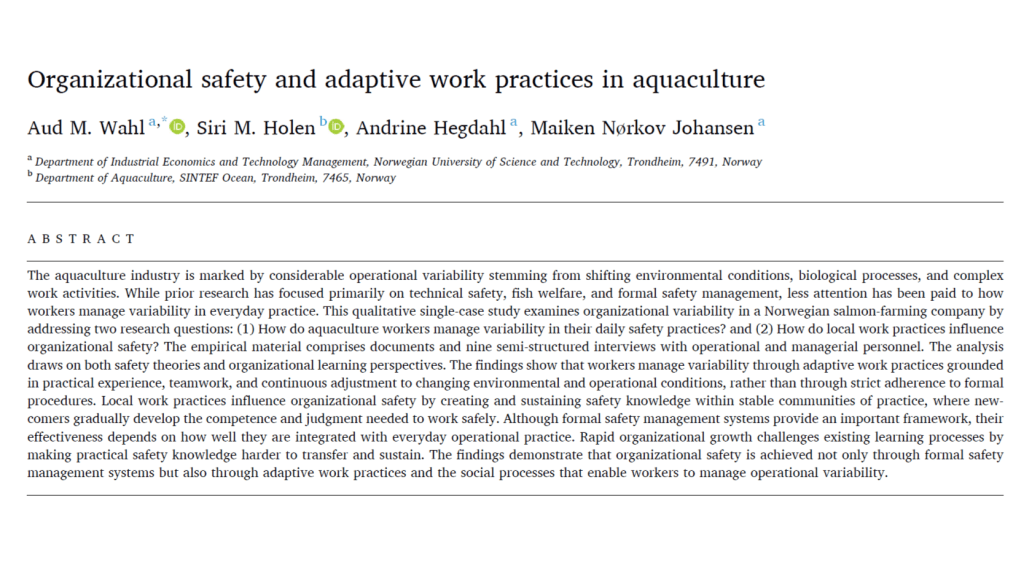
This unpacks how aquaculture workers manage variability in their daily safety practices and the connection to organisational safety.
PS. Check out my YouTube: https://youtube.com/@safe_as_pod?si=V2dbdmW–WbnhzA9
Shout a coffee: https://buymeacoffee.com/benhutchinson
Background:
· “Adaptability is increasingly recognized as vital for safety, challenging traditional views of human error in hazardous industries”
· “Rather than viewing frontline personnel as liabilities, they are regarded as assets who help keep the system functioning by detecting weaknesses, compensating for design flaws, and adapting to changing conditions”
· “Rather than treating variability as a source of risk, [Resilience Engineering] conceptualizes it as a resource that enables flexibility, adaptation, and robust system performance”
· Woods’ proposed 4 complimentary views of resilient capacities: 1) “Resilience as rebound … a system’s ability to recover from disruption and return to its previous state”, 2) Resilience as robustness … resistance to known disturbances but can create vulnerabilities due to design trade-offs”, 3) “Graceful extensibility highlights the system’s capacity to adapt dynamically when pushed to its limits”, 4) “Sustained adaptability relates to the system’s long-term ability to evolve and reconfigure in response to ongoing change”
Results:
· Initial “training period is essential for learning job tasks, building confidence, and making independent safety judgments”
· And while all new employees undergo comprehensive onboarding training… “hands-on site training is considered the most critical part of the learning process” – this was said to start strong but diminishes once employees begin regular operations at the sites”
· “Several report a lack of follow-up over time and sometimes feel left on their own, responsible for their own learning beyond the initial theoretical phase”
· “findings show diverse practices regarding how and how often procedures are used in daily work. Some admit they do not regularly revisit or actively use the procedures after the initial training” & others note that focusing on procedures was strong for initial training but limited once work starts
· “safety knowledge in the company develops primarily through participation in everyday work rather than through formal safety systems alone”
· Workers “describe how judgment, risk awareness, and the ability to recognize when conditions have become unsafe emerge gradually through practical experience, collaboration, and repeated exposure to operational variability”
· Described was how rather than “simply transferring existing knowledge”, experienced workers built a shared understanding with newstarters on interpreting changing situations and making safe decisions under uncertainty
· “Safety competence, therefore, develops through “learning to be” a competent aquaculture worker rather than merely “learning about” safety through formal instruction”
· The company’s approach to pairing experienced workers with newstarters helps create “stable work teams, and emphasizing on-site learning creates favorable conditions for developing communities of practice”
· Despite formalised training, the “organization relies heavily on informal learning processes”
· E.g. “Socialization appears strong, whereas externalization and systematic sharing of practical experience are less developed”
· Therefore “valuable safety knowledge remains embedded within work teams and individual workers rather than becoming organizational knowledge”
· Hence procedures “cannot fully capture the situated judgment developed through experience and often lack sufficient input from practitioners”
· Reliance on tacit knowledge is a risk to the business losing critical knowledge; therefore companies should “complement informal learning with systematic arenas for experience sharing, reflection, and participatory rule development, enabling local knowledge to become part of organizational learning”
Adaptive Capacities
· Despite providing essential functions, adaptive capacities can “conceal organizational weaknesses. When experienced workers continually compensate for insufficient [resources etc.] … organizations risk becoming dependent on individual adaptations rather than strengthening the systems that support safe performance”
· “Adaptive capacity should therefore be viewed not solely as an individual competence but as an organizational capability that requires continuous learning, knowledge integration, and managerial support”
· Moreover onboarding new starters “appear to be sustained primarily through stable work relationships rather than through formal organizational structures”
· “Rapid organizational growth may strain these conditions”
· “These perspectives emphasize that safety emerges from adaptive, embodied activities rather than from strict adherence to procedures”
Gaps between WAI and WAD
· A common theme was a tension between formal procedures and informal practices
· And while the fish farming company’s internal system was constantly updated, “many informants report that it is rarely used in day-to-day work”
· Hence “team interaction and experience are highlighted as important safety factors, whereas procedures are sometimes perceived as time-consuming and unnecessary”
· They report limited use of Job Safety Analyses and an informal, unstructured briefing format exemplify the gap between WAI/prescribed and WAD
· Nevertheless, “limited use” of JSAs & informal unstructured briefings “were perceived by workers as a valuable way to reflect on hazards and how to address them collectively”
· Hence, workers adapted a formal process to their work practices and needs
Conclusion
· “Maintaining safety through variability and professional judgment rather than strict rules exemplifies resilience”
· But this for the authors raises the question: how little formalization can the system tolerate before it’s problematic?
· This study highlights that the effectiveness of or safety management systems, unsurprisingly, “depends on how well they are integrated into everyday operational practice”
· Adaptive capacity should be “understood as an organizational capability that emerges from the interaction among formal structures, practical experience, and social learning”
Ref: Wahl, A. M., Holen, S. M., Hegdahl, A., & Johansen, M. N. (2027). Organizational safety and adaptive work practices in aquaculture. Safety Science, 206, 107525.
Study link: https://doi.org/10.1016/j.ssci.2026.107525
LinkedIn post: https://www.linkedin.com/pulse/resilient-adaptive-capacities-role-safe-practices-hutchinson-phd–dtdkc


