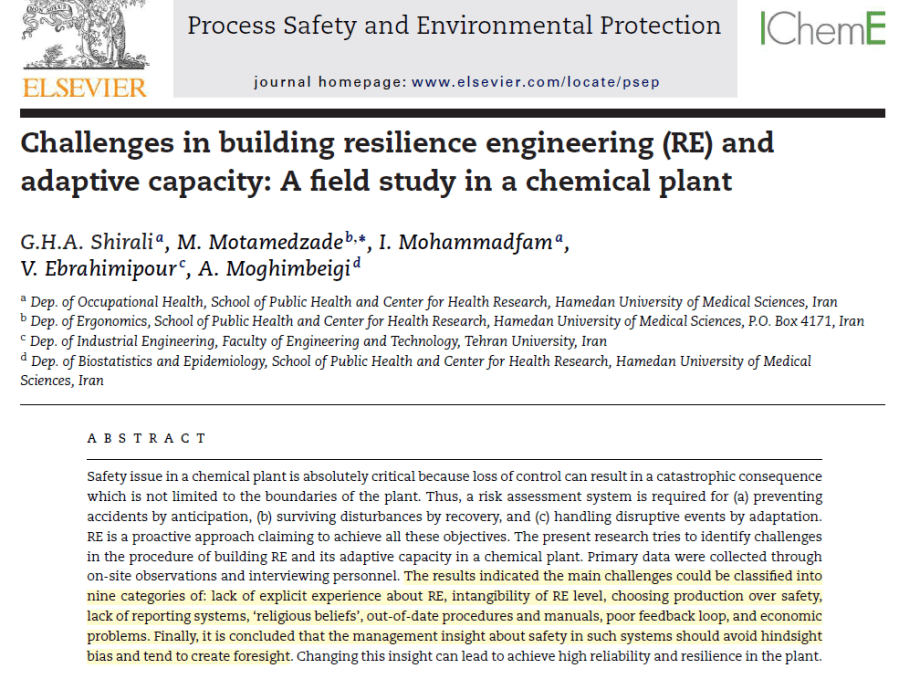
Can a complex system effectively navigate risk if it only understands failure in hindsight? This study explores the challenges of building adaptive capacity from a resilience engineering perspective in a chemical plant. On-site observations & interviews were used. PS. Check out my YouTube and recent Critical Control / barrier vid: https://youtube.com/@safe_as_pod?si=iUaDPJynPemQRZhY Shout a coffee: https://buymeacoffee.com/benhutchinson… Continue reading Challenges in building resilience engineering (RE) and adaptive capacity: A field study in a chemical plant
Tag: new view

HOP improves learning and reduces quality deviations – new research
Does HOP improve organisational learning behaviours and reduce quality deviations? It turns out, probably. This Master’s thesis from Chris Mastrangelo studied the effects of HOP principles on learning-behaviours, multi‑year trends in deviations, root‑cause classifications, corrective and preventive actions (CAPAs), and Human Performance Assessment (HPA) maturity assessments. Thesis link in comments. The HOP adoption was also… Continue reading HOP improves learning and reduces quality deviations – new research

Safe As ep 23 (quickisode 2): Safety-II debrief tool
Want to add a garnish of Safety-II inspired thinking into debriefs? Check out this 4 min quickisode. Today’s article is: Bentley, S. K., McNamara, S., Meguerdichian, M., Walker, K., Patterson, M., & Bajaj, K. (2021). Debrief it all: a tool for inclusion of Safety-II. Advances in Simulation, 6(1), 9. Spotify: https://open.spotify.com/episode/54H6o9h4ZiSSlgVFOjAqC6?si=kY5uaG1sRlyCW10ylAsmgw Apple: https://spotifycreators-web.app.link/e/ukQV4y4RRVb Make sure to subscribe… Continue reading Safe As ep 23 (quickisode 2): Safety-II debrief tool

“Punishing is about keeping our beliefs in a basically safe system intact. Learning is about changing these beliefs, and changing the system”
“Punishing is about keeping our beliefs in a basically safe system intact. Learning is about changing these beliefs, and changing the system” An interesting extract from Sid Dekker’s 2001 article ‘Disinheriting Fitts and Jones `47’. Summary in a week or two – but if you’ve read his later SafetyDifferently article ‘Is it 1947 yet?’, then… Continue reading “Punishing is about keeping our beliefs in a basically safe system intact. Learning is about changing these beliefs, and changing the system”

The Folly of Safety-III
Hollnagel’s response to some of the recent (and somewhat bizarre) articles on ‘Safety-III’. Spoiler: It’s not charitable. I’m relying on a lot of direct quotes. Providing context, Hollnagel argues: · Introduction of Safety-I and Safety-II (SI / SII) to characterise two opposite means of safety was “met with surprisingly large interest” and “also with some… Continue reading The Folly of Safety-III
Identification of management traits related to human factors in new views of safety approaches
This paper from Leônidas Brasileiro and colleagues evaluated common attributes across approaches grouped under ‘New View’. i.e. HRO, S-II, SD, RE & HOP – they used both literature and Delphi method. Not a summary since you can read the full paper. It’s an accessible read if you’re keen to quickly understand some key differences and… Continue reading Identification of management traits related to human factors in new views of safety approaches
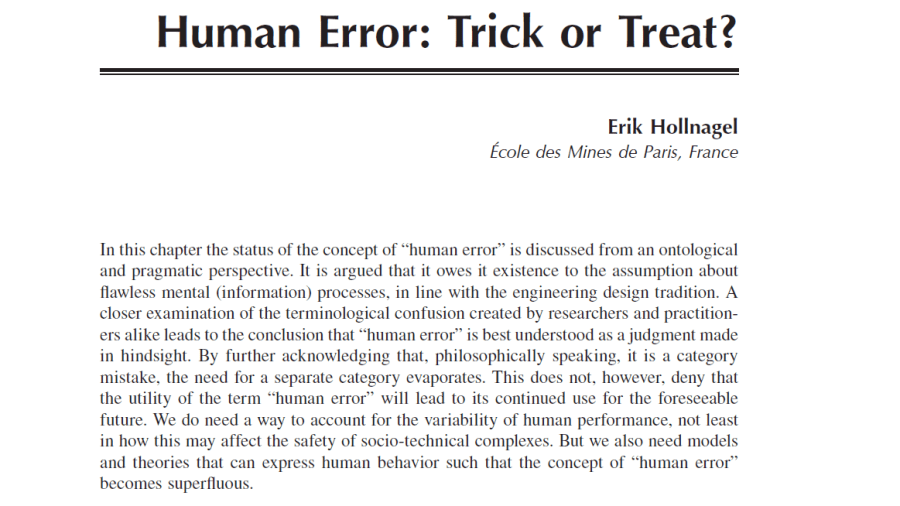
Human Error: Trick or Treat?
This 2007 chapter from Hollnagel unpacked whether we really need the concept of “human error” (HE). It’s a whole chapter, so I’ve skipped HEAPS. Tl;dr according to Hollnagel: · “there is no need of a theory of “human error” because the observed discrepancies in performance should be explained by a theory of normal performance rather… Continue reading Human Error: Trick or Treat?

Human Success: Old wine in new bottles, or a shift of mindset for HRA in an automated world?
A really interesting conference paper from Andreas Bye, discussing whether shifting Human Reliability Analysis (HRA) terminology from human error to human success would help alleviate some of the blame-connotations. Also discussed is the human role in automated systems. It was meant to be a mini-post with a few dot-points and a couple of images, but… Continue reading Human Success: Old wine in new bottles, or a shift of mindset for HRA in an automated world?

Understanding Accidents – From Root Causes to Performance Variability
This 2002 discussion paper from Erik Hollnagel unpacks some assumptions of different accident models. Note: In this work, accident model isn’t the specific tool or method (e.g. ICAM), but a “frame of reference as the accident model, i.e., a stereotypical way of thinking about how an accident occurs”. i.e. the mental models and justifications on… Continue reading Understanding Accidents – From Root Causes to Performance Variability
 SafetyInsights.org