Who learns the most from accidents: prime contractors or the subcontractor?
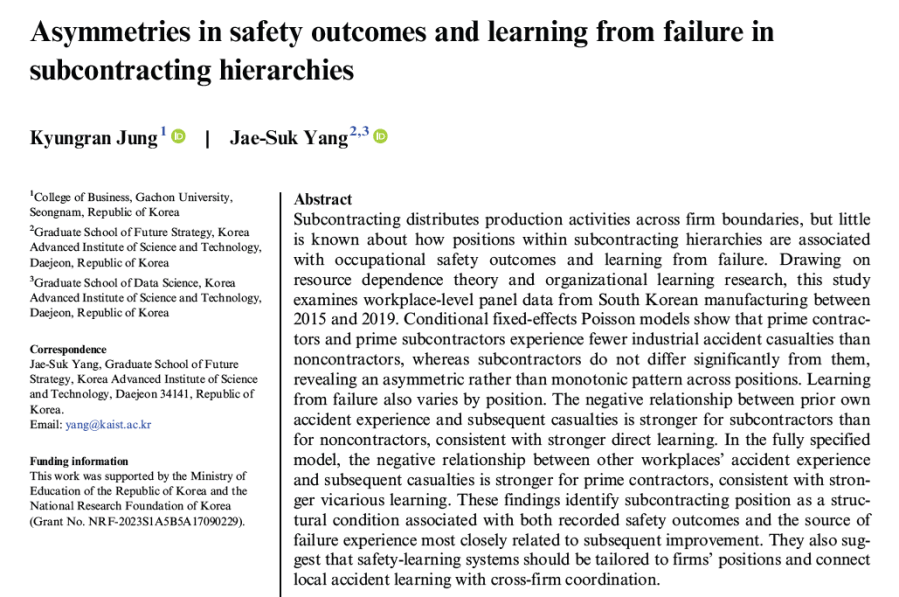
This Korean study evaluated learning from failure in manufacturing between prime contractors, prime subcontractors, subcontractors and non-contractors.
Shared under an open access licence.
PS. Check out my YouTube: https://youtube.com/@safe_as_pod?si=V2dbdmW–WbnhzA9
Shout a coffee: https://buymeacoffee.com/benhutchinson
Extracts:
· “subcontracting may distribute not only production activities but also the occupational safety risks associated with those activities unevenly across firms”
· prime contractors and prime subcontractors experience fewer industrial accident casualties than noncontractors, whereas subcontractors do not differ significantly from them, revealing an asymmetric rather than monotonic pattern across positions”
· “When accident disclosure is perceived to carry employment or organizational costs, some incidents may be less likely to enter official records”
· Subbies seem to learn better from their own accidents than firms outside subcontracting do; so after an accident, subbies reduced their later injuries far more than other firms did (~13% vs <1% for non-subs per prior injury)
· “the broad coordinating position of prime contractors may facilitate the use of others’ accident experience”
· “access to information about others’ accidents is not sufficient for vicarious learning”
· “direct learning is comparatively stable across manufacturing contexts, while vicarious learning is more context-dependent and may rely on the relevance and comparability of others’ experience”
· “Serious accidents occur relatively infrequently, minor incidents and errors may remain unreported, and even when accident information is available, the complexity of technologies and work processes can make underlying causes difficult to diagnose”
· “The same accident experience can produce different learning outcomes, depending on organizations’ opportunities to access relevant information, their motivation to respond, and their ability to interpret its implications and translate lessons into corrective action”
· “occupational safety interventions should be tailored to organizations’ positions within subcontracting hierarchies rather than applied uniformly across firms”
· “For subcontractors, systems that translate on-site accident experience into corrective action may be particularly valuable”
· “prime contractors can support these efforts through technical guidance, safety training, joint hazard assessments, and stronger safety-management practices”
· “information-sharing systems should provide contextual details on technologies, work processes, contributing factors, and preventive responses rather than aggregate accident counts alone”
· “the study highlights safety outcomes and learning as relational phenomena embedded in multitiered subcontracting networks”
#safetyscience #workplacesafety #WHS #OHS #subcontracting #constructionsafety #SIF


