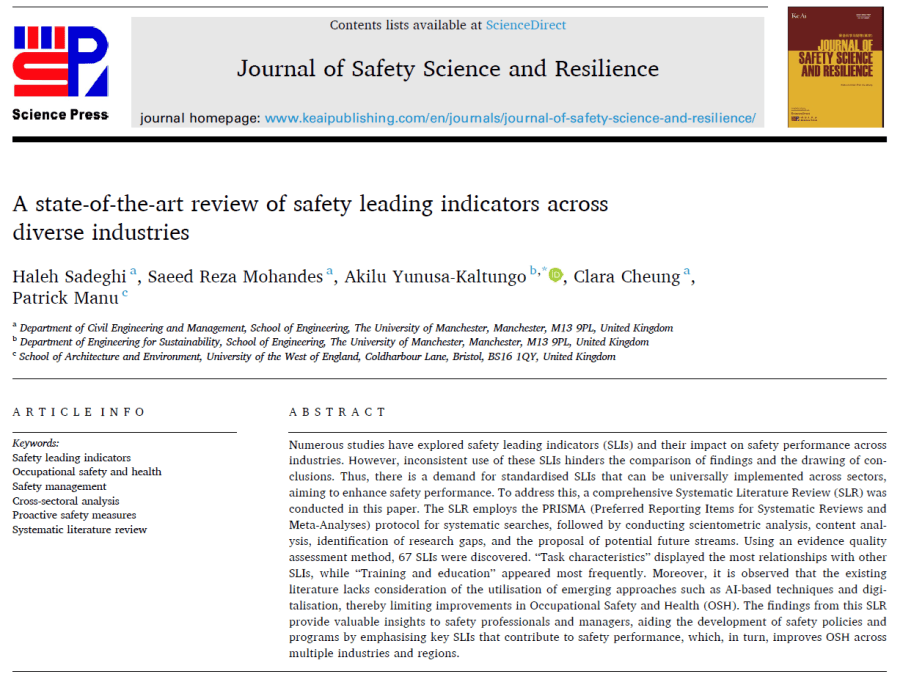
Which safety leading indicators (SLIs) are researched most commonly?
69 studies were reviewed exploring that question.
Shared under open access licence.
PS. Check out my YouTube: https://youtube.com/@safe_as_pod?si=V2dbdmW–WbnhzA9
Shout a coffee: https://buymeacoffee.com/benhutchinson
First they cover the old chestnut of lagging injury measures, where their “value as predictors of future safety remains uncertain” & may lack “sufficient insights”.
What are organisations measuring instead, or at least, researchers investigating?
They identified 67 common SLIs. Training and education appeared most. Why? They suggest “there is a legal requirement for training” & it’s “easy to quantify how many hours of training have been delivered”.
Indicators were unevenly distributed across the PDCA cycle, “69 % of the indicators were mapped onto the ‘Do (D)’ group”, where only 4% were under “Act”. As such, few indicators measure learning or improvement.
This could be due to most indicators focusing on implementing OHS plans, e.g. identifying risk profiles or undertaking activities. The 4% of Act were post-incident learning, safety program eval/improvement & evaluating the indicators themselves.
In essence, most of the indicators shown in this article would primarily show whether activities were done, but less if any useful changes resulted, or if the indicators tell you something useful.
The research has a lot of limits – limited longitudinal, mixed-method, or intervention-based designs. Many studies evaluated SLIs via self-reported data.
The supposed links to ‘safety culture’, climate and compliance are “often taken for granted” and rarely are directly tested.
Health is also largely missing: “Metrics for psychosocial risk, chronic exposure, and mental well-being remain underrepresented”.
Authors sum up the evidence corpus as “promising but methodologically uneven”.
Importantly: they warn that the commonality/frequency counts of SLIs, e.g. how commonly training etc. are used “should not be regarded as a definitive ranking of the most significant SLIs”.
Hence, how often indicators are used, naturally, tells little about whether it’s effective. Also, indicators may be popular because they’re easy to measure.
Looking at the Table 2 measures – you’ll also see that almost all of them are outcome measures, rather than assessing the quality or effectiveness underpinning the measure, or upstream & precursor measures (e.g. inputs or even current-state monitoring).
** And super speculatively: They observed an uptick in SLI publications after 2014, which “is in line with the rise of ideas like “Safety Differently,” which redefine safety as having systems that can adapt and act proactively instead of just avoiding accidents”.
#SafetyLeadership #LeadingIndicators #WHS #SafetyScience #RiskManagement #SafetyIndicators


