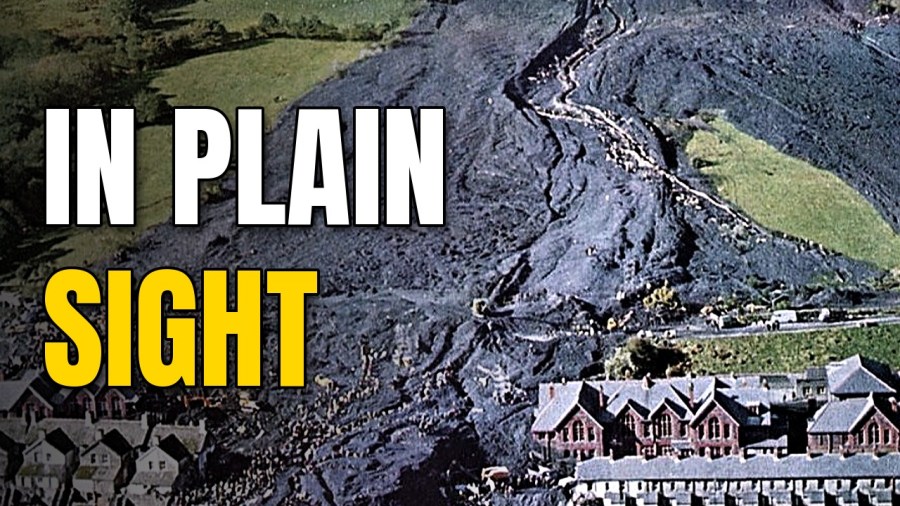
“They were like moles being asked about the habits of birds.”
So said the Aberfan tribunal, describing witnesses who had been oblivious to dangers in front of their eyes. In 1966, a colliery spoil tip slide onto a Welsh village and school, killing 144 people (116 children).
It wasn’t the result of wicked organisations or ‘amoral calculators’ (per Vaughan’s words). In coal mining at that time, attention and expertise was focused underground, not aboveground.
Tips were treated as mere housekeeping issues – a bit like dustbins, and even mining legislation barely mentioned them. As such, a major hazard sat in front of the eyes of those responsible to manage it, but also outside of their ‘perceptual horizon’.
They saw a housekeeping issue, not a major hazard.
Pidgeon & O’Leary, drawing heavily on Barry Turner’s work, call this a fundamental paradox of any ‘safety culture’: shared assumptions that illuminate some hazards also blind us to others.
Or as Vaughan said about NASA & the Challenger disaster, culture “provided a way of seeing that was simultaneously a way of not seeing”.
This doesn’t, of course, mean abandoning established ways of thinking about hazards (not that we likely could, anyway). It’s also about ways of stepping outside of them – leveraging different perspectives.
Pidgeon & O’Leary call it safety imagination: suspending assumptions about how we did ‘safety’ in the past, and asking what issues are outside of our current assumptions, beliefs, or risk registers.
If this topic interests you – then check out my latest YouTube & Spotify/Apple episode.
Most high-hazard organisations likely have their own ‘spoil tip’ hazard that’s either been normalised, or masked to our current belief systems.
E.g. a high-energy hazard task with only weak admin controls that’s just seen as “that’s how we’ve always done it”.
#safetyculture #safetyscience #disasterincubation #humanfactors #psychology #whs #ohs #leadership


