Can a complex system effectively navigate risk if it only understands failure in hindsight?
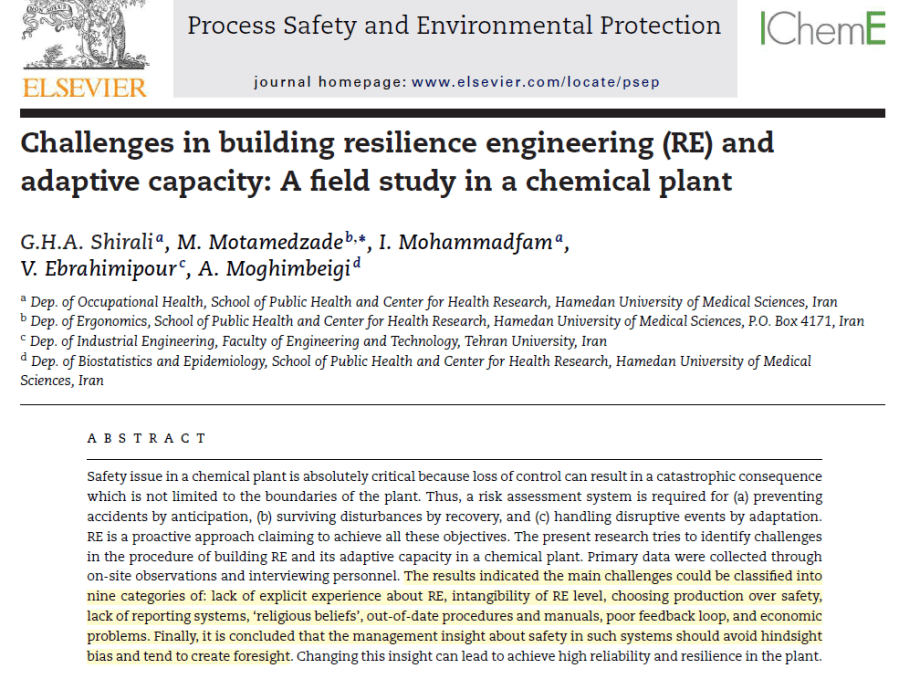
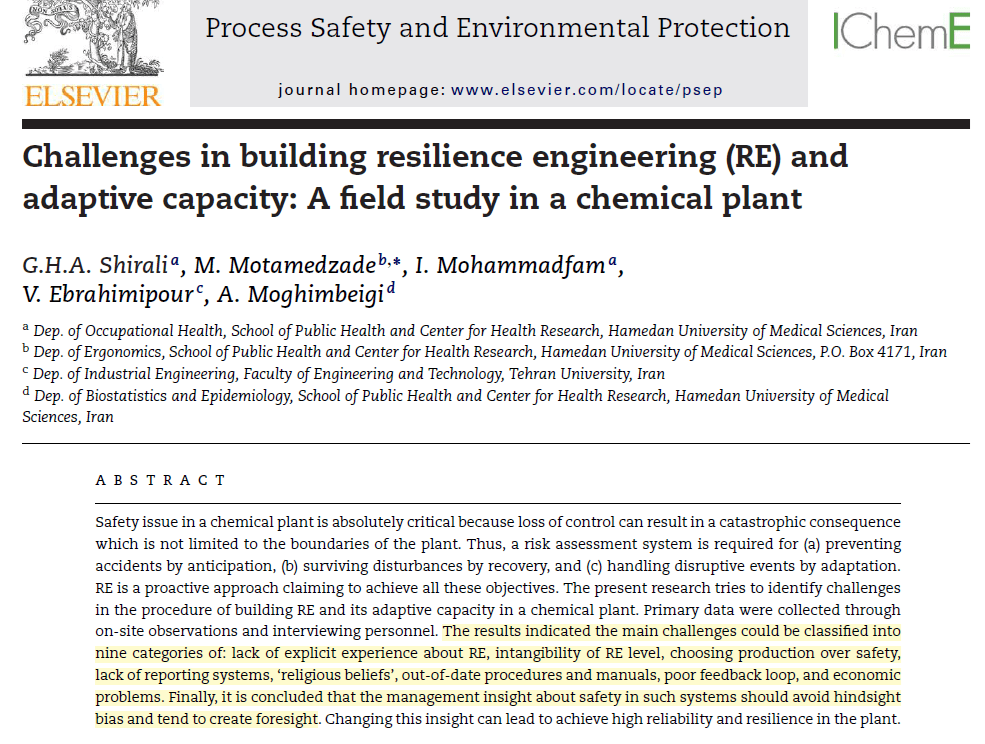
This study explores the challenges of building adaptive capacity from a resilience engineering perspective in a chemical plant. On-site observations & interviews were used.
PS. Check out my YouTube and recent Critical Control / barrier vid: https://youtube.com/@safe_as_pod?si=iUaDPJynPemQRZhY
Shout a coffee: https://buymeacoffee.com/benhutchinson
Extracts:
· “RE is a proactive approach” intended to support “preventing accidents by anticipation”, “surviving disturbances by recovery” and “handling disruptive events by adaptation”
· A unique part of RE is how it emphases “understanding how this success is obtained,” including how people “learn… and adapt to create safety in an environment with gaps, hazards, trade-offs, and multiple goals”
· Resilient performance requires an ability to “respond to various disturbances”, “flexibly monitor what is going on”, “anticipate disruptions, pressures, and their consequences”, and “learn from experience”
· Systems shouldn’t be considered resilient when they rely on operators’ adaptive capacities “ “in an uncontrolled manner”, e.g. human abilities must operate together with “constructed safeguards and organizational factors” in expected and unexpected conditions
· They note traditional accident analysis was based on “a simple and linear approach which trends to blame the operators, instead of systematic identification of origins”; this produces “limited learning and improvement”
· They say “Production is always a winner” because some managers considered safety “a big barrier against progress for production goals”; others said “safety always comes first”, but “neglect it decisively in their performance”
· As memories of accidents fade, “production becomes dominant”, people move towards “production and efficiency” and “the drift process operates uncontrollably”
· Interestingly, operators “have not really known safety boundaries, because those were not previously defined and mapped for” and therefore “hardly recognize when safety is at risk”
· One said “I am not really sure whether I would be authorized or not to stop production line, when safety is at risk”
· And operators need to know “when to relax the pressure on efficiency goals” before approaching safety margins too closely
· “Messengers are shot and whistleblowers are dismissed or discredited”
· And without an integrated reporting system, operators keep safety concerns privately; e.g. “risks would remain latent and processes go on unchecked”
· They note that procedures were “incomprehensible, inaccessible, and inaccurate”, and many were outdated, unavailable during operations, written in a language operators couldn’t read & developed without frontline input
· “An out-of-date procedure or manual can sometimes be more damaging than having no procedures or manuals”
· Training was commonly “designed without any need assessment”; it was delivered after accidents or during “dead times” & evaluated through a simple checklist that didn’t reveal weaknesses in outcomes
· Feedback was also based on hindsight, had long delays between operator input & implemented change, and can’t “support an adaptation and learning process”
· “Complex systems can no longer wait for accidents to think about safety”, nor should organisations assume safety can be engineered through “extensive error counting” or via tweaking isolated procedures, people or equipment
· “Safety is a ‘dynamic non event’”, where past success may conceal the daily risk exposures when organisations treat the absence of accidents as evidence of future safety
· And “Putting safety as the first priority is not enough” because priorities change under production and external pressures
· They say that safety should be understood as “something the plant does, rather than something the plant has”
Study link: https://doi.org/10.1016/j.psep.2011.08.003
My YouTube: https://www.youtube.com/@safe_as_pod
My site with more reviews: SafetyInsights.org
Shout me a coffee: https://buymeacoffee.com/benhutchinson
Safe As LinkedIn group: https://www.linkedin.com/groups/14717868


