Can well-intended safety support from leaders undermine recovery after injury?
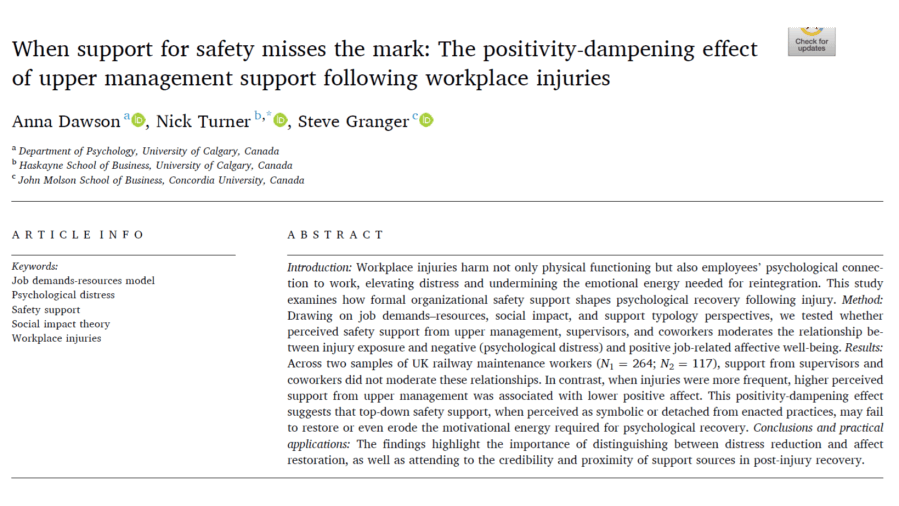
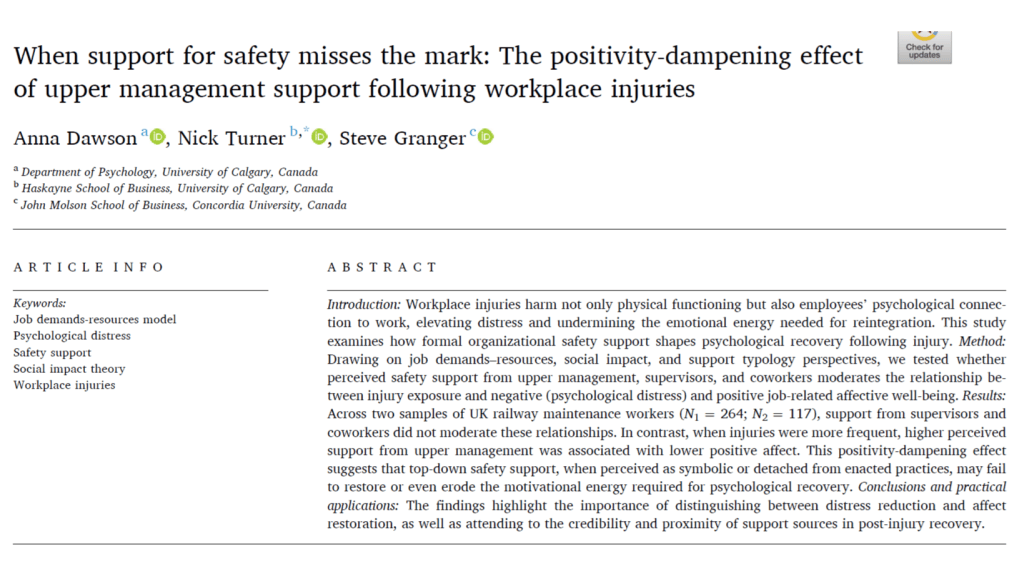
This explores how formal organisational safety support influences psychological recovery after injury via two samples from UK railway maintenance workers.
PS. Check out my YouTube: https://youtube.com/@safe_as_pod?si=V2dbdmW–WbnhzA9
Shout a coffee: https://buymeacoffee.com/benhutchinson
Background:
• “Workplace injuries disrupt not only physical functioning but also employees’ psychological connection to work”
• “These intertwined stressors illustrate that recovery from workplace injury is not only a physical process but also a psychological and social one”
• Per Social Impact Theory (SIT), “the social influence of a source depends on three functions: strength (authority, credibility), immediacy (relational closeness, frequency of contact), and number (volume or redundancy of supportive cues)”
• “Upper management typically possesses high strength but low immediacy: their support often carries symbolic weight but limited emotional resonance”
• “When expressed primarily through general communications or safety statements, such support may lack the relational proximity required for motivational impact”
• “Supervisors combine strength with relational immediacy, enabling them to influence both the logistics of post-injury adjustment (e.g., task reassignment, scheduling, modified duties) and its emotional tone (e.g., empathy, reassurance, fairness)”
• “Coworkers, who lack formal authority but are high in immediacy and number, are often best positioned to provide daily reinforcement and shared understanding”
Findings:
• “coworker and supervisor support did not moderate the relationship between injury and either psychological distress or positive job-related affective well-being”
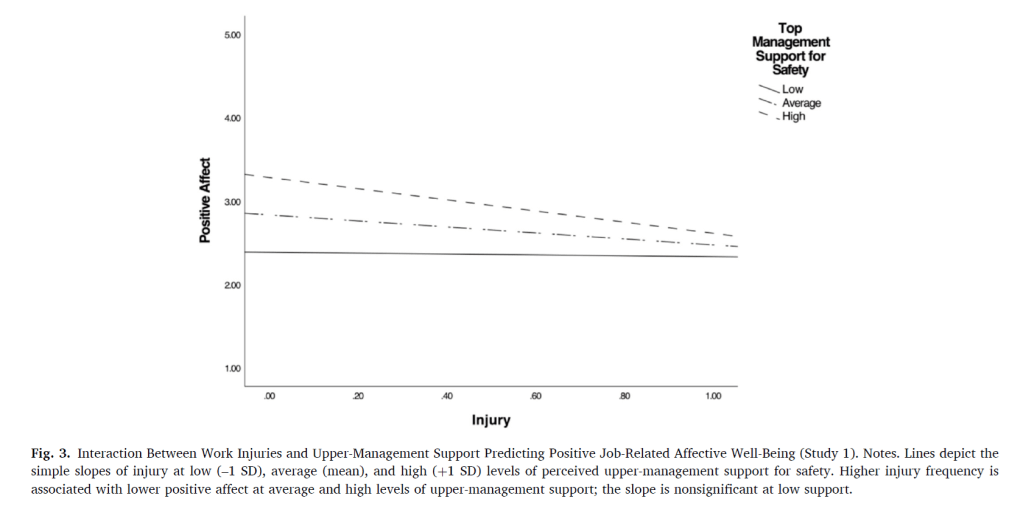
• However “upper management support showed a consistent and theoretically significant pattern for positive affect: when injury exposure was higher, positive affect was lower under higher perceived upper-management support”
• “This emerging positivity dampening pattern suggests that top-down safety support, under conditions of frequent or salient injury, may fail to restore and may even diminish the motivational and emotional energy needed for recovery”
• “Rather than functioning as an energizing resource, managerial communications about safety may become psychologically inert or subtly deflating when perceived as detached from day-to-day realities”
• “certain well- intended forms of support may lose motivational potency when they are perceived as perfunctory, generic, or incongruent with injured workers’ lived experience of recovery and reintegration”
• When leader support is seen as distal, support “may lose motivational salience or even signal inauthenticity, thereby undermining the reactivation of energy required for reintegration”
• “Support that blends the strength of leadership with the immediacy and frequency of direct supervisor contact, such as when upper management messages are co-delivered and reinforced locally, may achieve greater emotional resonance”
• In all, the findings “suggest that upper-management support may lose motivational value when it is perceived as symbolic or insufficiently reinforced through local action and tangible accommodation”
• And “injury may function as an interpretive moment in which employees reassess the credibility of organizational commitments to safety, shaping whether subsequent communications are received as restorative or as performative”
Study link: https://doi.org/10.1016/j.jsr.2026.05.018


