Can naïve adoption of Safety-II / HOP without good evidence move us backwards?
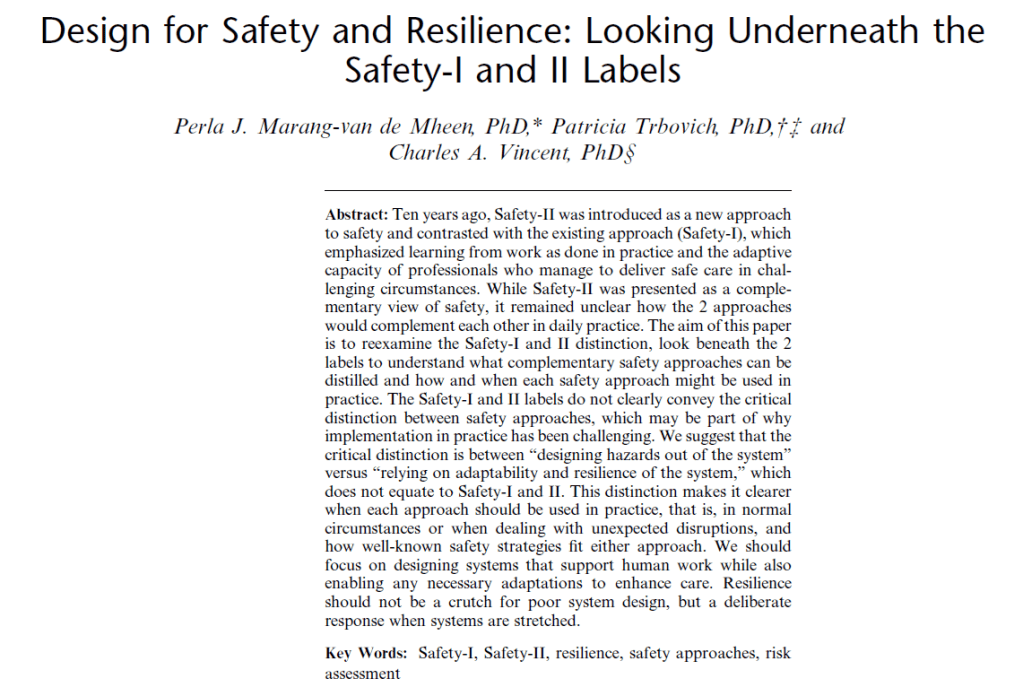
This paper proposes that the Safety-I / II concepts don’t adequately convey the critical distinctions between designing out hazards vs adaptation.
PS. Check out my YouTube: https://youtube.com/@safe_as_pod?si=V2dbdmW–WbnhzA9
Shout a coffee: https://buymeacoffee.com/benhutchinson
Extracts:
· “How do systems become safe? The route to safety depends, of course, on the system in question”
· Aviation & nuclear etc. rely on highly proceduralised & tightly regulated approaches – safety is engineered in as much as possible
· But even here people still need adaptability, flexibility, professional judgement, expertise etc.
· They ask “Should we aim to design a safe system, constrain its operations, and effectively engineer safety?”, or is it better to “enhance the capacity of both individuals and organizations to adapt … [to pressures, demands] and rely more on human ingenuity”?
· Safety-II reflected criticisms of a narrow, rigid “excessively managerial approach to safety (Safety-I)”
· But they note some weren’t convinced by the Safety-I/II distinction “viewing the portrayal of Safety-I as an unrecognizable caricature, a strawman which bore little resemblance to established thinking on safety”
· These authors believe that by framing the distinction as Safety-I/II or as a “new paradigm”, it “unintentionally created a great deal of confusion”
· Safety-II views “safety to be a state of as many things going right as possible rather than fewer things going wrong, which seems to be a circular argument, as focusing on what goes right presupposes an understanding of what can go wrong”
· This focus, they say, “runs the risk of undermining decades of work to reveal and respond to the harms that patients suffer”
· And “naïve adoption of Safety-II without rigorous evaluation14 is a danger and potentially highly retrograde development”
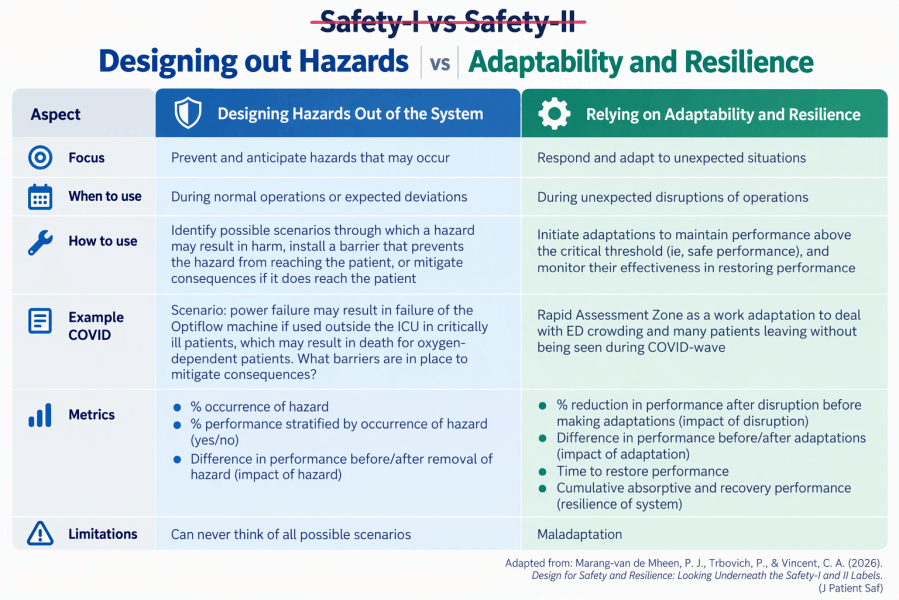
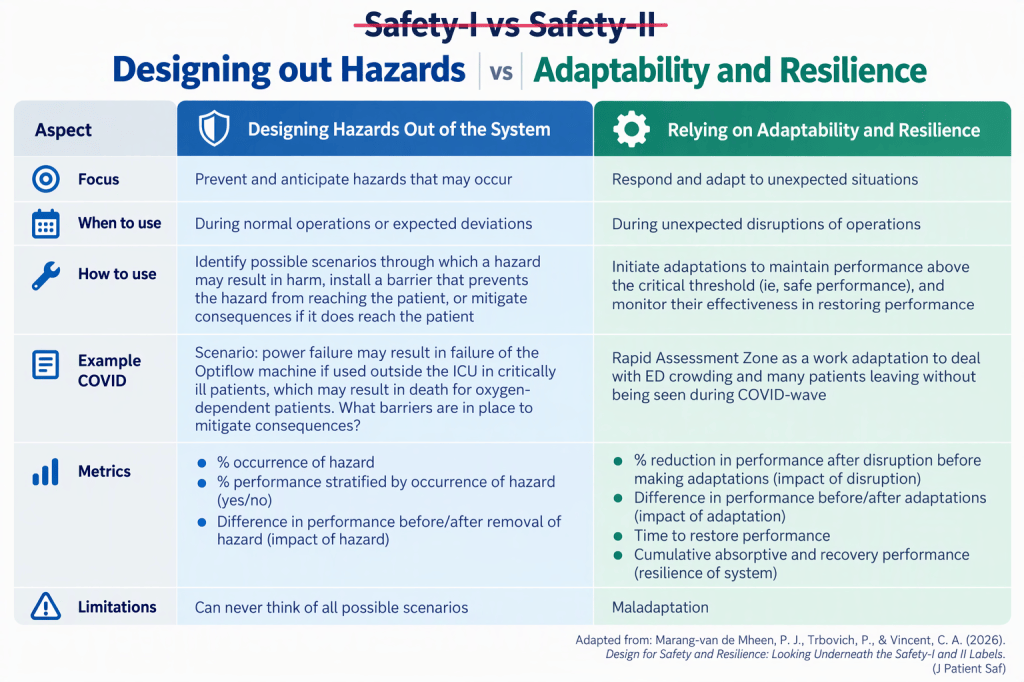
· Instead, they suggest a more precise delineation is between “designing hazards out of the system” vs “relying on adaptability and resilience of the system”
· Designing out hazards is “focused on identifying scenarios through which hazards may result in patient harm, so that we can install barriers that will prevent the hazard from reaching the patient or mitigate its consequences”
· While design improvements may substantially reduce harm, it still needs “to be complemented by allowing for necessary adaptations and resilience in the face of disruptions”
· They say their own strategies of ‘risk control’ and ‘improving capacity for monitoring, adaptation and response’ is well-suited for a path forward
· For disruptions: we need the adaptive capacity of people and need to better understand which adaptive strategies are used, including their effectiveness
· They note that much of the adaptive capacity in healthcare is needed even “in normal circumstances because of the poor reliability and usability of basic systems”
· While workarounds help work happen, they can also unintentionally create harm
· As such, more focus on design safety and the “usability and reliability of equipment and core health care processes would therefore reduce the need for adaptation and workarounds”
· Nevertheless, “Constraining adaptive capacity in some cases might make staff less willing to adapt in other circumstances where it is needed to maintain safety”
· “people may lose flexibility when faced with extensive rules and procedures, meaning that too much reliance on routines may reduce an organization’s ability to react quickly”
· But, building adaptive capacity also shouldn’t “excuse us from also working on improving the system rather than forcing people to be resilient in a system that is no longer safe”
· healthcare may need more balanced focus on design safety rather than “squandering adaptive capacity and exhausting our staff, and indeed our patients, by relying on resilience to get our systems to work”
NB. The table in this post was AI gen based on data from the article, to make it easier to read.
Study link: Design for Safety and Resilience: Looking… : Journal of Patient Safety
#safetyscience #safetyii #HOP #resilienceengineering #safetydifferently #newview


