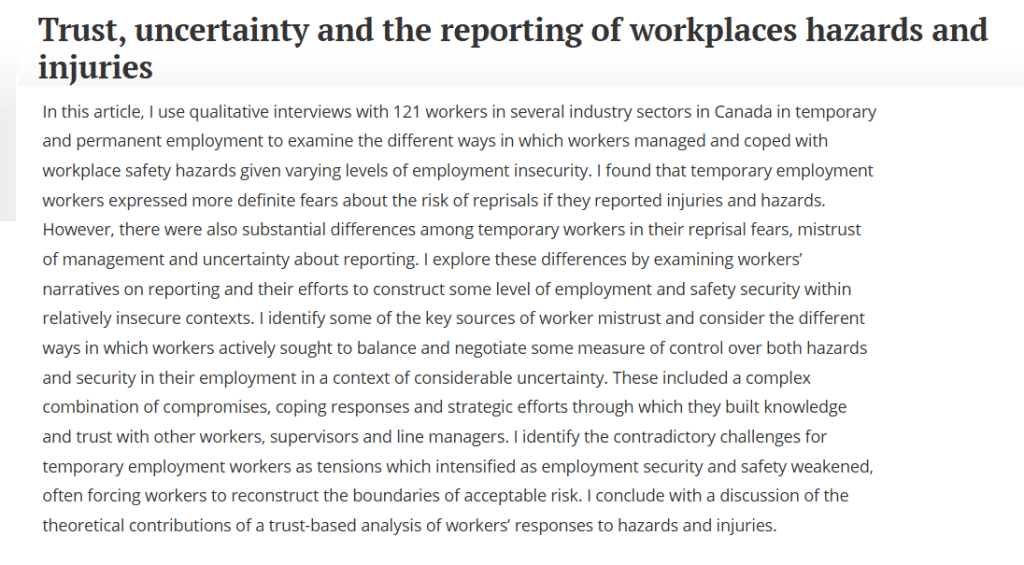
This study interviewed 121 workers across several Canadian sectors in temporary and permanent employment, exploring ways workers managed workplace hazards given employment insecurity.
Not a summary – way too much to cover.
Extracts:
- “temporary employment workers expressed more definite fears about the risk of reprisals if they reported injuries and hazards”
- “workers in less secure forms of employment are more likely to construct a need to accept greater safety risks in order to keep their employment”
- Workers are described as “strategic actors seeking to manage and strengthen their security and safety”, even if it leads to compromising their safety
- “precarious workers often have limited understanding of and experience with the work, the physical space, other workers and local management, implying more significant and varying challenges for these workers in judging … safety”

- “Uncertainty is also built into many safety judgements in as much as workers often do their jobs without having a clear sense of the possible injury or health outcomes given particular activities or conditions”
- “Since one possible outcome of an injury is not being able to work, safety reporting is not just a possible concession to employment precariousness, it is also part of a more complex employment calculus that workers often face when addressing and judging health and safety conditions”
- “workers may ‘knowingly’ accept certain injuries and hazards as the price of employment but, there are also degrees of uncertainty behind many of these compromises”
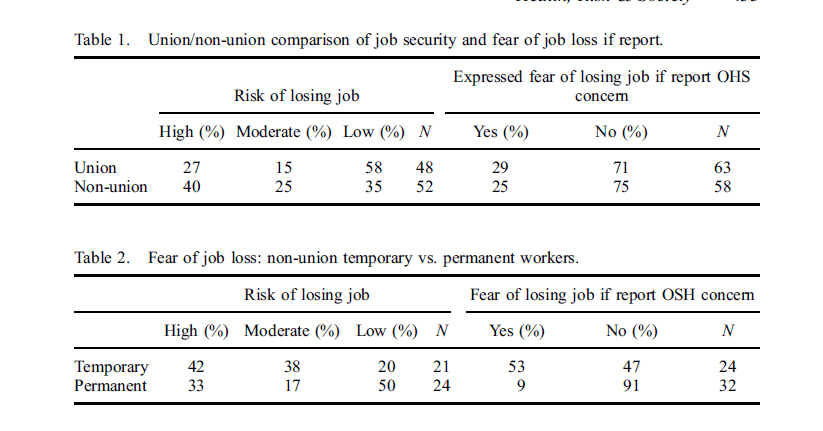
- Non-union workers were more likely to express fears of losing their job if they complained about safety (53%) compared to non-union (9%)
- “Uncertainty about the consequences of reporting can discourage reporting, even when supervisors encourage workers to report”
- “workers often relied on their fellow workers to judge whether they could report or not, either by watching what other workers did when they were involved in incidents or injuries nor, by asking for their advice”
- “mistrust of management or individual managers and supervisors was sometimes grounded in specific reprisal experiences or accounts by other workers”
- And “greater uncertainty about the consequences of reporting, tended to come from general distrust of the firm. Workers used their general treatment both by the firm as a whole, and by individual managers and supervisors to judge whether they were decent and cared for workers”
- “Workers sometimes see health and safety hazards as rational compromises for positive employment conditions”
- “A worker’s trust in management or individual managers can also be betrayed in other ways, most notably when workers are manipulated or coaxed into accepting serious health and safety risks and injuries”
- “Workers may accept minor safety issues if they have a good relationship with their manager”
- “The acceptance of certain injuries as minor or normal is one way that management control can operate”
- “Trust in one domain of a relationship can coexist with mistrust in other aspects”
- “The development of trust in management, supervisors, or workers in one aspect did not necessarily generalize to the reporting of injuries and hazards”
- “There is a mix of coercive and consensual management practices in most temporary workplaces”
- “A kind of trust in the ‘system’ was evident for some workers, where they believe they are protected by standards regarding safety and/or employment”
- “While the fear of reprisals is an important factor in injury and hazard reporting within precarious employment contexts, I found that even when fearful, workers sought and achieved a degree of safety and employment security, often balancing the risks of one against the other and sometimes strengthening both simultaneously”

Ref: Hall, A. (2016). Trust, uncertainty and the reporting of workplaces hazards and injuries. Health, Risk & Society, 18(7-8), 427-448.
Study link: https://doi.org/10.1080/13698575.2016.1264576
My site with more reviews: https://safety177496371.wordpress.com

 SafetyInsights.org
One thought on “Trust, uncertainty and the reporting of workplace hazards and injuries”