
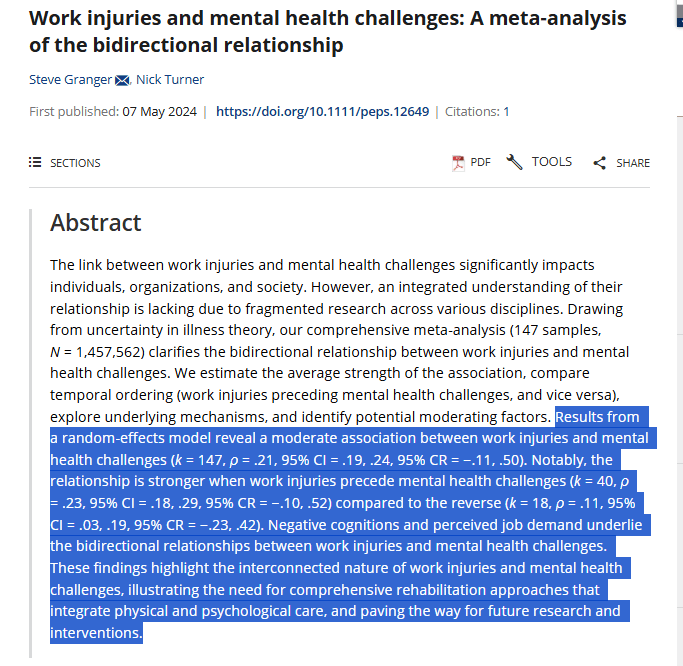
This meta-analysis investigated the relationship between work injuries and mental health challenges.
139 studies included.
Background:
· Mental health challenge is defined as prolonged deviations from the state of an individual’s psychological well-being
· “These deviations manifest as noticeable shifts in cognition, emotion, or behavior resulting in psychological distress”
· “various studies have documented that work injuries are associated with a decline in mental health over periods ranging from 8 days to 10 years … highlighting the enduring effects of work injuries”
· “This link is supported by the notion that a preoccupation with symptoms of poor mental health, such as being distracted or disinterested, increase the likelihood of experiencing work injuries”
Results
· “cumulative evidence indicates a consistent and modest link between work injuries and mental health challenges”
· “the average effect size varies significantly across studies, suggesting the influence of various conditional factors that shape the relationship”
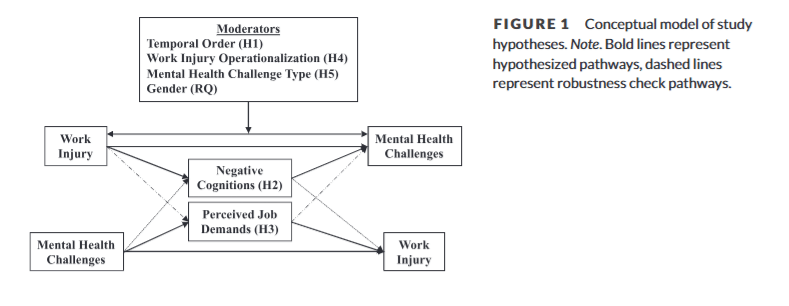
· “cognitive mechanisms related to uncertainty, such as negative cognitions and perceived job demands, were found to mediate both the work injury→mental health challenges and mental health challenges→work injury relationships”
· “the relationship is stronger when work injuries precede mental health challenges (p = .23)” compared to mental health challenges -> work injury (p = .11)”
· Hence, “mental health challenges are more likely to follow work injuries rather than precede them”
· They found two core factors influencing the bidirectional relationship:
1) “negative cognitions such as rumination serve to mediate the relationship between work injuries and mental health challenges”
2) the nature of work itself influences the relationship, where “the uncertain implications of more severe and frequent injuries can pose significant challenges for people”
· Gender wasn’t found to moderate the relationship, however they note that men tend to experience more work injuries and women exhibit higher depression which might obscure the findings long-term
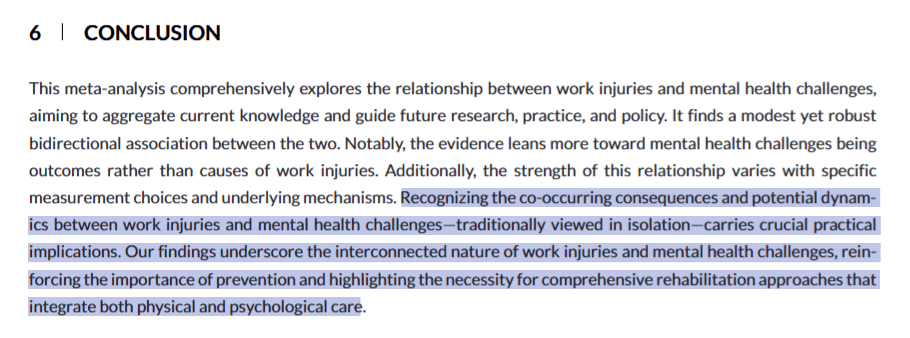
· They argue that while much research treats injuries as outcomes, these findings support “the need for a stronger focus on psychological rehabilitation alongside physical rehabilitation in return-to-work programs”
· Since the management of work injuries away from negative cognitions “is pivotal to prevent a potential descent into deeper mental health challenges”, the findings “stress the paramount importance of ensuring dignity, fair treatment, and adequate support post-injury”
· This “underscores the pressing need to integrate psychological rehabilitation with physical rehabilitation. While physical recovery is often the primary focus after a work injury, psychological distress can persist and complicate the recovery process” (emphasis added)
Ref: Granger, S., & Turner, N. (2025). Personnel Psychology, 78(1), 11-57.

Study link: https://doi.org/10.1111/peps.12649

 SafetyInsights.org
One thought on “Work injuries and mental health challenges: A meta-analysis of the bidirectional relationship”