
What impacts do boards of directors have on workplace safety? Found this an interesting extract from a paper I summarised over the weekend (will probably post next week). It systematically explored the links between boards of directors and their influence on safety. Of the 49 included studies, they found: · “Empirical studies gave no insight into… Continue reading How do boards of directors influence workplace safety?
Author: Ben Hutchinson
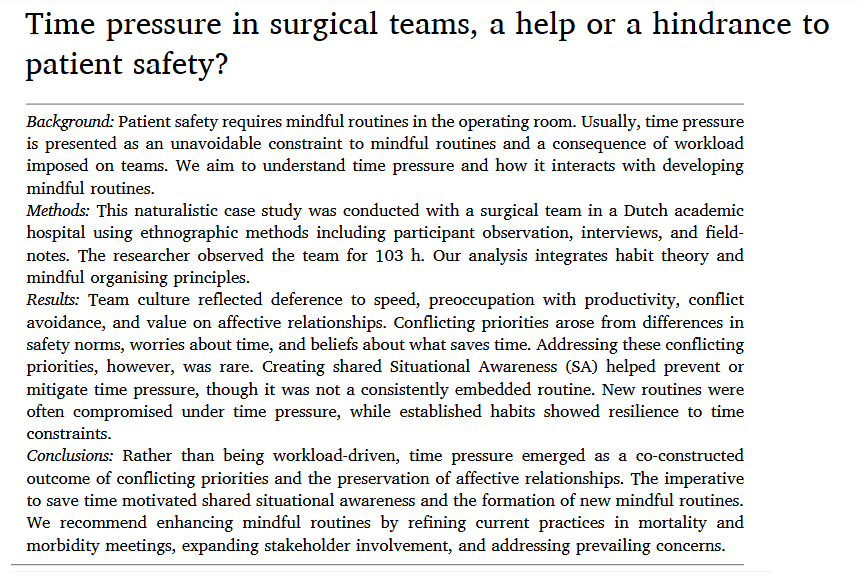
Time pressure in surgical teams, a help or a hindrance to patient safety?
I found this an interesting and brief read about the mindful routines of operating room staff, using a naturalistic decision making approach. Extracts: Ref: van Harten, A., Niessen, T. J., Koksma, J. J., Gooszen, H. G., & Abma, T. A. (2025). Heliyon. Shout me a coffee Study link: https://doi.org/10.1016/j.heliyon.2025.e41967 Shout me a coffee: https://buymeacoffee.com/benhutchinson LinkedIn post:… Continue reading Time pressure in surgical teams, a help or a hindrance to patient safety?

Formalised safety systems miss “three-quarters” of established factors linked to performance
Not much to say here – just found this an interesting extract from the ‘Digging Deeper’ focused on safety within NSW mining. They observe relating to the adoption of formalised safety management systems: · “Smaller organisations that take on such systems are often overwhelmed by their complexity” · And these systems “can be expensive to establish and… Continue reading Formalised safety systems miss “three-quarters” of established factors linked to performance
Learning from normal work: How to Proactively Reduce Risk When Nothing Goes Wrong
An interesting article from Marcin Nazaruk, exploring learning from everyday work. Skipping a bit, so check out the full article. First he says that while it’s important to learn from failure “it is too late”. For one, diminishing incident rates “can no longer accurately reflect safety performance … and simply focusing on behaviours and unsafe… Continue reading Learning from normal work: How to Proactively Reduce Risk When Nothing Goes Wrong

“Those found responsible have been sacked”: some observations on the usefulness of error
Another interesting paper co-authored by the late Richard Cook. This paper discusses the usefulness of error. It’s a larger post with a lot of quotes – I just can’t do a better or more succinct job of restating what they’ve already written. Providing background, they argue that while some see “error” as a dead-end, others… Continue reading “Those found responsible have been sacked”: some observations on the usefulness of error

Safety is simple…apparently: two visual representations of the same incident
Safety is simple, bruz … (apparently) (Both examples show the same event, but each uses a different lens. Images are slides taken from one of my presentations to highlight how investigations can be as much ‘constructions’, as searches for ‘objective’ facts, entirely separate to the perceiver or who gets to draw the line in the… Continue reading Safety is simple…apparently: two visual representations of the same incident

Safety audits almost never target the actual sources of operational danger
Reflecting on my first audit study – we found things many would expect (image 1), like audits largely focusing on administrative items, and superficial matters. And for my construction friends, we found ‘toolboxes’ used a lot to address an issue, even if that issue didn’t have any reasonable connection to something that you’d need to… Continue reading Safety audits almost never target the actual sources of operational danger

Safety culture and power dynamics in organizations
Not much to say here. This article briefly touched upon the interactions of power dynamics and safety culture. Some really cool stuff has been written about power in safety (check out my site). This only really briefly touches on a few points: · Starting with safety culture (SC), they say it has “even been abandoned by… Continue reading Safety culture and power dynamics in organizations

Leveraging Ergonomics and Human Factors (E/ HF) for community impact: what have we learned about how to make a difference
This was a banger – exploring the application of community ergonomics with a strong systems lens. If you’re interested in HF/E, systems thinking, social dynamics, power gradients and more then this will interest you. Can’t do it justice, so a few random extracts. Extracts: Finally they talk about ways to improve this practice – via… Continue reading Leveraging Ergonomics and Human Factors (E/ HF) for community impact: what have we learned about how to make a difference
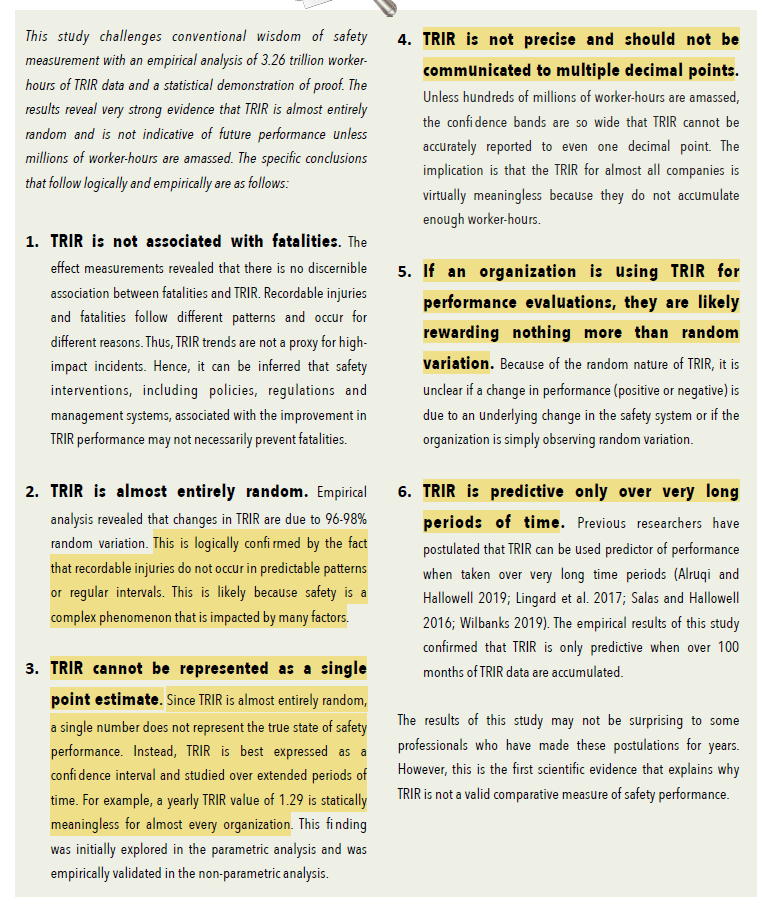
How to make injury metrics suck less?
How can we make injury metrics suck less? So this came out of a conversation with somebody (thanks Jordan Vince). I’m **not** a promoter of injury measures. I think we spend FAR too much time quibbling over what are, statistically speaking, quite rare events, when we have the entire spectrum of daily work to learn… Continue reading How to make injury metrics suck less?
 SafetyInsights.org