
Really cool article talking about probability – does it exist? Is it an objective property of the world, or a subjective and constructed phenomenon? And more. Thanks to Ben Cattaneo for putting this on my radar. Can’t do this justice and I’ve skipped HEAPS, so check out the full paper. Thanks to **** for highlighting… Continue reading Does probability exist?
Author: Ben Hutchinson
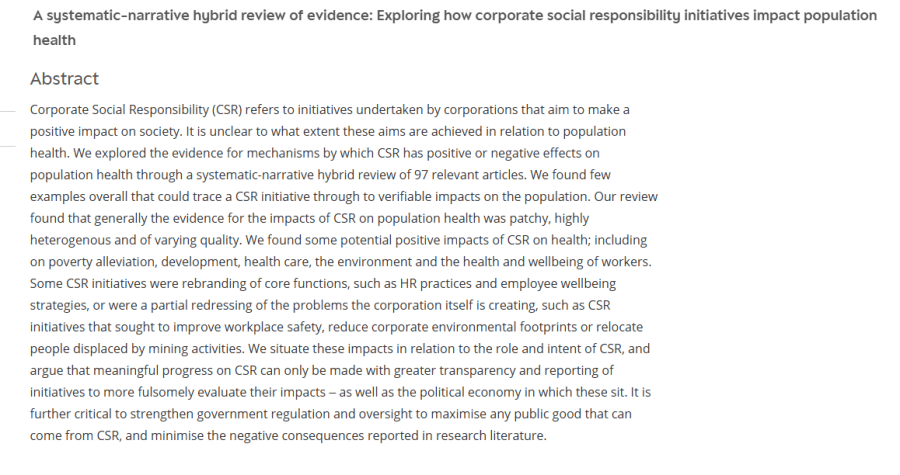
Exploring how corporate social responsibility initiatives impact population health
Do Corporate Social Responsibility (CSR) initiatives impact population health? This systematic review evaluated 97 studies to unpack the question. Tl;dr: Yes, CSR might positively impact some elements of health, poverty alleviation and the environment, but also lead to some negative impacts. Evidence, overall, isn’t strong. Extracts: · They “found evidence for positive impacts of CSR activities… Continue reading Exploring how corporate social responsibility initiatives impact population health

Production Pressure, Cognitive Failures, and Injuries Under an Insecure Job Climate
This study explored the links between production pressure, cognitive failures and injuries within an insecure job climate (JIC) environment. Data came from 1-month lagged survey data from 176 US workers. Extracts: · “Production pressure refers to an organizational emphasis on production to increase corporate profits and efficiency” · While intending to “eliminate wasteful contingencies of material, people,… Continue reading Production Pressure, Cognitive Failures, and Injuries Under an Insecure Job Climate

Major accidents and their geographical and temporal patterns around the world – 1900-2024
I knocked this up over the weekend and thought it would interest people – studied the patterns of natural and human-induced disasters from 1900 to 2024. I’m focusing more on the human-induced/human-made disasters. Some findings: · Asia reported the highest number of air disasters, then Europe, NA and the fewest in Oceania · NA recorded the most… Continue reading Major accidents and their geographical and temporal patterns around the world – 1900-2024
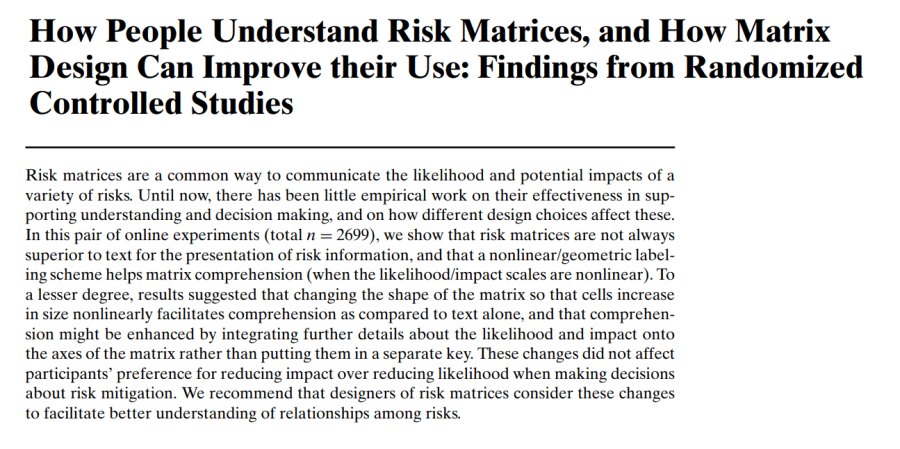
How People Understand Risk Matrices, and How Matrix Design Can Improve their Use: Findings from Randomized Controlled Studies
This study explored different risk matrix designs on user comprehension and use of matrices. I’ve posted a lot of research dunking on risk matrices (RMs), so here’s another olive leaf focusing on designing something potentially more useful. [** I still stand by the critical orientation, since we have little good evidence that RMs improve risk… Continue reading How People Understand Risk Matrices, and How Matrix Design Can Improve their Use: Findings from Randomized Controlled Studies

‘Buy me a coffee’ now live
So…this is awkward. How about that weather?/ or Final season of Game of Thrones / or [insert sports team win or loss] / or bizarre gardening accident? I expect this will be one of the rare times I’ll spruik this function, but there is now a button for donations on my site if you’re interested.… Continue reading ‘Buy me a coffee’ now live
Trust, uncertainty and the reporting of workplace hazards and injuries
This study interviewed 121 workers across several Canadian sectors in temporary and permanent employment, exploring ways workers managed workplace hazards given employment insecurity. Not a summary – way too much to cover. Extracts: Ref: Hall, A. (2016). Trust, uncertainty and the reporting of workplaces hazards and injuries. Health, Risk & Society, 18(7-8), 427-448. Study link: https://doi.org/10.1080/13698575.2016.1264576 My… Continue reading Trust, uncertainty and the reporting of workplace hazards and injuries
Procedure excellence: Changing paradigms to enable human reliability
This paper from Elliot Wolf-Stokes and Rob Fisher may interest peeps – around orientating towards operational excellence. Covers a lot of ground – systemic drivers to procedural departures, error drivers in written guidance, mental models, enablers of human reliability and more. I’ve skipped HEAPS, so just a few extracts (link to full paper in comments):… Continue reading Procedure excellence: Changing paradigms to enable human reliability
Ethical use of Risk Matrices
I found this an interesting section of a paper which I’ll post soon – talking briefly of the ethics of risk matrices. They’ve barely touched the surface, but good to see the reference to ethical practice in risk. Some points are that: Study posted maybe next week. Ref: Sutherland, H., Recchia, G., Dryhurst, S., &… Continue reading Ethical use of Risk Matrices
Getting away “Scott” (but not Susan) free: The effects of safety-specific abusive supervision and supervisor gender on follower attributions & safety
This study explored how workers perceive and rationalise abusive supervision, and how gender influences the relationship. 3 studies were utilised – 2 experimental and 1 field study. For background: · Abusive supervision “may not always be perceived as harmful, as employees’ perceptions of abusive supervision are subjective (Tepper, 2000), including their evaluations of supervisors’ intentions… Continue reading Getting away “Scott” (but not Susan) free: The effects of safety-specific abusive supervision and supervisor gender on follower attributions & safety
 SafetyInsights.org