Four shark attacks in NSW in 48 hours…is this a coincidence? Maybe not. A colleague raised an interesting question about the recent shark attacks. And knowing nothing about sharks, except that they tend to hang out in bodies of water, prompted me to check some studies. (NB. I didn’t do a probability analysis – but… Continue reading Four shark attacks in 48 hours… coincidence? Maybe not
Thinking fast and slow: “System 1 continuously generates suggestions for System 2: impressions, intuitions, intentions, and feelings.”
“System 1 continuously generates suggestions for System 2: impressions, intuitions, intentions, and feelings.” — and — “If endorsed by System 2, impressions and intuitions turn into beliefs, and impulses turn into voluntary actions.” Found these interesting statements from Kahneman about the relationship between Type 1 and Type 2 processing ‘agents’ in the brain (which he… Continue reading Thinking fast and slow: “System 1 continuously generates suggestions for System 2: impressions, intuitions, intentions, and feelings.”
Can Chatbots Provide Genuine Social Connection?
Millions of people use chatbots for social companionship – so how well do they perform compared to people? Specifically, how well do they perform versus supportive vs unsupportive people?
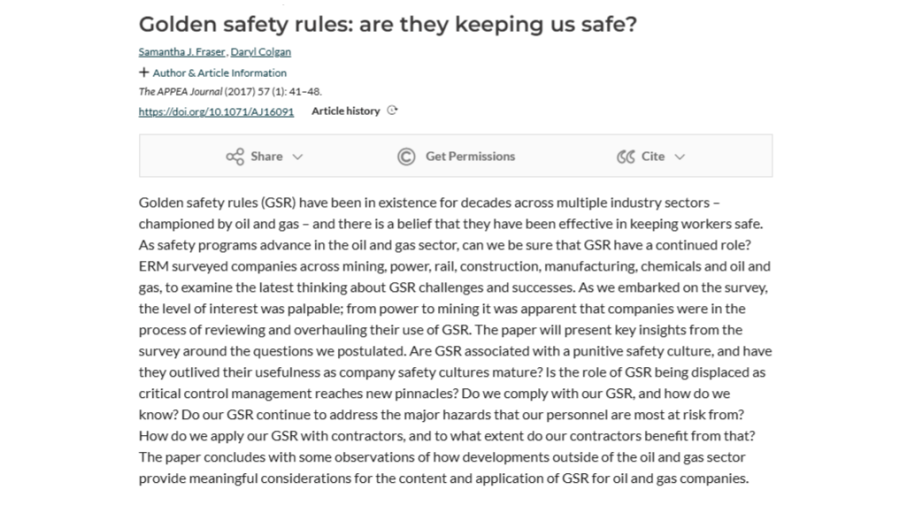
Golden safety rules: are they keeping us safe?
[NB. Minor update and reshare since I think this topic will interest people] This was a small survey study of 18 practitioners across 15 various hazardous industry companies (chemical, oil & gas, construction, mining, mower + more). The goal was to understand the perspectives of whether Golden Safety Rules (GSR) (also called Life Saving Rules,… Continue reading Golden safety rules: are they keeping us safe?
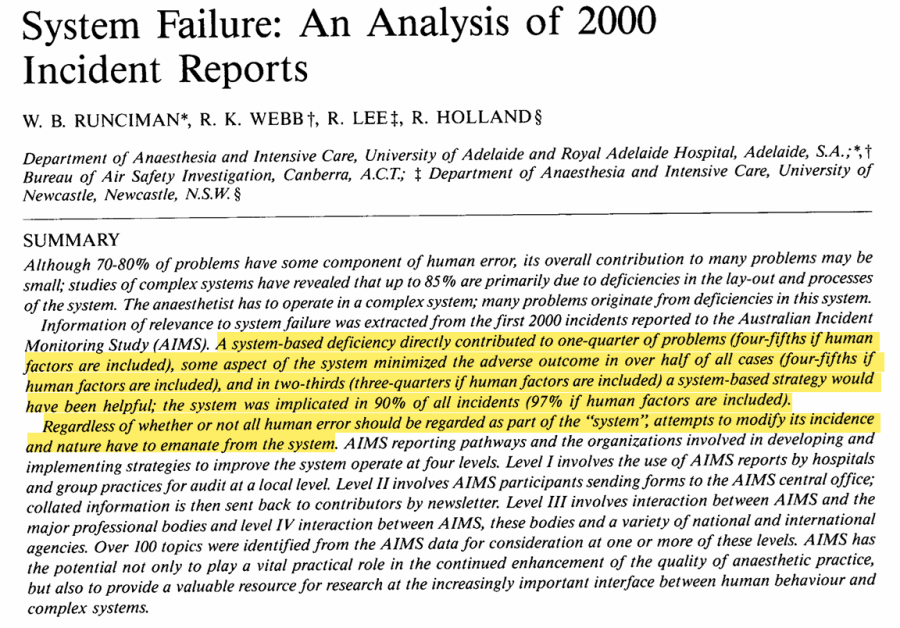
“the system was implicated in 90% of all incidents (97% if human factors are included)” – 1993 medical study
Systems-based issues implicated in almost all incidents, according to this 1993 study. They assessed the source of the factors in 2000 reported medical incidents from the Australian Incident Monitoring Study (AIMS). If you gloss-over the specific percentages, they said: · “The notion that many problems result primarily from defects in the system rather than from deficiencies… Continue reading “the system was implicated in 90% of all incidents (97% if human factors are included)” – 1993 medical study
Safe As: How effective are warning signs?
How effective are warning signs? This ep unpacks the question via a meta-analysis, exploring the factors that make for an effective, or not, warning sign.
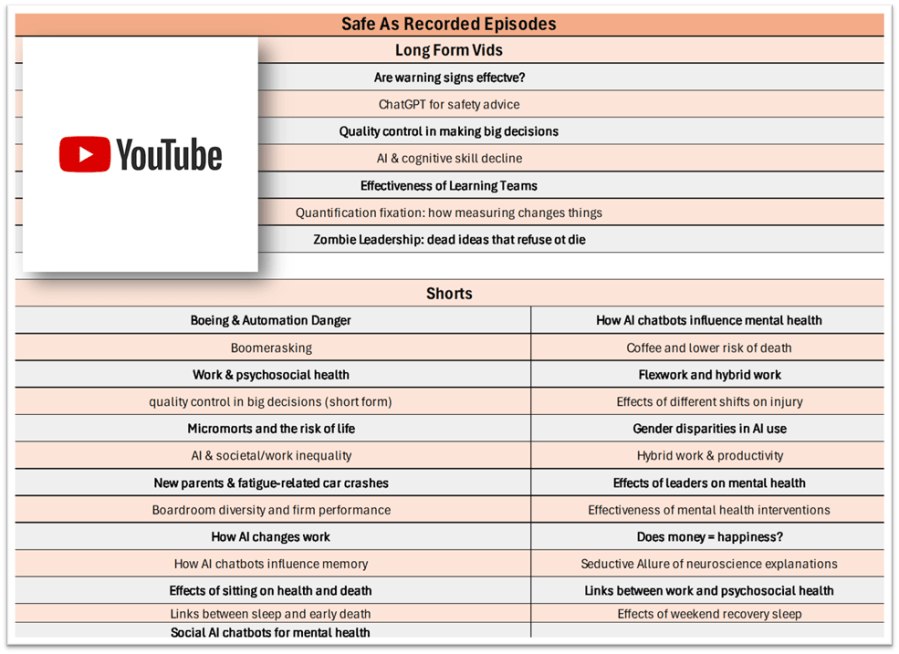
Safe As YouTube episode schedule
Have you subscribed to my new YouTube channel? I’ve just recorded all of the below eps – a mix of safety, AI, risk, cognition, and more general pop-sci. Please help share the word if you find this useful (subscribe, like and comment on my vids)! Hard to get my channel noticed by the vengeful algorithm.… Continue reading Safe As YouTube episode schedule
Safe As: Can AI make your doctors worse at their job?
Can #AI make your doctor worse at their job? This multicentre study compared physician ADR (Adenoma Detection Rate) before and after AI-assisted detection – and then after removing the AI-assistance. What do you think – will the overall benefits of AI overweigh the negative and unintended skill drops of people? (*** Please subscribe, like and… Continue reading Safe As: Can AI make your doctors worse at their job?
AI: Structural vs Algorithmic Hallucinations
#AI: Structural vs Algorithmic Hallucinations There’s several typologies that have sorted different types of hallucinations – this is just one I recently saw. This suggests that structural hallucinations are an inherent part of the mathematical and logical structure of the #LLM, and not a glitch or bad prompt. LLMs are probabilistic engines, with no understanding… Continue reading AI: Structural vs Algorithmic Hallucinations
Risk Compensation: Revisited and Rebutted
Do anti-lock brakes or bike helmets *increase* risk, since people adapt to the measure and therefore corner faster or use less self-protective behaviours? A lot has been said about Risk Homeostasis (RH), Risk Compensation (RC) or the Peltzman effect. But as it seems, we have little convincing, rigorous evidence that its core premises are demonstrable… Continue reading Risk Compensation: Revisited and Rebutted

