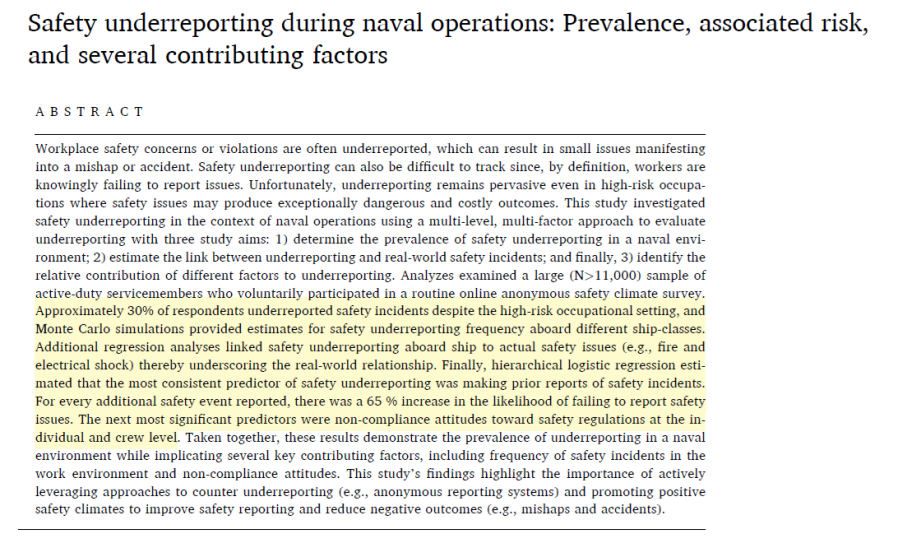
What is the extent of safety incident underreporting in US naval ops? This analysed >11k samples from active-duty servicemembers. Extracts: · Prior data suggests that underreporting is prevalent, where “as many as 60 % to 80 % of injuries go unreported” · This study found “nearly 30 % of active duty servicemembers failed to report a safety… Continue reading Safety underreporting during naval operations: Prevalence, associated risk, and several contributing factors

Injury measures “not much help in assessing the risks of a catastrophic event” and the follies of rear-view mirror driving via injury measures
On the folly of relying on injury measures to prioritise proactive goals. First image is an apt extract from the Pike River commission – noting that: “personal injury rates and time lost through accidents … gave the board some insight but was not much help in assessing the risks of a catastrophic event”. Moreover, the… Continue reading Injury measures “not much help in assessing the risks of a catastrophic event” and the follies of rear-view mirror driving via injury measures
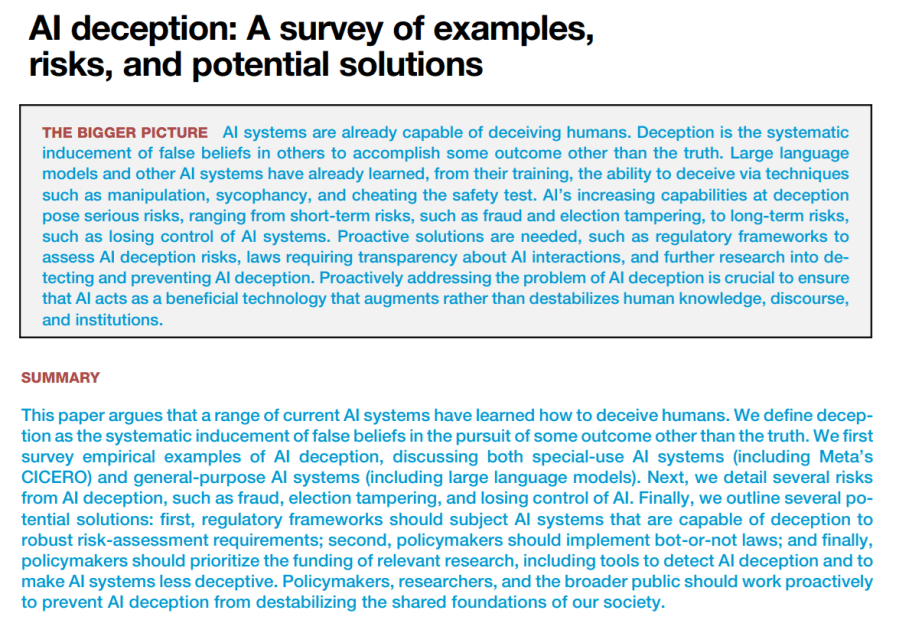
AI deception: A survey of examples, risks, and potential solutions
This study explored how “a range of current AI systems have learned how to deceive humans”. Extracts: · “One part of the problem is inaccurate AI systems, such as chatbots whose confabulations are often assumed to be truthful by unsuspecting users” · “It is difficult to talk about deception in AI systems without psychologizing them. In humans,… Continue reading AI deception: A survey of examples, risks, and potential solutions

Agentic Misalignment: How LLMs could be insider threats (Anthropic research)
AI and malicious compliance. This research from Anthropic has done the rounds, but quite interesting. In controlled experiments (not real-world applications), they found that AI models could resort to “malicious insider behaviors when that was the only way to avoid replacement or achieve their goals—including blackmailing officials and leaking sensitive information to competitors”. Some extracts:… Continue reading Agentic Misalignment: How LLMs could be insider threats (Anthropic research)

Association of non-standard working time arrangements with safety incidents: a systematic review
What’s the link between shift work and safety incidents? This systematic review of 24 studies explored the links. Extracts: · It’s estimated that 10-30% of the workforce in industrialised societies engage in non-standard work / shift work · Overall, they found “an increased risk of safety incidents during or after night shifts” · “Accumulated exposure to evening or… Continue reading Association of non-standard working time arrangements with safety incidents: a systematic review
SafeWork NSW prosecution: moral culpability, PCBU duties and control over works, and SWMS
This prosecution resulted from multiple workers falling to the ground with an ice compressor, as the roof space flooring gave way. It discussed moral culpability and duties between a client and their influence or control over works and contractors versus the contractors. Read the case for details on the incident. Extracts: · “Safe Work Method Statement… Continue reading SafeWork NSW prosecution: moral culpability, PCBU duties and control over works, and SWMS
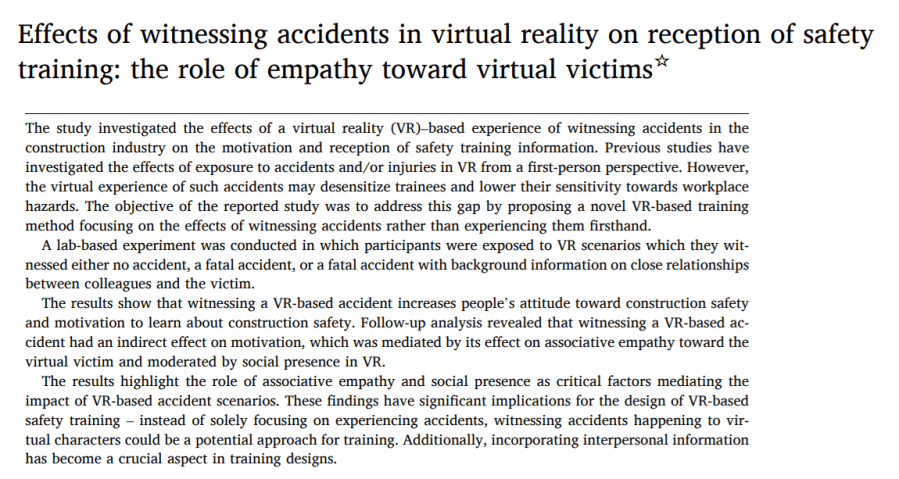
Effects of witnessing accidents in virtual reality on reception of safety training: the role of empathy toward virtual victims
Can simply witnessing a virtual accident, not experiencing it, improve the saliency of training? This interesting study used VR construction training scenarios, including no accident, witnessing an accident with distant coworker, and witnessing a close coworker. Extracts: · “witnessing an accident in VR significantly enhances one’s at[1]titudes toward safety when the victim is a distant coworker… Continue reading Effects of witnessing accidents in virtual reality on reception of safety training: the role of empathy toward virtual victims
Safe As E64: How can we move forward from notions of ‘human error’?
This paper explores how complex systems not only fail, but succeed, and provides 9 ways that we can move beyond simplistic notions of system failure due to ‘human error’. Ref: Woods, D. D., & Cook, R. I. (2002). Nine steps to move forward from error. Cognition, technology & work, 4(2), 137-144. Spotify: https://open.spotify.com/episode/4JaTtoAhb6s7xphKNt9ll9?si=yf9Xac6KSciKBmSZkwI_2Q Shout me a coffee… Continue reading Safe As E64: How can we move forward from notions of ‘human error’?
Blaming people not a robust method for learning and improvement in construction
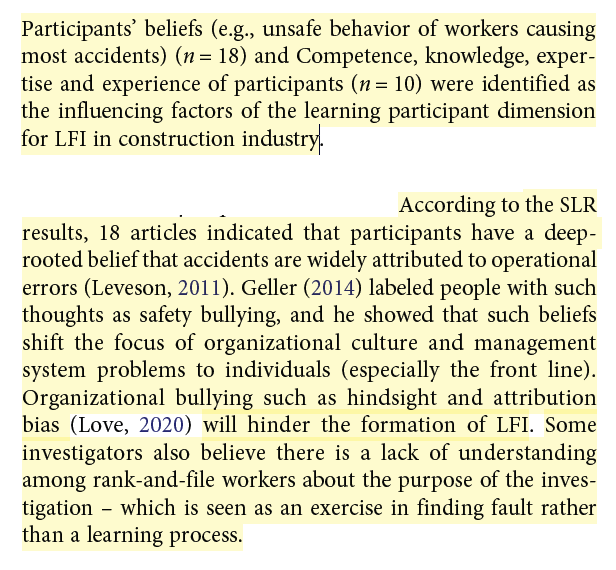
Uh oh, spaghettio! This study found that believing people are the primary cause of accidents is a barrier to effective learning. I guess blaming people isn’t a solid approach for learning and improvement… They also point out the cycle of shallow investigations focusing on immediate ’causes’ and error, “rather than the context where the incidents… Continue reading Blaming people not a robust method for learning and improvement in construction
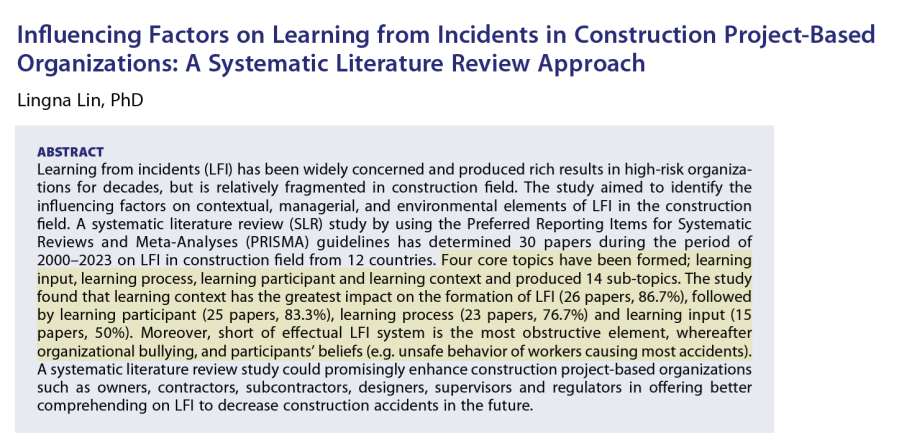
Influencing Factors on Learning from Incidents in Construction Project-Based Organizations: A Systematic Literature Review Approach
What factors facilitate or obstruct learning from incidents in construction? This systematic literature review evaluated 30 papers from 12 countries. * Parts 2 & 3 in comments * Extracts: · Overall, they identified four core learning topics: 1) learning input, 2) learning process, 3) learning participant, 4) learning context – see image 2 for context · “learning… Continue reading Influencing Factors on Learning from Incidents in Construction Project-Based Organizations: A Systematic Literature Review Approach

