This article about authentic leadership may be of interest – in part arguing it may perpetuate a “childish, romantic, and ultimately toxic idea”. They argue: · Authentic leadership is said to be a popular but is rather conceptually vague · It’s said to stem from “self-awareness, internalized moral perspective, balanced processing of information, and relational transparency — in short, being “true… Continue reading There is nothing authentic about authentic leadership: Forbes article

Who Cares If It’s Recordable? How Misapplied Practices in OSHA Injury & Illness Recordkeeping Infringe on the Ethics of Care
Extracts from Leslie Rex Stockel, PhD, CSP, SMP, FASSP’s article on misplaced safety practices and ethics of care: · “Approximately half a million dollars of annual salaries were sitting in the room spending at least an hour trying to decide … whether the case should be counted as an OSHA recordable case” · “This decision would impact… Continue reading Who Cares If It’s Recordable? How Misapplied Practices in OSHA Injury & Illness Recordkeeping Infringe on the Ethics of Care
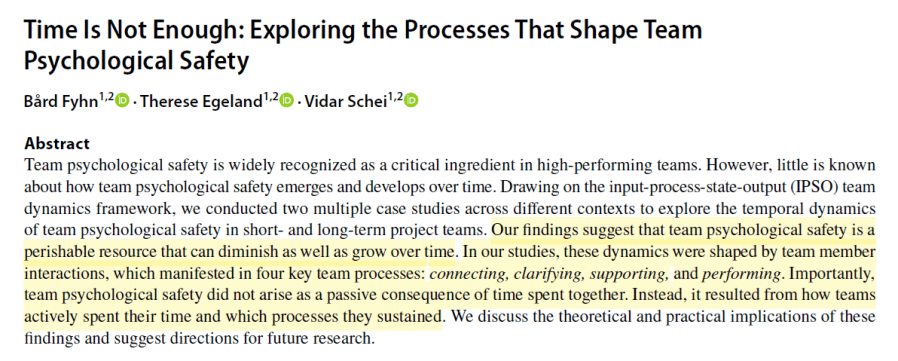
Time Is Not Enough: Exploring the Processes That Shape Team Psychological Safety
This study explored the factors that shaped psychological safety: · “Team psychological safety is a perishable resource that can diminish as well as grow over time” · “Team psychological safety did not arise as a passive consequence of time spent together. Instead, it resulted from how teams actively spent their time and which processes they sustained” · “Time… Continue reading Time Is Not Enough: Exploring the Processes That Shape Team Psychological Safety
Safe As E55: Butt-covering paperwork & false safety
What if the paperwork that management come to rely on, rather than providing assurance of safe work methods, is more a ritual, disconnected from real work, or how people create safety in the field? What if, in some cases, this paperwork creates a false sense of safety and indeed, masquerades as a false butt covering… Continue reading Safe As E55: Butt-covering paperwork & false safety
Can stronger system design = weaker human insights? Gary Klein – Seeing What Others Don’t
Can better design limit our insights? More extracts from Gary Klein’s ‘Seeing What Others don’t’. This covers some unintended consequences of ‘good’ principles of computer system/info system design (image 1): · “The system should help people do their jobs better” · “It should clearly display critical cues—the items of information that users rely on to do their… Continue reading Can stronger system design = weaker human insights? Gary Klein – Seeing What Others Don’t
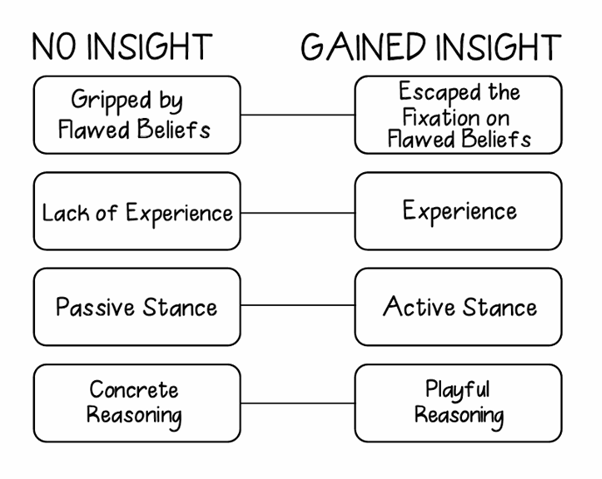
When insights do or don’t emerge – extracts from Gary Klein
Extracts from Gary Klein’s ‘Seeing What Others Don’t’, about how insights and intuitions emerge, or don’t. Based on cases examined by Klein: · Insights failed to emerge when some “fixated on some erroneous ideas that blinded them to the discovery” · “The strategy for the successful twins seemed to be to speculate and test, whereas the failure… Continue reading When insights do or don’t emerge – extracts from Gary Klein
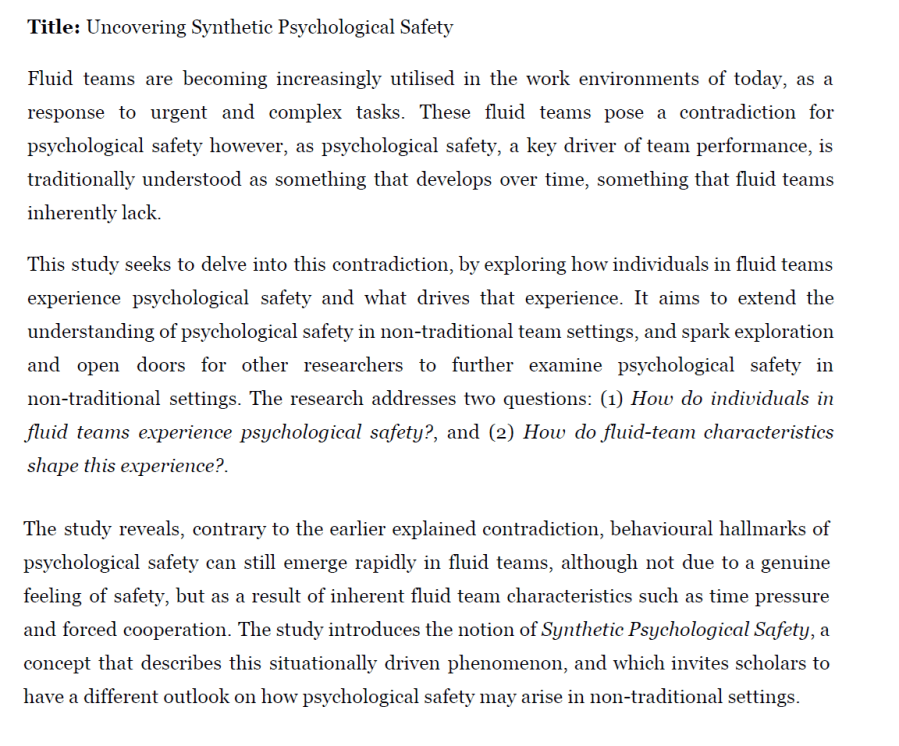
Uncovering Synthetic Psychological Safety
An interesting Master’s thesis, which explored a novel concept: ‘synthetic psychological safety’. This is a “a state in which the outcomes of psychological safety … are present, but arise from the characteristics that constitute a fluid team rather than interpersonal depth … ‘assembled rather than grown”. Extracts: · “These [synthetic PS] behaviours do not stem from… Continue reading Uncovering Synthetic Psychological Safety
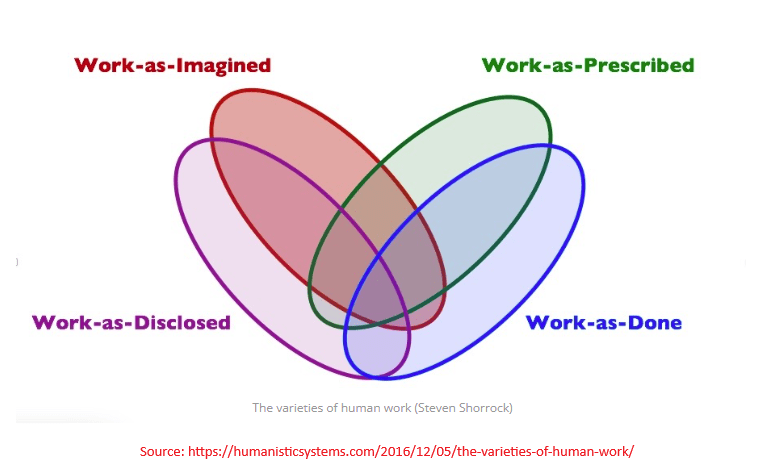
Safe As E54: Work-as-imagined, prescribed, disclosed, and done
How do the models of how we think about work reveal and conceal features of the work? Today we explore varieties of human work: work-as-imagined, work-as-prescribed, work-as-disclosed, and work-as-done. Source: Shorrock, S. (2016, December 5). The varieties of human work. Humanistic Systems. https://humanisticsystems.com/2016/12/05/the-varieties-of-human-work/ Spotify: https://open.spotify.com/episode/6lbaKStF0rf1GHbGgh6oKI?si=sq2y93gHRQ2Mqee2hIchqA Shout me a coffee (one-off or monthly recurring)
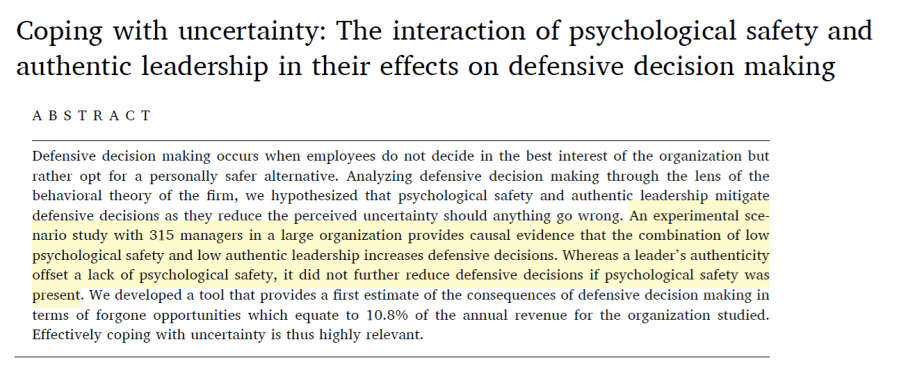
Coping with uncertainty: The interaction of psychological safety and authentic leadership in their effects on defensive decision making
Coping with uncertainty: The interaction of psychological safety and authentic leadership in their effects on defensive decision making This studied the relationship between defensive decision making and psychological safety and authentic leadership. 315 managers were involved in an experimental scenario. Extracts: · Defensive decision making occurs “when employees do not decide in the best interest of… Continue reading Coping with uncertainty: The interaction of psychological safety and authentic leadership in their effects on defensive decision making

Analysing coronial inquests into mining fatalities: A systems thinking approach
This applied a systems thinking incident approach to Queensland mining fatality coronial inquiries. Extracts: · “As predicted, the majority of contributory factors were identified at the level of frontline staff and other operational personnel” · “However, the Accimap analysis identified that these risks were influenced by systemic issues originating from higher levels, particularly the absence of clear… Continue reading Analysing coronial inquests into mining fatalities: A systems thinking approach

