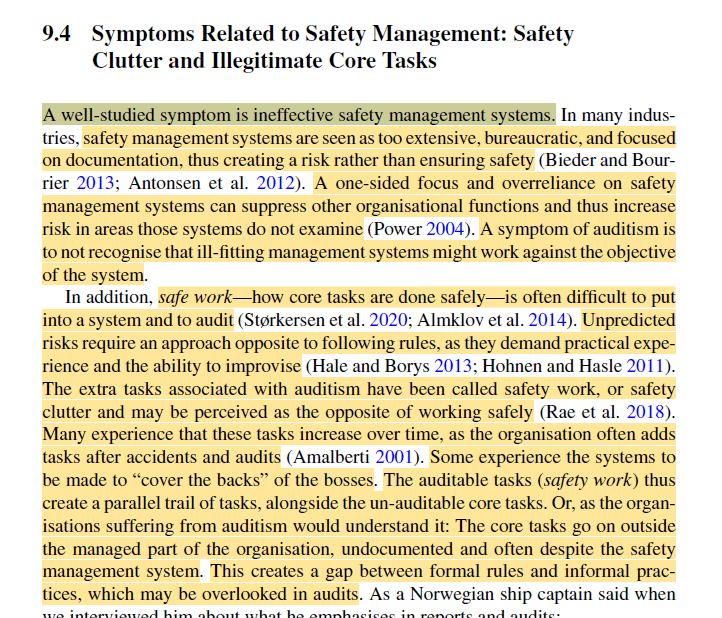
Safety Management Systems and the problem of clutter and illegitimate core tasks (“bullshit tasks”). I’ve posted this paper before (see links), but here’s another extract. I don’t have much to say, as it doesn’t need explaining. The paper is worth a read, though. Author: Størkersen, K. V. (2024). Auditism: Symptoms, Safety Consequences, Causes, and Cure.… Continue reading Safety Management Systems, safety clutter and illegitimate tasks (“BS work”)

Leadership, followers’ mental health and job performance in organizations: A comprehensive meta-analysis from an occupational health perspective
This meta-analysis studied the links between leadership and mental health and job performance indices of followers. [NB. Look out for next week’s compendium on leadership research] No real surprises with the findings. They note that leadership, of course, “is not a neutral element”, and may influence both positive and negative effects. Extracts: · “results reveal that… Continue reading Leadership, followers’ mental health and job performance in organizations: A comprehensive meta-analysis from an occupational health perspective

Confirmation bias and priming in investigations: ‘Human & Organizational Potential’
Here’s one of (prob) several upcoming posts about Ivan Pupulidy, PhD and Crista Vesel, MSc’s book ‘Human and Organizational Potential’. This part looks at confirmation bias within investigations and uses the US Forest Service’s then current Investigation Guide: · “Confirmation bias is a tendency to search for information that confirms one’s preconceptions. When discussing confirmation bias… Continue reading Confirmation bias and priming in investigations: ‘Human & Organizational Potential’
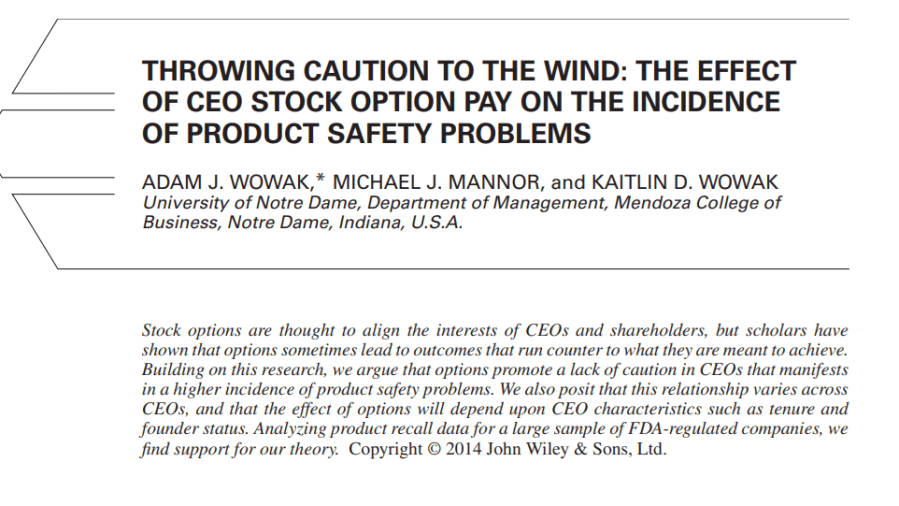
Throwing caution to the wind: the effect of CEO stock option pay on the incidence of product safety problems
Do CEO stock options negatively affect product safety? Possibly, according to this study. They compared CEO stock options and product safety recalls on FDA regulated companies between 2004 – 11. PS. Keep an eye out for next week’s compendium on leadership research 👍 Background: · “A central premise of agency theory is that organizations can align… Continue reading Throwing caution to the wind: the effect of CEO stock option pay on the incidence of product safety problems
New site name: SafetyInsights.org
Woot, time to celebrate: I finally created a proper domain name: SafetyInsights.org Unfortunately, this doesn’t make any key quality of life upgrades to the site. But, whatever. However, as a thanks to everybody for the support – have a balloon:
Magistrate critical of wordy, ineffective paper systems for helping workers
Really interesting appeal discussing the limits of documented safety processes, like SWMSs. Thanks to Robert Allan for sharing this (link to his post below) Extracts: Ref: Nicholson v GCMR Project Services Pty Ltd [2024] QDC 58 Shout me a coffee Report link: https://archive.sclqld.org.au/qjudgment/2024/QDC24-058.pdf Rob’s post: https://www.linkedin.com/posts/robertallan3_safety-whs-safetydna-activity-7324976142170411008-sN-u?utm_source=share&utm_medium=member_desktop&rcm=ACoAAAeWwekBvsvDLB8o-zfeeLOQ66VbGXbOpJU LinkedIn post: https://www.linkedin.com/posts/benhutchinson2_really-interesting-legal-appeal-discussing-activity-7326421978083401728–zi8?utm_source=share&utm_medium=member_desktop&rcm=ACoAAAeWwekBvsvDLB8o-zfeeLOQ66VbGXbOpJU

Nothing to fear: strong corporate culture and workplace safety
Are ‘strong’ corporate cultures a blessing or curse for workplace safety? This study explored the question. Interestingly, they used machine learning to extract ‘cultural’ cues from CEO earnings calls. Cultural cues were scored based on the frequency of words relating to innovation, integrity, quality, respect and teamwork. They then compare company performance to the number… Continue reading Nothing to fear: strong corporate culture and workplace safety

LLMs Are Not Reliable Human Proxies to Study Affordances in Data Visualizations
This was pretty interesting – it compared GPT-4o to people in extracting takeaways from visualised data. They were also interested in how well the LLM could simulate human respondents/responses. Note that the researchers are primarily interested in whether the GPT-4o model acts as a suitable proxy for human responses – they recognise there are other… Continue reading LLMs Are Not Reliable Human Proxies to Study Affordances in Data Visualizations

Leading safely: The impact of generalist CEOs on workplace safety
Does the skillset of the CEO influence workplace safety? Yes according to this study. In the lead-up to next week’s leadership research compendium, this study evaluated whether generalist or specialist CEOs have a greater impact on OSHA reported safety incidents (note the limitation). Generalists are CEOs with wider industry experience (worked in more industries) whereas… Continue reading Leading safely: The impact of generalist CEOs on workplace safety
Barrier systems and human performance expectations
I’ve shared this white paper before, but, whatever. Interesting enough to re-share. The CIEHF whitepaper for barriers covers a lot of ground, but here’s some selected extracts: · Controls “means all of the measures expected to be in place to prevent incidents”, and includes barriers and safeguards · Barriers are “controls that are assessed as being sufficiently… Continue reading Barrier systems and human performance expectations

