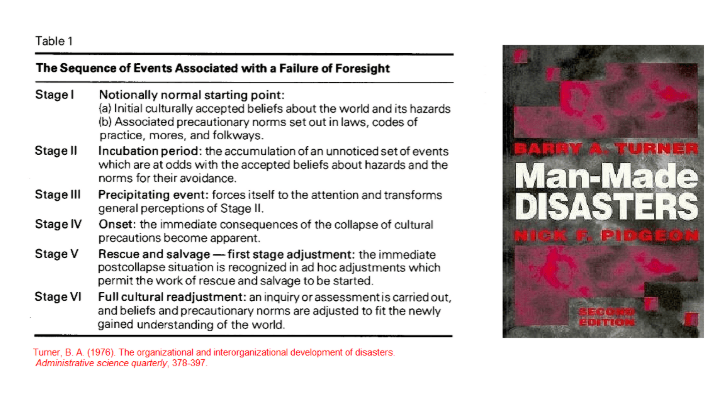
So while I don’t often explicitly refer to the late Barry Turner’s work on LinkedIn or regularly post his articles, he’s been the most influential researcher on my own work and is tacitly embedded in my language and thinking. If you’ve heard of Man-Made Disasters, disaster incubation, perceptual horizon, decoy phenomena, failures of foresight (and… Continue reading Foresights before disaster: An ode to Barry Turner

What Control Measures Should I Use? Applying the Total Worker Health Hierarchy of Controls to Manage Workplace Fatigue
This new paper from Drew Dawson and others reconceptualised fatigue risk management within Total Worker Health (TWH) Hierarchy of Controls (HOC). THW HOC works as an extension to the traditional HOC, and “presents strategies in order of effectiveness, ranging from “eliminate,” “substitute,” “redesign,” “educate,” and “encourage” categories” They say that while is mostly associated with… Continue reading What Control Measures Should I Use? Applying the Total Worker Health Hierarchy of Controls to Manage Workplace Fatigue
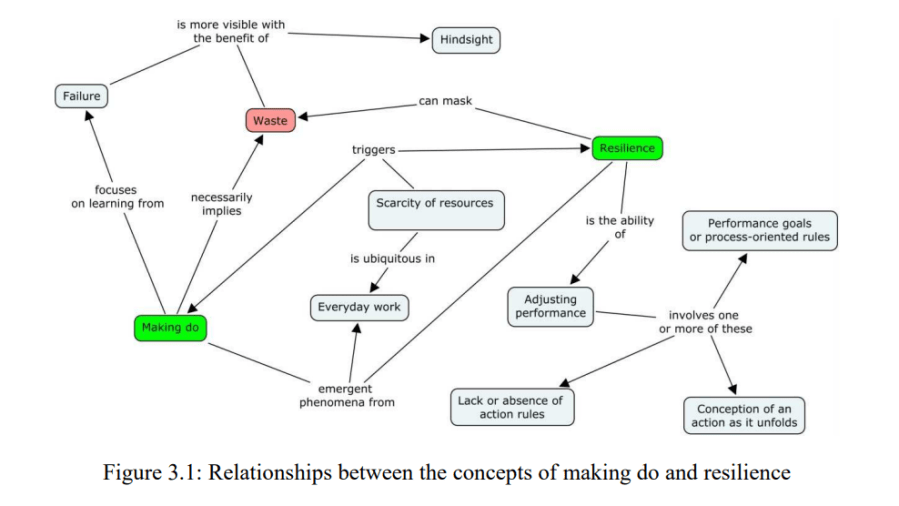
The difference between ‘making do’ and resilience in complex systems
This paper explores the difference between ‘making do’ and resilience. Not a summary, but a few extracts: · Making do has been defined, from a waste perspective as “a situation where a task is started without all its standard inputs, or the execution of a task is continued although the availability of at least one standard… Continue reading The difference between ‘making do’ and resilience in complex systems
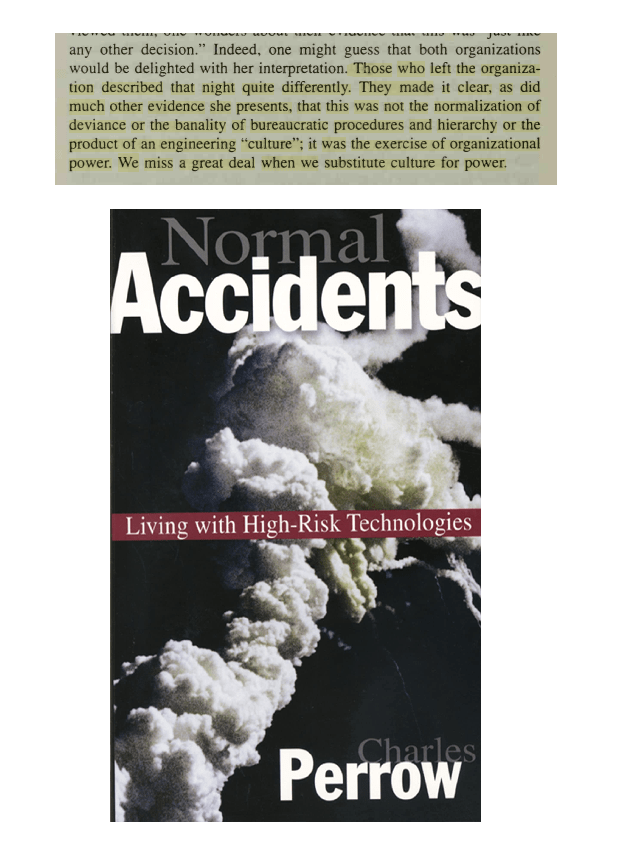
“We miss a great deal when we substitute culture for power” – Charles Perrow on the role of power in disaster
“We miss a great deal when we substitute culture for power” I love this quote from Perrow in Normal Accidents (emphasis added). Perrow briefly discusses the role of power in organising risky technology. Discussing Vaughan’s interpretation of the Challenger disaster: · “I also find the role of power and interests minimized in Diane Vaughn’s otherwise excellent… Continue reading “We miss a great deal when we substitute culture for power” – Charles Perrow on the role of power in disaster

Safety Management Systems may struggle with psychosocial factors and other complex phenomena
Certified safety management systems (OHSM) may struggle with complex, multi-factorial matters, like psychosocial safety. Extracts: · The OHSM “does not necessarily tackle the most urgent work environment issues and may exclude important aspects of the work environment such as psychosocial factors” · “some [OHSM] approaches may be ill-equipped to tackle complex sociotechnical issues and psychosocial matters, and… Continue reading Safety Management Systems may struggle with psychosocial factors and other complex phenomena

Why do doctors make poor decisions? Spotlighting ‘noise’ as an under-recognised source of error in clinical practice
A brief read covering the concept of noise, pertaining to judgements. This is based on the work from Kahneman, Sibony and Sunstein. From the article: · While biases in judgements have captured a lot of attention, “it has been suggested that ‘noise’ (defined as an undesirable variability in human judgements) is a highly important, yet under-recognised… Continue reading Why do doctors make poor decisions? Spotlighting ‘noise’ as an under-recognised source of error in clinical practice

Attributing Cause for Occupational Accidents in Construction: A Descriptive Single Case Study
This thesis from Jennifer Serne explored how construction safety professionals attribute accident causes. 37 participants were included with 20 accident scenarios, 13 individual semi-structured interviews and 8 summative focus groups. For background: · Originally proposed by Heider in 1958, it’s said that people are “psychologically driven to determine the causes of others’ behavior” · And… Continue reading Attributing Cause for Occupational Accidents in Construction: A Descriptive Single Case Study
Compendium: Learning and improvement without incidents
Here’s a mini-compendium of…well, probably a lot of stuff with only a tenuous link to ‘learning’. I tried to focus on learning that doesn’t require incidents, but you’ll find those here, too. There’s >100 articles, mostly full-text. I think I went overboard. Unfortunately, it’s barely sorted. It includes: Check out my YouTube channel: https://youtube.com/@safe_as_pod?si=sZmhFw3gB3ubXjzK Shout… Continue reading Compendium: Learning and improvement without incidents

Analyzing Procedure Performance using Abstraction Hierarchy: Implications of Designing Procedures for High-risk Process Operations
This paper explored the use of procedures and operator performance from the perspective of work domain analysis/abstraction hierarchy. I’ve skipped heaps – the ‘doing’ part of the abstraction hierarchy, but their descriptions of the problem and the discussion had some gold. For context: · Procedural issues have been linked in a number of major accidents… Continue reading Analyzing Procedure Performance using Abstraction Hierarchy: Implications of Designing Procedures for High-risk Process Operations

Karl Weick: Leadership as the Legitimation of Doubt
An interesting article from Karl Weick discussing the merits of ‘leadership as the Legitimation of Doubt’. He argues the strengths of a leader saying ‘I don’t know’. Some extracts: · Providing an example, he argues that a leader saying “I don’t know,” … was a strong act of leadership, not a weak one” · “It was strong… Continue reading Karl Weick: Leadership as the Legitimation of Doubt

