
This explored the effects of physical hazard exposures on worker job satisfaction. Survey from >2k Korean construction workers. Background: · “physical hazards such as noise, vibration, and exposure to hazardous substances also contribute to job stress” and behavioural changes · “Continuous exposure to such risks can result in cumulative mental and physical strain, increasing job-related stress, and… Continue reading The Impact of Physical Hazards on Workers’ Job Satisfaction in the Construction Industry: A Case Study of Korea
Hollnagel on “Human error”: error as cause, process or outcome
Not much to say – some extracts from a 2007 chapter from Erik Hollnagel, unpacking whether we really need “human error”? I knocked the summary up last night and will probably post in the next couple of weeks. Oh man, I need to give up on chapters…what a slog. He argues: · Human error “is not… Continue reading Hollnagel on “Human error”: error as cause, process or outcome

Factors affecting learning from incidents: A cross-industry review
This study systematically reviewed the research to unpack the factors that influence learning from incidents (LFI). Likely nothing new to anybody, but it is a good reference paper for tracking down specific research. Background: · Common reasons for ineffective LFI are “underreporting of incidents (Sanne, 2008), incapacity to identify latent circumstances (Jacobsson et al., 2009), the… Continue reading Factors affecting learning from incidents: A cross-industry review
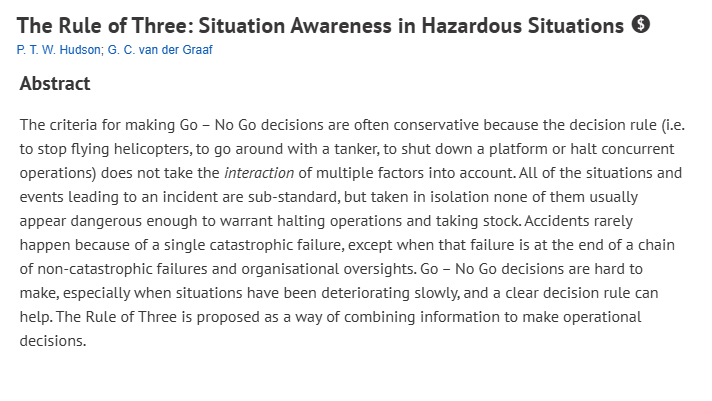
The rule of three: Situation awareness in hazardous situations
“The rule of three provides a mechanism that converts the risk continuum into a dichotomy for the purposes of decision-making. It does not, however, ignore the expertise of operators … Put another way, the rule of three structures expert decision-making; it does not replace it”

Contextualising new safety paradigms: A study in a large Australian construction company
This study explored the presence, implementation, appetite and feasibility of 12 principles representing “new safety paradigms”. It involved focus groups with 53 participants and a cross-sectional survey of 514 employees. I’ve skipped HEAPS (actually, the entire results section – so check out the full paper). Background: · “The review by Karanikas et al. (2022) revealed… Continue reading Contextualising new safety paradigms: A study in a large Australian construction company

How do boards of directors influence workplace safety?
What impacts do boards of directors have on workplace safety? Found this an interesting extract from a paper I summarised over the weekend (will probably post next week). It systematically explored the links between boards of directors and their influence on safety. Of the 49 included studies, they found: · “Empirical studies gave no insight into… Continue reading How do boards of directors influence workplace safety?
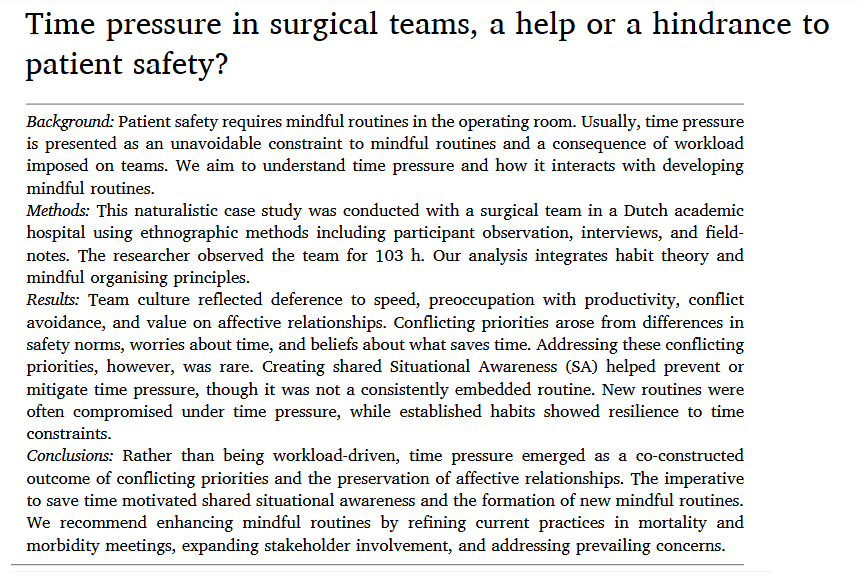
Time pressure in surgical teams, a help or a hindrance to patient safety?
I found this an interesting and brief read about the mindful routines of operating room staff, using a naturalistic decision making approach. Extracts: Ref: van Harten, A., Niessen, T. J., Koksma, J. J., Gooszen, H. G., & Abma, T. A. (2025). Heliyon. Shout me a coffee Study link: https://doi.org/10.1016/j.heliyon.2025.e41967 Shout me a coffee: https://buymeacoffee.com/benhutchinson LinkedIn post:… Continue reading Time pressure in surgical teams, a help or a hindrance to patient safety?

Formalised safety systems miss “three-quarters” of established factors linked to performance
Not much to say here – just found this an interesting extract from the ‘Digging Deeper’ focused on safety within NSW mining. They observe relating to the adoption of formalised safety management systems: · “Smaller organisations that take on such systems are often overwhelmed by their complexity” · And these systems “can be expensive to establish and… Continue reading Formalised safety systems miss “three-quarters” of established factors linked to performance
Learning from normal work: How to Proactively Reduce Risk When Nothing Goes Wrong
An interesting article from Marcin Nazaruk, exploring learning from everyday work. Skipping a bit, so check out the full article. First he says that while it’s important to learn from failure “it is too late”. For one, diminishing incident rates “can no longer accurately reflect safety performance … and simply focusing on behaviours and unsafe… Continue reading Learning from normal work: How to Proactively Reduce Risk When Nothing Goes Wrong

“Those found responsible have been sacked”: some observations on the usefulness of error
Another interesting paper co-authored by the late Richard Cook. This paper discusses the usefulness of error. It’s a larger post with a lot of quotes – I just can’t do a better or more succinct job of restating what they’ve already written. Providing background, they argue that while some see “error” as a dead-end, others… Continue reading “Those found responsible have been sacked”: some observations on the usefulness of error

