
Safety is simple, bruz … (apparently) (Both examples show the same event, but each uses a different lens. Images are slides taken from one of my presentations to highlight how investigations can be as much ‘constructions’, as searches for ‘objective’ facts, entirely separate to the perceiver or who gets to draw the line in the… Continue reading Safety is simple…apparently: two visual representations of the same incident

Safety audits almost never target the actual sources of operational danger
Reflecting on my first audit study – we found things many would expect (image 1), like audits largely focusing on administrative items, and superficial matters. And for my construction friends, we found ‘toolboxes’ used a lot to address an issue, even if that issue didn’t have any reasonable connection to something that you’d need to… Continue reading Safety audits almost never target the actual sources of operational danger

Safety culture and power dynamics in organizations
Not much to say here. This article briefly touched upon the interactions of power dynamics and safety culture. Some really cool stuff has been written about power in safety (check out my site). This only really briefly touches on a few points: · Starting with safety culture (SC), they say it has “even been abandoned by… Continue reading Safety culture and power dynamics in organizations

Leveraging Ergonomics and Human Factors (E/ HF) for community impact: what have we learned about how to make a difference
This was a banger – exploring the application of community ergonomics with a strong systems lens. If you’re interested in HF/E, systems thinking, social dynamics, power gradients and more then this will interest you. Can’t do it justice, so a few random extracts. Extracts: Finally they talk about ways to improve this practice – via… Continue reading Leveraging Ergonomics and Human Factors (E/ HF) for community impact: what have we learned about how to make a difference
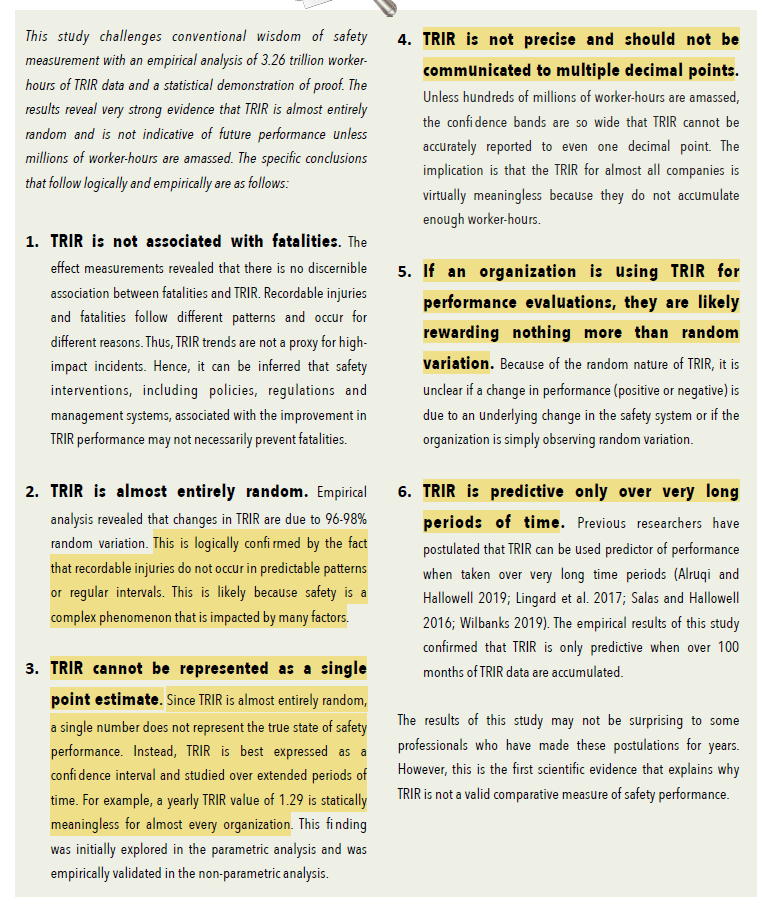
How to make injury metrics suck less?
How can we make injury metrics suck less? So this came out of a conversation with somebody (thanks Jordan Vince). I’m **not** a promoter of injury measures. I think we spend FAR too much time quibbling over what are, statistically speaking, quite rare events, when we have the entire spectrum of daily work to learn… Continue reading How to make injury metrics suck less?

Does probability exist?
Really cool article talking about probability – does it exist? Is it an objective property of the world, or a subjective and constructed phenomenon? And more. Thanks to Ben Cattaneo for putting this on my radar. Can’t do this justice and I’ve skipped HEAPS, so check out the full paper. Thanks to **** for highlighting… Continue reading Does probability exist?
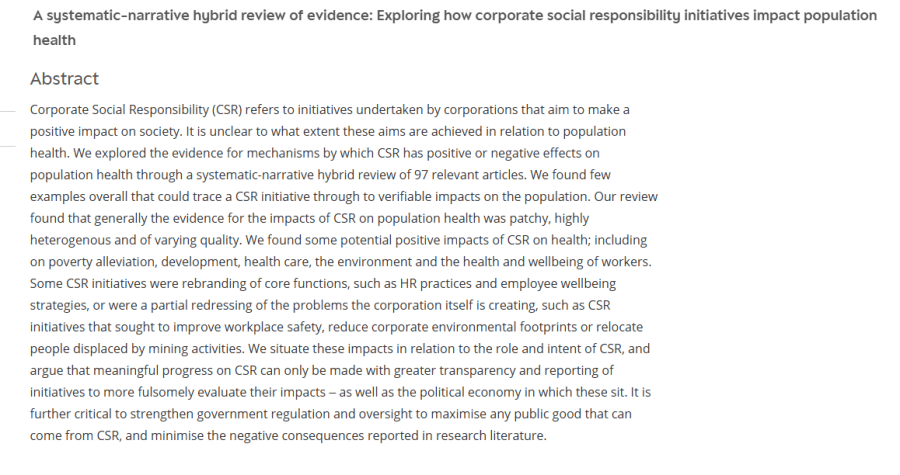
Exploring how corporate social responsibility initiatives impact population health
Do Corporate Social Responsibility (CSR) initiatives impact population health? This systematic review evaluated 97 studies to unpack the question. Tl;dr: Yes, CSR might positively impact some elements of health, poverty alleviation and the environment, but also lead to some negative impacts. Evidence, overall, isn’t strong. Extracts: · They “found evidence for positive impacts of CSR activities… Continue reading Exploring how corporate social responsibility initiatives impact population health

Production Pressure, Cognitive Failures, and Injuries Under an Insecure Job Climate
This study explored the links between production pressure, cognitive failures and injuries within an insecure job climate (JIC) environment. Data came from 1-month lagged survey data from 176 US workers. Extracts: · “Production pressure refers to an organizational emphasis on production to increase corporate profits and efficiency” · While intending to “eliminate wasteful contingencies of material, people,… Continue reading Production Pressure, Cognitive Failures, and Injuries Under an Insecure Job Climate

Major accidents and their geographical and temporal patterns around the world – 1900-2024
I knocked this up over the weekend and thought it would interest people – studied the patterns of natural and human-induced disasters from 1900 to 2024. I’m focusing more on the human-induced/human-made disasters. Some findings: · Asia reported the highest number of air disasters, then Europe, NA and the fewest in Oceania · NA recorded the most… Continue reading Major accidents and their geographical and temporal patterns around the world – 1900-2024
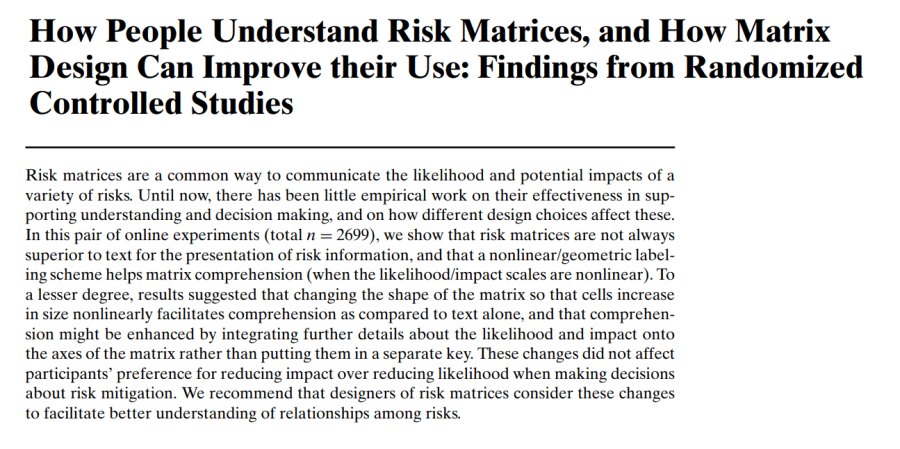
How People Understand Risk Matrices, and How Matrix Design Can Improve their Use: Findings from Randomized Controlled Studies
This study explored different risk matrix designs on user comprehension and use of matrices. I’ve posted a lot of research dunking on risk matrices (RMs), so here’s another olive leaf focusing on designing something potentially more useful. [** I still stand by the critical orientation, since we have little good evidence that RMs improve risk… Continue reading How People Understand Risk Matrices, and How Matrix Design Can Improve their Use: Findings from Randomized Controlled Studies

