
This open access article may interest people – it explored the future of human factors/ergonomics in Industry 5.0 (I05). Not a summary but you can read the full paper freely. Some extracts: Shout me a coffee Study link: https://doi.org/10.3390/app15042123 LinkedIn post: https://www.linkedin.com/posts/benhutchinson2_this-open-access-article-may-interest-people-activity-7300617102564933632-WGPj?utm_source=share&utm_medium=member_desktop&rcm=ACoAAAeWwekBvsvDLB8o-zfeeLOQ66VbGXbOpJU
Tag: ai

Human factor analysis of cockpit work incidents in high-speed workboats: the mystery hidden between the lines
This study unpacked what investigators look at and how they construct causes in high-speed workboats. It employed a Safety-II / HOP / HF perspective. Tl;dr: human factors are poorly evaluated and largely seen as individual-level factors. Some extracts: · “Although the analysis focused on negative observations, it also identified HFs that supported the activity” · “Many pivotal… Continue reading Human factor analysis of cockpit work incidents in high-speed workboats: the mystery hidden between the lines
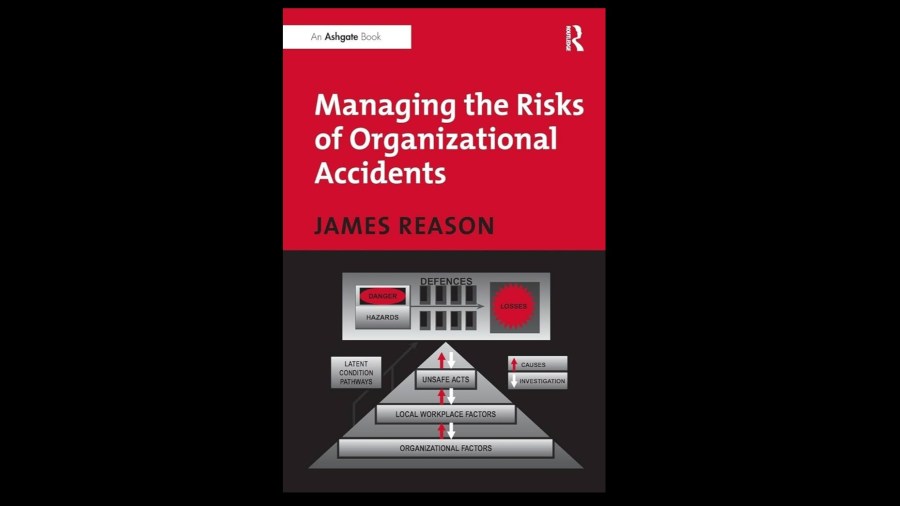
The mixed blessing of risk defences and redundancy: James Reason
A few random extracts from James Reason’s timelessly awesome Managing the Risks of Organizational accidents. (Note: This isn’t an endorsement of the somewhat linearity of defences-in-depth, since we have evidence that emergent behaviour can playout in reality and with equifinality etc) There’s hundreds of things I could extract (and maybe will in time), but here’s… Continue reading The mixed blessing of risk defences and redundancy: James Reason

“I think, therefore I err”: An article about ‘good errors’, heuristics and intelligent systems
“Every intelligent system makes errors”, so said Gerd Gigerenzer. Here’s a couple of page extracts from a 2005 paper. Not sure if I’ll summarise it or not (it’s really interesting, but tough to capture in a summary…) The paper: · Challenges the rationalistic and normative ideal as cognition as purely a logical and rational one, ignoring… Continue reading “I think, therefore I err”: An article about ‘good errors’, heuristics and intelligent systems

Automation’s lacklustre effects on fatal accidents & cheap migrant labour hampering adoption of engineering controls
REALLY interesting findings from Associate Professor Masahiro Yoshida. It suggests that automation over a historical context didn’t really drive down workplace injuries since it tended to be employed in already mature industries. And, ready access to cheap migrant workforces may hinder broader industrial risk reduction due to a negative correlation with automation investment. And the… Continue reading Automation’s lacklustre effects on fatal accidents & cheap migrant labour hampering adoption of engineering controls
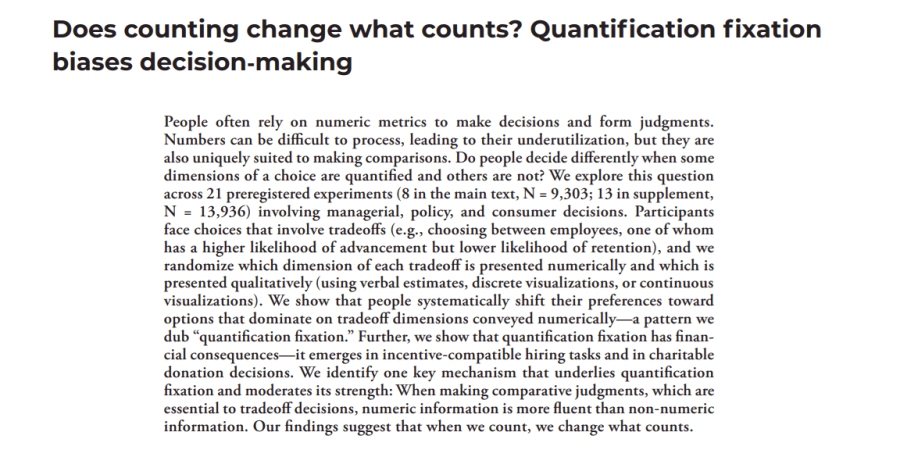
Does counting change what counts? Quantification fixation biases decision-making
Saw this posted on LinkedIn (forget who shared it) and found it really interesting. This study, across 21 experiments and 23k participants in managerial, policy and consumer contexts, studied how numbers and quantification distorts decision-making Context: · Quantification is spreading and has reached into almost every personal and professional area · New-borns are given Apgar… Continue reading Does counting change what counts? Quantification fixation biases decision-making

Constructions of “Human Error” (Mini-Compendium)
Here’s a bunch of linked articles (and a video) unpacking the constructs, or uses, of “human error”. (‘Keep calm’ header image source is my own, from a presentation) Welcome any additions. Shout me a coffee Link: https://safety177496371.wordpress.com/2021/08/05/searching-for-the-origins-of-the-myth-80-human-error-impact-on-maritime-safety/ Link: https://safety177496371.wordpress.com/2025/01/31/hollnagel-on-human-error-error-as-cause-process-or-outcome/ Link: https://safety177496371.wordpress.com/2024/09/05/the-emperors-new-clothes-or-whatever-happened-to-human-error/ Link: https://safety177496371.wordpress.com/2024/07/24/human-error-and-violation-of-rules-in-industrial-safety-a-systematic-literature-review/ Link: https://safety177496371.wordpress.com/2024/07/01/design-rules-based-on-analyses-of-human-error/ Link: https://safety177496371.wordpress.com/2024/06/21/understanding-human-error-in-naval-aviation-mishaps/ Link: https://safety177496371.wordpress.com/2024/05/24/state-of-science-evolving-perspectives-on-human-error/ Link: https://safety177496371.wordpress.com/2024/05/14/six-stages-to-the-new-view-of-human-error/ Link: https://safety177496371.wordpress.com/2024/04/16/human-performance-in-barrier-thinking-problems-with-human-error-post-1/ Link: https://safety177496371.wordpress.com/2024/01/18/perspectives-on-human-error-hindsight-biases-and-local-rationality/… Continue reading Constructions of “Human Error” (Mini-Compendium)
Hollnagel on “Human error”: error as cause, process or outcome
Not much to say – some extracts from a 2007 chapter from Erik Hollnagel, unpacking whether we really need “human error”? I knocked the summary up last night and will probably post in the next couple of weeks. Oh man, I need to give up on chapters…what a slog. He argues: · Human error “is not… Continue reading Hollnagel on “Human error”: error as cause, process or outcome

Contextualising new safety paradigms: A study in a large Australian construction company
This study explored the presence, implementation, appetite and feasibility of 12 principles representing “new safety paradigms”. It involved focus groups with 53 participants and a cross-sectional survey of 514 employees. I’ve skipped HEAPS (actually, the entire results section – so check out the full paper). Background: · “The review by Karanikas et al. (2022) revealed… Continue reading Contextualising new safety paradigms: A study in a large Australian construction company
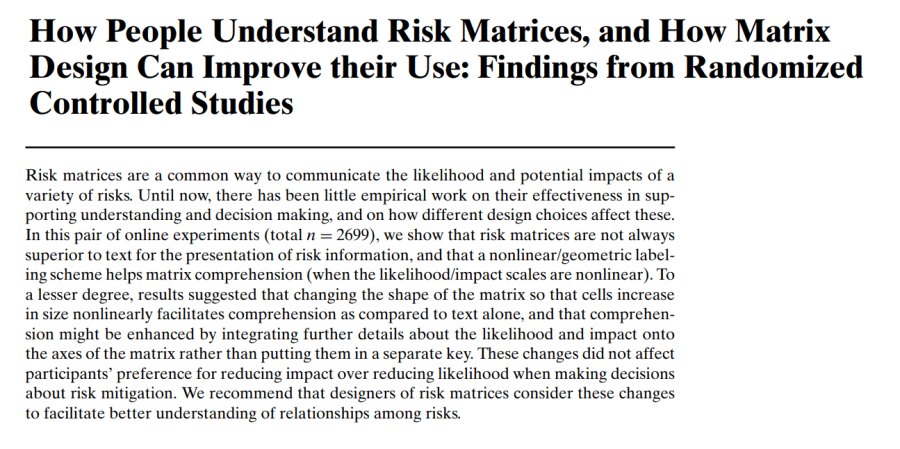
How People Understand Risk Matrices, and How Matrix Design Can Improve their Use: Findings from Randomized Controlled Studies
This study explored different risk matrix designs on user comprehension and use of matrices. I’ve posted a lot of research dunking on risk matrices (RMs), so here’s another olive leaf focusing on designing something potentially more useful. [** I still stand by the critical orientation, since we have little good evidence that RMs improve risk… Continue reading How People Understand Risk Matrices, and How Matrix Design Can Improve their Use: Findings from Randomized Controlled Studies
 SafetyInsights.org