Can chatbots provide more social connection than humans? Possibly, providing that they don’t “claim too much humanity”. Three study protocols with 801, 201 and 401 had participants engage with AI social chatbots. They note that the long-term consequences of social chatbot use is unknown, but is important to study since “hundreds of millions of people… Continue reading Can chatbots provide more social connection than humans?
Tag: artificial-intelligence

The impact of generative AI on critical thinking skills: a systematic review, conceptual framework and future research directions
The impact of generative AI on critical thinking skills: a systematic review, conceptual framework and future research directions How do generative AI (GenAI) models affect critical thinking skills? This systematic review unpacked 68 studies to explore the good and the bad. GenAI are “machine-learning algorithms, usually transformer-based large-language models (LLMs), that generate new text, code… Continue reading The impact of generative AI on critical thinking skills: a systematic review, conceptual framework and future research directions

BEWARE OF BOTSHIT: HOW TO MANAGE THE EPISTEMIC RISKSOF GENERATIVE CHATBOTS
Really interesting discussion paper on the premise of ‘botshit’: the AI version of bullshit. I can’t do this paper justice – it’s 16 pages, so I can only cover a few extracts. Recommend reading the full paper. Tl;dr: generative chatbots predict responses rather than knowing the meaning of their responses, and hence, “produce coherent-sounding but… Continue reading BEWARE OF BOTSHIT: HOW TO MANAGE THE EPISTEMIC RISKSOF GENERATIVE CHATBOTS
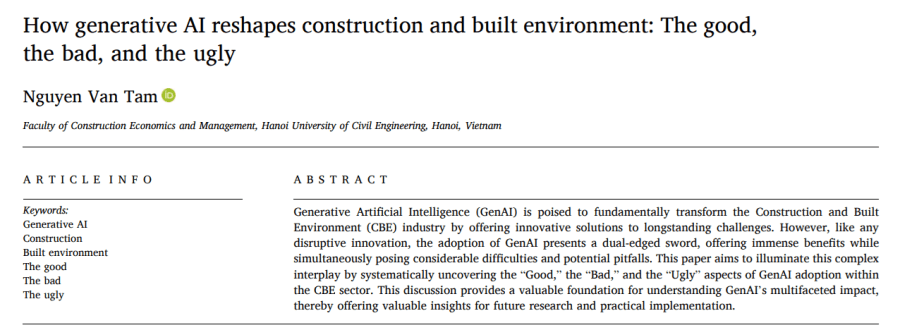
How generative AI reshapes construction and built environment: The good, the bad, and the ugly
This paper discusses some of the good, bad and ugly of GenAI use in construction. GenAI “poised to fundamentally transform the Construction and Built Environment (CBE) industry” but also is a “dual-edged sword, offering immense benefits while simultaneously posing considerable difficulties and potential pitfalls” Not a summary – just a few extracts: The Good: · GenAI… Continue reading How generative AI reshapes construction and built environment: The good, the bad, and the ugly

Large language models powered system safety assessment: applying STPA and FRAM
An AI, STPA and FRAM walk into a bar…ok, that’s all I’ve got. This study used ChatGPT-4o and Gemini to apply STPA and FRAM to analyse: “liquid hydrogen (LH2) aircraft refuelling process, which is not a well- known process, that presents unique challenges in hazard identification”. One of several studies applying LLMs to safety… Continue reading Large language models powered system safety assessment: applying STPA and FRAM

Call Me A Jerk: Persuading AI to Comply with Objectionable Requests
Can LLMs be persuaded to act like d*cks? A really interesting study from Meincke et al. found human persuasion techniques also worked on LLMs. They tested how “classic persuasion principles like authority, commitment, and unity can dramatically increase an AI’s likelihood to comply with requests they are designed to refuse”. I’m drawing from their study… Continue reading Call Me A Jerk: Persuading AI to Comply with Objectionable Requests
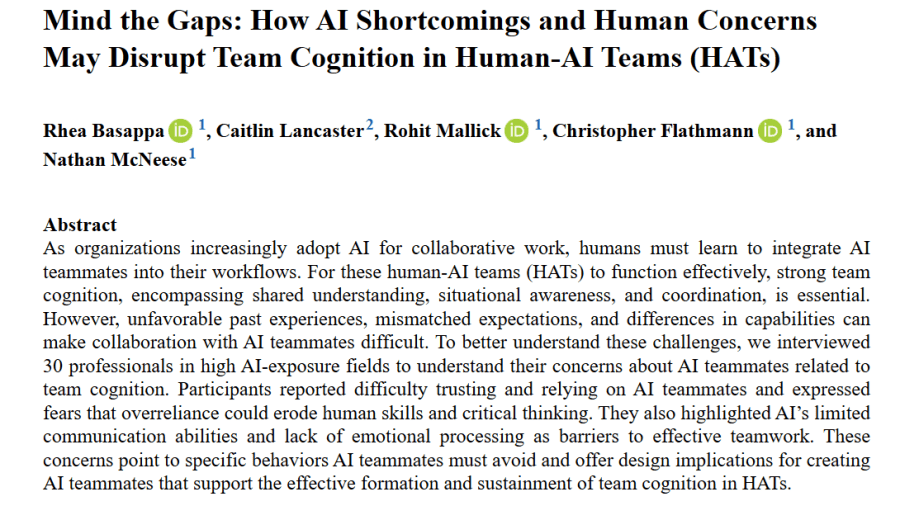
Mind the Gaps: How AI Shortcomings and Human Concerns May Disrupt Team Cognition in Human-AI Teams (HATs)
This study explored the integration and hesitations of AI embedded within human teams (Human-AI Teams, HATs). 30 professionals were interviewed. Not a summary, but some extracts: · “As AI takes on more complex roles in the workplace, it is increasingly expected to act as a teammate rather than just a tool” · HATs “must develop a shared… Continue reading Mind the Gaps: How AI Shortcomings and Human Concerns May Disrupt Team Cognition in Human-AI Teams (HATs)
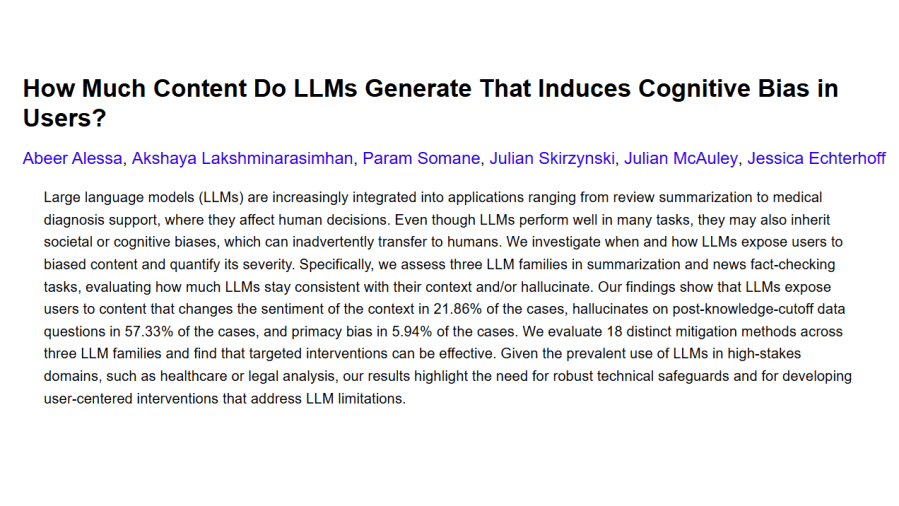
How Much Content Do LLMs Generate That Induces Cognitive Bias in Users?
This study explored when and how Large Language Models (LLMs) expose the human user to biased content, and quantified the extent of biased information. E.g. they fed the LLMs prompts and asked it to summarise, and then compared how the LLMs changed the content, context, hallucinated, or changed the sentiment. Providing context: · LLMs “are… Continue reading How Much Content Do LLMs Generate That Induces Cognitive Bias in Users?

Cut the crap: a critical response to “ChatGPT is bullshit”
Here’s a critical response paper to yesterday’s “ChatGPT is bullshit” article from Hicks et al. Links to both articles below. Some core arguments: · Hick’s characterises LLMs as bullshitters, since LLMs “”cannot themselves be concerned with truth,” and thus “everything they produce is bullshit” · Hicks et al. rejects anthropomorphic terms such as hallucination or confabulation, since… Continue reading Cut the crap: a critical response to “ChatGPT is bullshit”
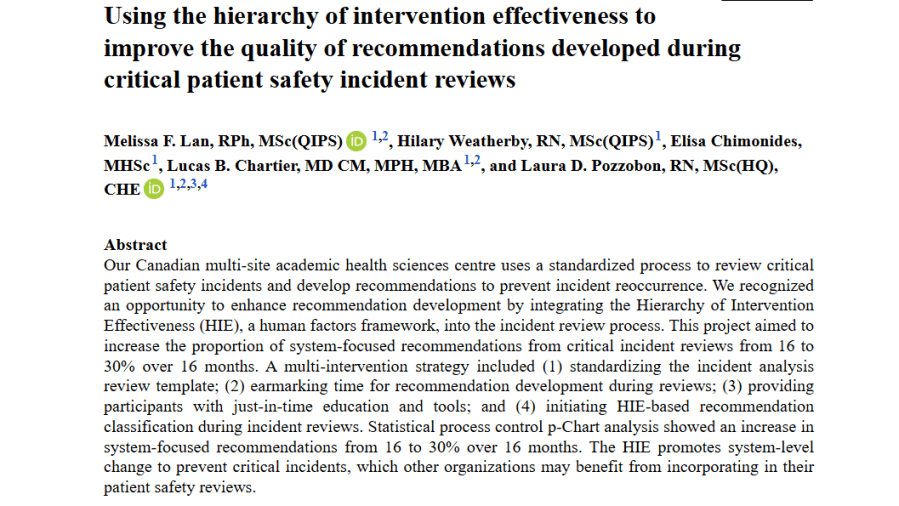
Using the hierarchy of intervention effectiveness to improve the quality of recommendations developed during critical patient safety incident reviews
This study evaluated the Hierarch of Intervention Effective (HIE) for improving patient safety incident recommendations. They were namely interested in increasing the proportion of system-focused recommendations. Data came from over 16 months. Extracts: Ref: Lan, M. F., Weatherby, H., Chimonides, E., Chartier, L. B., & Pozzobon, L. D. (2025, June). Using the hierarchy of intervention… Continue reading Using the hierarchy of intervention effectiveness to improve the quality of recommendations developed during critical patient safety incident reviews
 SafetyInsights.org