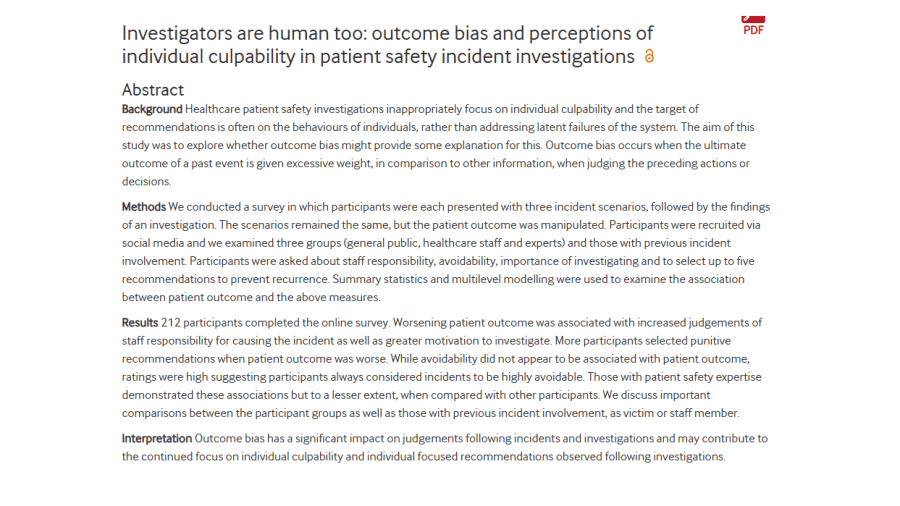
This study explored whether outcome bias might explain why healthcare investigations focus on individual culpability over addressing latent conditions in the system. 212 participants were allocated to one of three scenarios followed by the findings of an investigation (see scenario overviews below). For background: · Prior work has identified that the “overwhelming majority of recommendations… Continue reading Investigators are human too: outcome bias and perceptions of individual culpability in patient safety incident investigations
Tag: bias
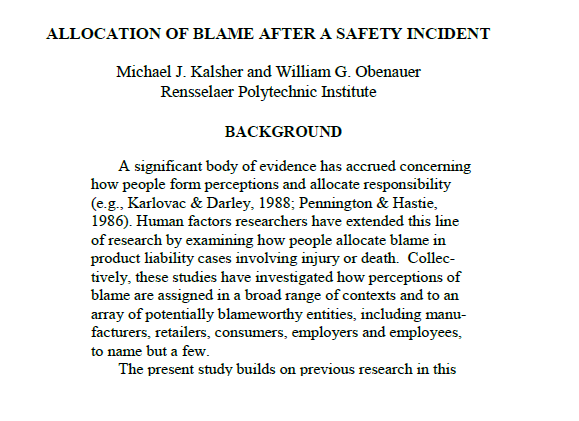
Allocation of Blame After a Safety Incident
This single page conference paper discussed an experiment on how blame is allocated following incidents. The scenario was a “realistic, but fictitious” incident involving a worker (both experienced or not experienced, depending on the scenario), whom is killed when touching an energised bus bar while feeding electrical wire into a pedestal. They systematically manipulated the… Continue reading Allocation of Blame After a Safety Incident
Dual-Process Theories of Higher Cognition: type 1 and type 2 preferred over system 1 and system 2
I think it’s fair to say that Kahneman has been central in the general awareness of cognitive processing concepts, like System 1 / System 2. Dual processing concepts (but also tri-processing), have a long history, but also have their critics. Moreover, system 1 / system 2 isn’t currently the preferred nomenclature. If this topic interests… Continue reading Dual-Process Theories of Higher Cognition: type 1 and type 2 preferred over system 1 and system 2
 SafetyInsights.org