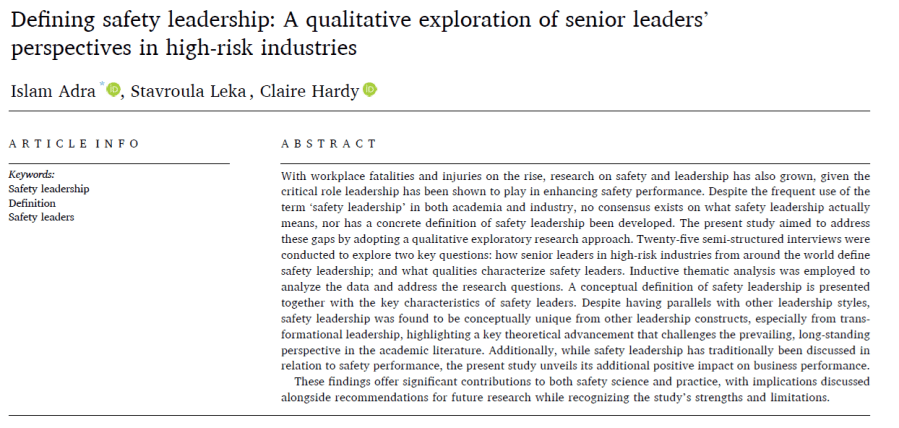
How do senior leaders in high-risk industries define safety leadership? And what qualities characterise them? This interview study of 25 leaders unpack these questions. Note. Those cynics which moan about why safety needs to take concepts like leadership or culture and whack ‘safety’ on the front should read this. Once again, another study highlighting domain-specificity.… Continue reading Defining safety leadership: A qualitative exploration of senior leaders’ perspectives in high-risk industries
Tag: business
There is nothing authentic about authentic leadership: Forbes article
This article about authentic leadership may be of interest – in part arguing it may perpetuate a “childish, romantic, and ultimately toxic idea”. They argue: · Authentic leadership is said to be a popular but is rather conceptually vague · It’s said to stem from “self-awareness, internalized moral perspective, balanced processing of information, and relational transparency — in short, being “true… Continue reading There is nothing authentic about authentic leadership: Forbes article
The Critical Role of Psychological Risk and Safety in Eliciting Worker Well-Being
This explored the links between psychosocial risk and psychological safety on worker well-being. Survey responses from >800 workers in Malaysian were obtained. Usefully, it’s another study that slightly challenges the claim that you ‘can’t have too much psychological safety’. We need far more targeted evidence to make that claim. Extracts: · “our results revealed a significant… Continue reading The Critical Role of Psychological Risk and Safety in Eliciting Worker Well-Being

Deming: “Eliminate numerical quotas for the work force” and exhortations for accountability, since they are “directed at the wrong people”
“What is wrong with posters and exhortations? They are directed at the wrong people”. So Deming wisely argues. For Deming: · Such exhortations are problematic since they to “arise from management’s supposition that the production workers could, by putting their backs into the job, accomplish zero defects, improve quality, improve productivity, and all else that is… Continue reading Deming: “Eliminate numerical quotas for the work force” and exhortations for accountability, since they are “directed at the wrong people”
Safe As week in review: Ineffectiveness of individual mental health interventions / Fatigue risk via defences in depth / AI LLMs are BS’ing you
Safe As covered this week: 31: Do individual mental health interventions work? Maybe not. Do individual level mental health interventions, like personal resilience training, yoga, fruit bowls and training actually improve measures of mental health? This study suggests not. Using survey data from >46k UK workers, it was found that workers who participated in individual-level… Continue reading Safe As week in review: Ineffectiveness of individual mental health interventions / Fatigue risk via defences in depth / AI LLMs are BS’ing you
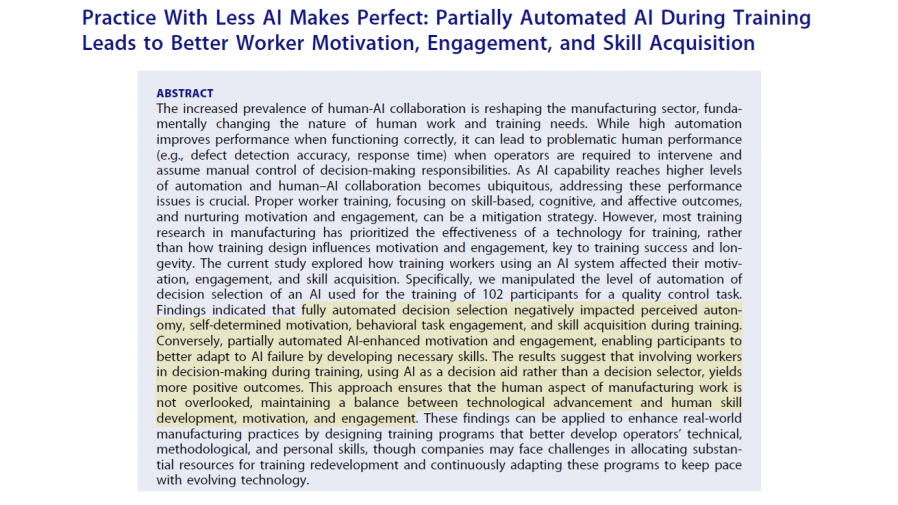
Practice With Less AI Makes Perfect: Partially Automated AI During Training Leads to Better Worker Motivation, Engagement, and Skill Acquisition
How does AI use in training improve, or impact, skill acquisition? This study manipulated training protocols with varying levels of AI decision-making automation, among 102 participants during a quality control task. Extracts: · “Partial automation led to the most positive outcomes” · “Participants who were trained with the fully automated version of the AIEDS had a significantly… Continue reading Practice With Less AI Makes Perfect: Partially Automated AI During Training Leads to Better Worker Motivation, Engagement, and Skill Acquisition

Paradoxical safety leadership: Conceptualization and measurement
Should leaders embrace paradoxes and tensions? This study developed a paradoxical safety leadership (PSL) construct. Extracts: · PSL is a “multidimensional construct that consists of seemingly contradictory yet interrelated leader behaviors to meet competing goals and demands in safety management” · It integrates a “both-and approach to organizational tensions” to effectively manage “salient competing demands arising from… Continue reading Paradoxical safety leadership: Conceptualization and measurement

Safe As 25: Do workers in high-risk industries use and value procedures?
Are your safety procedures effective aids to help navigate safe and reliable work? Do you know? And, do your workers use and value those procedures? Today we’re uncovering the painful realisation of how a compliance culture can erode trust, disengage workers and leave you dangerously exposed when things go wrong. Today’s study is Peres, S.… Continue reading Safe As 25: Do workers in high-risk industries use and value procedures?

The day-to-day stability of safety climate in the offshore oil and gas industry
Is safety climate stable day-to-day or more dynamic and variable? A really interesting study which explored the stability of safety climate over a 28 day offshore work period (hitch). Background: · “Safety climate is a domain-specific form of organizational climate (Schneider, 1975). It is defined as ‘shared perceptions with regard to the priority of safety policies,… Continue reading The day-to-day stability of safety climate in the offshore oil and gas industry
Safe As 22: Zombie ideas of leadership – time to exorcise the deceased concepts?
What if many of the ideas we cling to about leaders, are more zombie ideas – outdated concepts that refuse to die? What if some of these ideas are holding back progress in moving forward with more calibrated and effective principles of leadership? Today’s study is: Haslam, S. A., Alvesson, M., & Reicher, S. D.… Continue reading Safe As 22: Zombie ideas of leadership – time to exorcise the deceased concepts?
 SafetyInsights.org