
Are your safety procedures effective aids to help navigate safe and reliable work? Do you know? And, do your workers use and value those procedures? Today we’re uncovering the painful realisation of how a compliance culture can erode trust, disengage workers and leave you dangerously exposed when things go wrong. Today’s study is Peres, S.… Continue reading Safe As 25: Do workers in high-risk industries use and value procedures?
Tag: business

The day-to-day stability of safety climate in the offshore oil and gas industry
Is safety climate stable day-to-day or more dynamic and variable? A really interesting study which explored the stability of safety climate over a 28 day offshore work period (hitch). Background: · “Safety climate is a domain-specific form of organizational climate (Schneider, 1975). It is defined as ‘shared perceptions with regard to the priority of safety policies,… Continue reading The day-to-day stability of safety climate in the offshore oil and gas industry
Safe As 22: Zombie ideas of leadership – time to exorcise the deceased concepts?
What if many of the ideas we cling to about leaders, are more zombie ideas – outdated concepts that refuse to die? What if some of these ideas are holding back progress in moving forward with more calibrated and effective principles of leadership? Today’s study is: Haslam, S. A., Alvesson, M., & Reicher, S. D.… Continue reading Safe As 22: Zombie ideas of leadership – time to exorcise the deceased concepts?

What type of leadership behaviors are functional in teams? A meta-analysis
Does leadership behaviour in teams matter? If so, what behaviours for effective teams? This meta-analysis of 50 studies (from 2006, so note the age) explored the above question, focused on task-focused and person-focused leader behaviours. It was meant to be a mini-post, but grew into a full post because I couldn’t be bothered cutting it… Continue reading What type of leadership behaviors are functional in teams? A meta-analysis

The relationship between humble leadership and team adaptation: two paths model perspective
This study investigated how humble leadership fosters team outcomes, like team adaptation. Psychological safety climate and reflexivity were explored as mediating pathways. Surveys at two time points across 56 work teams (233 members) were collected. Background: · The word humility derives from the Latin humilitas, meaning from the earth/grounded · Humility has a long history and is… Continue reading The relationship between humble leadership and team adaptation: two paths model perspective
Safe As podcast ep 14: Leadership walkarounds – ritualistic peacocking or solid trust building?
We’ve all heard about or been part of them – leader walkarounds. Are walkarounds backed by solid evidence – do they break down silos, enhance trust, and foster psychological safety, or more symbolic peacocking activities to be *seen* to care, rather than *actually* caring? Today’s article is Foster, M., & Mazur, L. (2023). Impact of… Continue reading Safe As podcast ep 14: Leadership walkarounds – ritualistic peacocking or solid trust building?
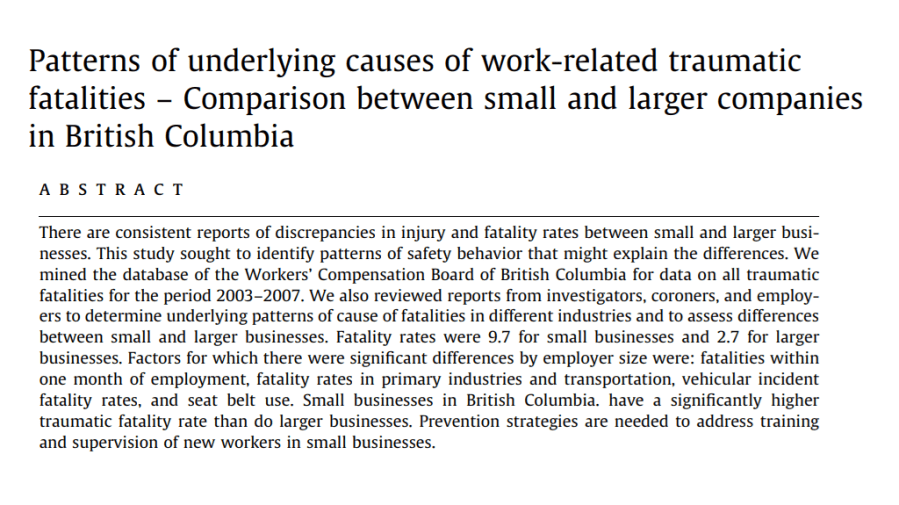
Patterns of underlying causes of work-related traumatic fatalities – Comparison between small and larger companies in British Columbia
This study mined the Workers’ Compensation Board of British Columbia (WCB) to compare discrepancies in injury and fatalities between small and large businesses. I’ve skipped a lot. For background: · Data from 2003-07 found the traumatic fatality rate among workers in small businesses (<20 person-years) was 9.7 per 100k person-years vs 2.7 per 100k in… Continue reading Patterns of underlying causes of work-related traumatic fatalities – Comparison between small and larger companies in British Columbia

The Impact of Physical Hazards on Workers’ Job Satisfaction in the Construction Industry: A Case Study of Korea
This study explored how physical workplace hazards influence job satisfaction in construction, and how mental threats mediate the relationship, and how perceived job quality and security moderate the effects. 2,202 construction workers in Korea were surveyed. Key findings: · “exposure to physical hazards significantly contributes to mental stress, leading to reduced job satisfaction” · And “a heightened… Continue reading The Impact of Physical Hazards on Workers’ Job Satisfaction in the Construction Industry: A Case Study of Korea
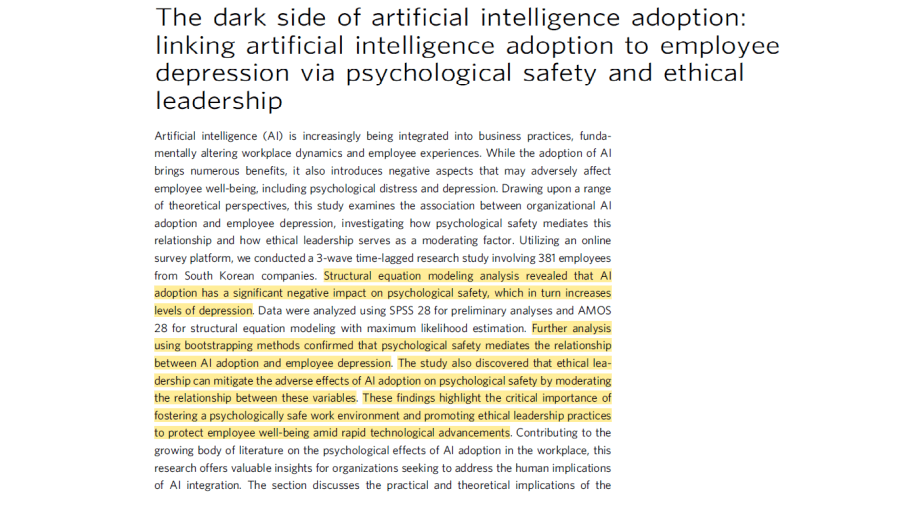
The dark side of artificial intelligence adoption: linking artificial intelligence adoption to employee depression via psychological safety and ethical leadership
Can adopting workplace AI technologies adversely affect employee psychological distress and depression? Yes according to this study. Online surveys of 381 employees in S.Korean companies was used. Background: · “In AI-centric environments .. AI reshapes jobs and workflows, affecting workers’ psychological health, satisfaction, commitment, and performance, as well as broader organizational outcomes” · “While AI adoption affects… Continue reading The dark side of artificial intelligence adoption: linking artificial intelligence adoption to employee depression via psychological safety and ethical leadership

From the Boardroom to the Jobsite: Female Board Representation and Workplace Safety
This study explored the effects that female board representation (FBR) on workplace safety. Note: ‘safety’ in this study is based on reported incidents. So consider that caveat. Data included 266 firms and 1,442 firm-year observations. Background: · “having female directors on corporate boards can influence a firm’s financial performance (Post and Byron 2015), social responsibility… Continue reading From the Boardroom to the Jobsite: Female Board Representation and Workplace Safety
 SafetyInsights.org