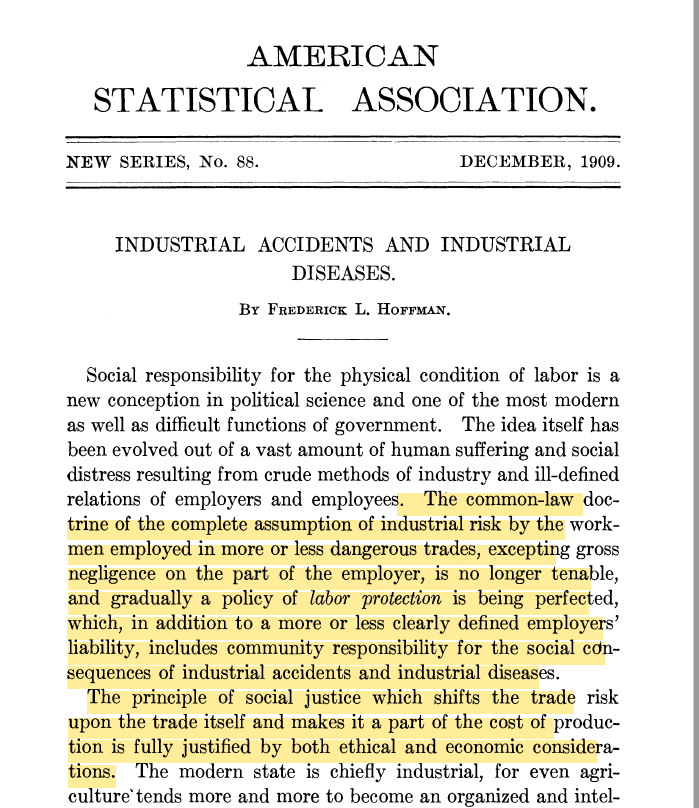
Another interesting read from 1909, talking about ‘social responsibility’ and industrial accidents & diseases in the US. Really modern thinking here – that: 1) ‘trade’ should bear the fair burden of injury 2) compensation is about justice and social responsibility 3) a worker’s free will to work in dangerous industries is a myth (they often… Continue reading Industrial Accidents and Industrial Diseases – 1909 article
Tag: business

Automation’s lacklustre effects on fatal accidents & cheap migrant labour hampering adoption of engineering controls
REALLY interesting findings from Associate Professor Masahiro Yoshida. It suggests that automation over a historical context didn’t really drive down workplace injuries since it tended to be employed in already mature industries. And, ready access to cheap migrant workforces may hinder broader industrial risk reduction due to a negative correlation with automation investment. And the… Continue reading Automation’s lacklustre effects on fatal accidents & cheap migrant labour hampering adoption of engineering controls

Compendium: Blame, Just Culture & language
Here’s another compendium of articles exploring blame and language in the construction of post-hoc causality explanations, or how blame effects learning and investigations. The other part covers some articles around Just Culture and restorative culture. Note: I’ve mostly focused on articles that I’ve either already summarised or that I could find a full text link… Continue reading Compendium: Blame, Just Culture & language
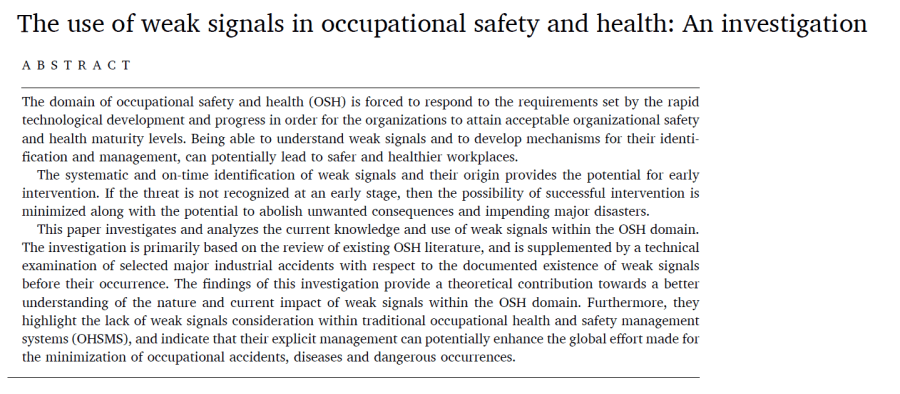
The use of weak signals in occupational safety and health: An investigation
This study explored current knowledge and use of weak signals in safety. Thanks to Clive Lloyd for sharing this a couple weeks back. As you’d expect, this sort of topic, based on accidents, is pretty replete with hindsight and outcome knowledge but is interesting nevertheless. Extracts: · They have been defined as an “…imprecise early indication… Continue reading The use of weak signals in occupational safety and health: An investigation

Boards of directors’ influences on occupational health and safety: a scoping review of evidence and best practices
This literature review evaluated the impact of boards of directors on workplace safety. 49 studies met inclusion. Way too much to cover. Background: · “There is a growing understanding that operative leadership, from line managers to senior management, plays an important role in occupational health and safety” · Leadership “do not act in a vacuum”… Continue reading Boards of directors’ influences on occupational health and safety: a scoping review of evidence and best practices

Factors affecting learning from incidents: A cross-industry review
This study systematically reviewed the research to unpack the factors that influence learning from incidents (LFI). Likely nothing new to anybody, but it is a good reference paper for tracking down specific research. Background: · Common reasons for ineffective LFI are “underreporting of incidents (Sanne, 2008), incapacity to identify latent circumstances (Jacobsson et al., 2009), the… Continue reading Factors affecting learning from incidents: A cross-industry review
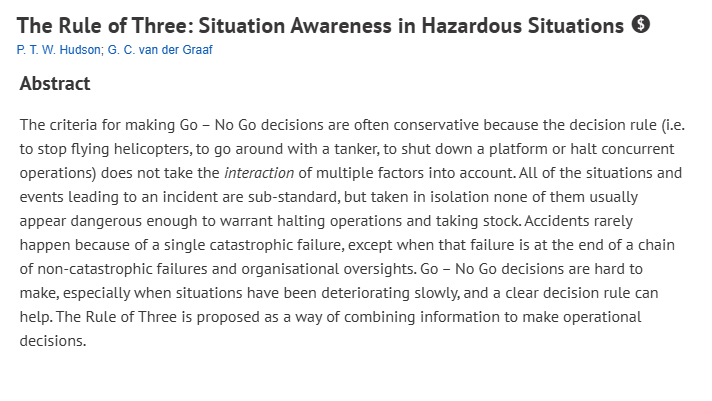
The rule of three: Situation awareness in hazardous situations
“The rule of three provides a mechanism that converts the risk continuum into a dichotomy for the purposes of decision-making. It does not, however, ignore the expertise of operators … Put another way, the rule of three structures expert decision-making; it does not replace it”

How do boards of directors influence workplace safety?
What impacts do boards of directors have on workplace safety? Found this an interesting extract from a paper I summarised over the weekend (will probably post next week). It systematically explored the links between boards of directors and their influence on safety. Of the 49 included studies, they found: · “Empirical studies gave no insight into… Continue reading How do boards of directors influence workplace safety?
Learning from normal work: How to Proactively Reduce Risk When Nothing Goes Wrong
An interesting article from Marcin Nazaruk, exploring learning from everyday work. Skipping a bit, so check out the full article. First he says that while it’s important to learn from failure “it is too late”. For one, diminishing incident rates “can no longer accurately reflect safety performance … and simply focusing on behaviours and unsafe… Continue reading Learning from normal work: How to Proactively Reduce Risk When Nothing Goes Wrong

Safety audits almost never target the actual sources of operational danger
Reflecting on my first audit study – we found things many would expect (image 1), like audits largely focusing on administrative items, and superficial matters. And for my construction friends, we found ‘toolboxes’ used a lot to address an issue, even if that issue didn’t have any reasonable connection to something that you’d need to… Continue reading Safety audits almost never target the actual sources of operational danger
 SafetyInsights.org