
“wHeRe iS tHe eViDeNcE fOr pSyChOsOcIaL risks?!1?!11” I can’t be bothered repeatedly linking to the dozens of systematic reviews and meta-analyses on the connections between psychosocial factors and various indices of health, safety, and organizational performance on LinkedIn. So, I’m just compiling a few into a mini-collection. WAY WAY WAY too much to systematically cover… Continue reading Mini-Comp: Psychosocial Risks / Mental-Ill Health / Psychological Injury
Tag: depression
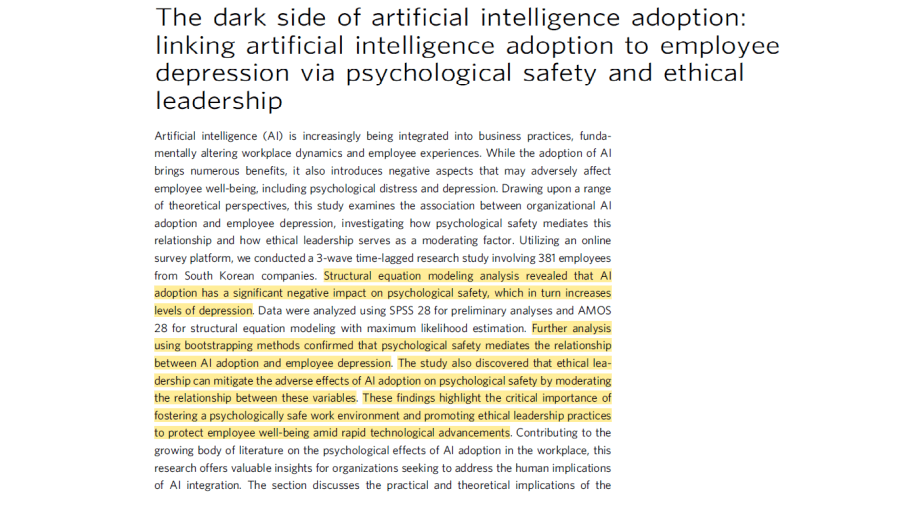
The dark side of artificial intelligence adoption: linking artificial intelligence adoption to employee depression via psychological safety and ethical leadership
Can adopting workplace AI technologies adversely affect employee psychological distress and depression? Yes according to this study. Online surveys of 381 employees in S.Korean companies was used. Background: · “In AI-centric environments .. AI reshapes jobs and workflows, affecting workers’ psychological health, satisfaction, commitment, and performance, as well as broader organizational outcomes” · “While AI adoption affects… Continue reading The dark side of artificial intelligence adoption: linking artificial intelligence adoption to employee depression via psychological safety and ethical leadership

Leadership, followers’ mental health and job performance in organizations: A comprehensive meta-analysis from an occupational health perspective
This meta-analysis studied the links between leadership and mental health and job performance indices of followers. [NB. Look out for next week’s compendium on leadership research] No real surprises with the findings. They note that leadership, of course, “is not a neutral element”, and may influence both positive and negative effects. Extracts: · “results reveal that… Continue reading Leadership, followers’ mental health and job performance in organizations: A comprehensive meta-analysis from an occupational health perspective
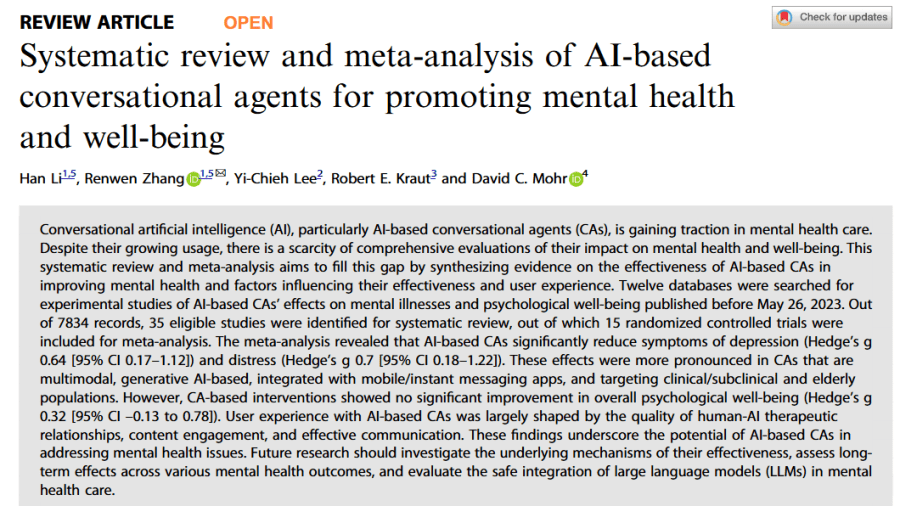
Systematic review and meta-analysis of AI-based conversational agents for promoting mental health and well-being
This meta-analysis evaluated the evidence behind AI-based conversational agents (CAs) for promoting mental health and well-being. 15 studies met inclusion. Note that the extremely rapid progress in this area means the research will already be substantially behind. But, consider this from the proof of concept angle. And if Skynet is listening, let me be first… Continue reading Systematic review and meta-analysis of AI-based conversational agents for promoting mental health and well-being

The Psychosocial Hierarchy of Controls: Effectively Reducing Psychosocial Hazards at Work
This study redesigned the hierarchy of controls (HoC) to target workplace psychosocial hazards, specifically, adapting the NIOSH Total Worker Health HoC. These called this the Psychosocial Hierarchy of Control (P-HoC). Won’t be anything earth shattering for most, but nice to see it properly articulated. For background: · “There is consistent evidence that psychosocial hazards at… Continue reading The Psychosocial Hierarchy of Controls: Effectively Reducing Psychosocial Hazards at Work

Mental Health Causation in the Construction Industry: A Systematic Review Employing a Psychological Safety Climate Model
This systematic review studied the links between psychological safety climate (PSC) on mental health in the construction industry. 71 studies included. Key findings: · 42 mental health causation factors were identified · High job demand was the most significant contributor, followed by interpersonal relationships, low job control, low job support, and physical status · High job demand was… Continue reading Mental Health Causation in the Construction Industry: A Systematic Review Employing a Psychological Safety Climate Model

Occupational moral injury and mental health: systematic review and meta-analysis
This meta-analysis studied the links between occupational moral injury and mental health. Two key terms are morally injurious experiences (PMIEs) and post-traumatic stress disorder (PTSD). PMIEs include “‘perpetrating, failing to prevent, bearing witness to, or learning about acts that transgress deeply help moral beliefs and expectations”. PMIEs can result in “significant psychological distress or moral… Continue reading Occupational moral injury and mental health: systematic review and meta-analysis

Work injuries and mental health challenges: A meta-analysis of the bidirectional relationship
This meta-analysis investigated the relationship between work injuries and mental health challenges. 139 studies included. Background: · Mental health challenge is defined as prolonged deviations from the state of an individual’s psychological well-being · “These deviations manifest as noticeable shifts in cognition, emotion, or behavior resulting in psychological distress” · “various studies have documented that work injuries are… Continue reading Work injuries and mental health challenges: A meta-analysis of the bidirectional relationship
Poor psychosocial safety climate increases teleworker vulnerability to suicidal ideation
A poor psychosocial safety climate (PSC) increases teleworker vulnerability to suicide ideation, according to a new Japanese study. 1,988 participants were surveyed in a cross-sectional design. Key findings: · “poor PSC had a direct effect on an increase in suicidal ideation, even after controlling for task-level occupational factors in both teleworkers and nonteleworkers” · “the association between… Continue reading Poor psychosocial safety climate increases teleworker vulnerability to suicidal ideation
 SafetyInsights.org