
This thesis from Jennifer Serne explored how construction safety professionals attribute accident causes. 37 participants were included with 20 accident scenarios, 13 individual semi-structured interviews and 8 summative focus groups. For background: · Originally proposed by Heider in 1958, it’s said that people are “psychologically driven to determine the causes of others’ behavior” · And… Continue reading Attributing Cause for Occupational Accidents in Construction: A Descriptive Single Case Study
Tag: investigation

ChatGPT for analysing investigations
I think this is one of the better uses of LLMs regarding investigations – they trained their model to evaluate accident reports and extract key details from the reports. They found: · It could extract key information from unstructured data and “significantly reduce the manual effort involved in accident investigation report analysis and enhance the overall… Continue reading ChatGPT for analysing investigations

Human factor analysis of cockpit work incidents in high-speed workboats: the mystery hidden between the lines
This study unpacked what investigators look at and how they construct causes in high-speed workboats. It employed a Safety-II / HOP / HF perspective. Tl;dr: human factors are poorly evaluated and largely seen as individual-level factors. Some extracts: · “Although the analysis focused on negative observations, it also identified HFs that supported the activity” · “Many pivotal… Continue reading Human factor analysis of cockpit work incidents in high-speed workboats: the mystery hidden between the lines
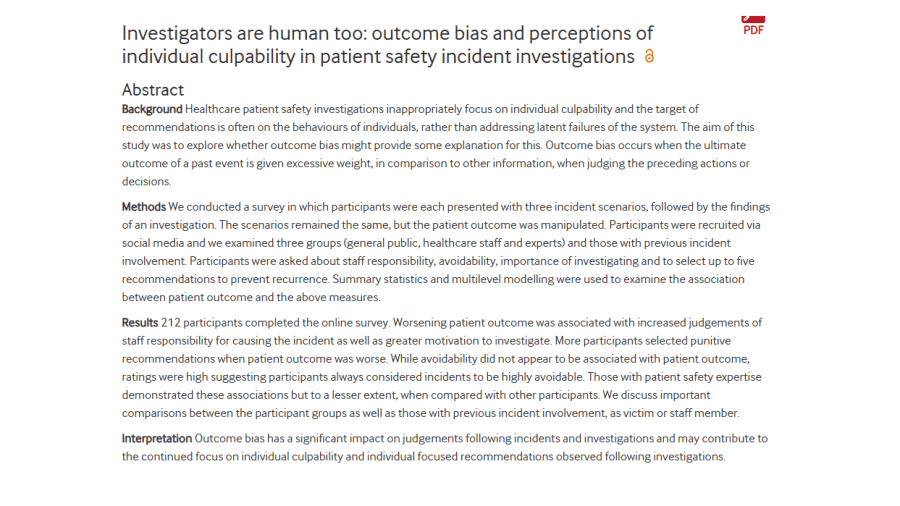
Investigators are human too: outcome bias and perceptions of individual culpability in patient safety incident investigations
This study explored whether outcome bias might explain why healthcare investigations focus on individual culpability over addressing latent conditions in the system. 212 participants were allocated to one of three scenarios followed by the findings of an investigation (see scenario overviews below). For background: · Prior work has identified that the “overwhelming majority of recommendations… Continue reading Investigators are human too: outcome bias and perceptions of individual culpability in patient safety incident investigations
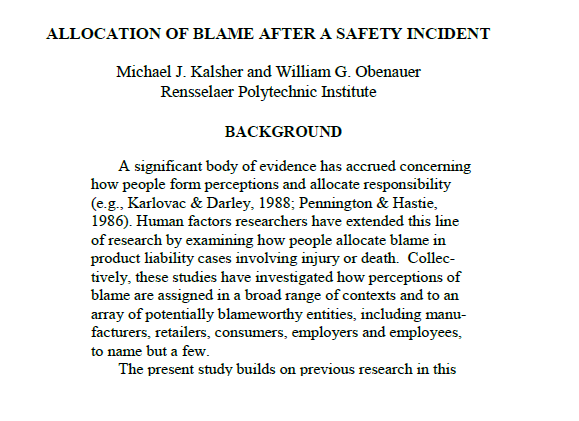
Allocation of Blame After a Safety Incident
This single page conference paper discussed an experiment on how blame is allocated following incidents. The scenario was a “realistic, but fictitious” incident involving a worker (both experienced or not experienced, depending on the scenario), whom is killed when touching an energised bus bar while feeding electrical wire into a pedestal. They systematically manipulated the… Continue reading Allocation of Blame After a Safety Incident
 SafetyInsights.org