This report, part of creative sentencing research, explored Serious Incidents and Fatalities (SIFs) in mining, and the causes, and the most effective controls for SIFs. Another aim was around the fallibility of people, and when they make mistakes, ensuring there are adequate capacities “so that they ‘fail safely’”, rather than “rather than ‘failing lucky”, or… Continue reading Building Resilience into Safety Management Systems: Precursors and Controls to Reduce Serious Injuries and Fatalities (SIFs)
Tag: major accident

Safe AF ep #4: Relationship between fatal and non-fatal accidents based on 23k accidents
Is there a connection between fatal and non-fatal accidents, or is it a fallacy to focus on the minor potential events with the hope of managing the major events? Today’s study explores these relationships based on 23k reported serious accidents in the Netherlands. Ref: Bellamy, L. J. (2015). Exploring the relationship between major hazard, fatal… Continue reading Safe AF ep #4: Relationship between fatal and non-fatal accidents based on 23k accidents

Barrier / control system failures in the BP Texas City disaster & organisational factors
This paper explored the barrier system (e.g. controls) performance in the genesis of the 2005 BP Texas City disaster. Not much to say – the images say enough. Some extracts: · As per image 1, several organisational factors or management delivery system were central in the poor barrier system performance · They propose many of these factors… Continue reading Barrier / control system failures in the BP Texas City disaster & organisational factors

On “Black Swans” and “Perfect Storms”: Risk Analysis and Management When Statistics Are Not Enough
Really interesting 2012 article from Pate-Cornell about black swans, perfect storms and risk management. Although Pate-Cornell isn’t likely a household name within safety, she’s one of the GOATs in risk analysis. As usual, I’ve skipped a lot. Her key thesis is that popularised concepts like black swans and perfect storms have “struck the public’s imagination”… Continue reading On “Black Swans” and “Perfect Storms”: Risk Analysis and Management When Statistics Are Not Enough

Exploring the relationship between major hazard, fatal and non-fatal accidents through outcomes and causes
This study from Linda Bellamy explored whether there is a relationship between major hazards, and fatal and non-fatal accidents. Analysis of 23k Dutch serious reportable accidents was analysed via the StoryBuilder software (largely based around bowties). [NB. As always, there’s certain limitations and nuances with relying on reported accidents, particularly around how they’re reported, how… Continue reading Exploring the relationship between major hazard, fatal and non-fatal accidents through outcomes and causes
The Nimrod accident inquiry: An exploration of paper safety, clutter, false safety and more
“There was a very real sense in which all three parties were simply going through the motions together of producing ‘paper safety’” This is a nearly 600 page accident inquiry for the 2006 military aircraft accident – just a few extracts I found interesting regarding broader safety management. It’s a fantastic read and a masterclass… Continue reading The Nimrod accident inquiry: An exploration of paper safety, clutter, false safety and more
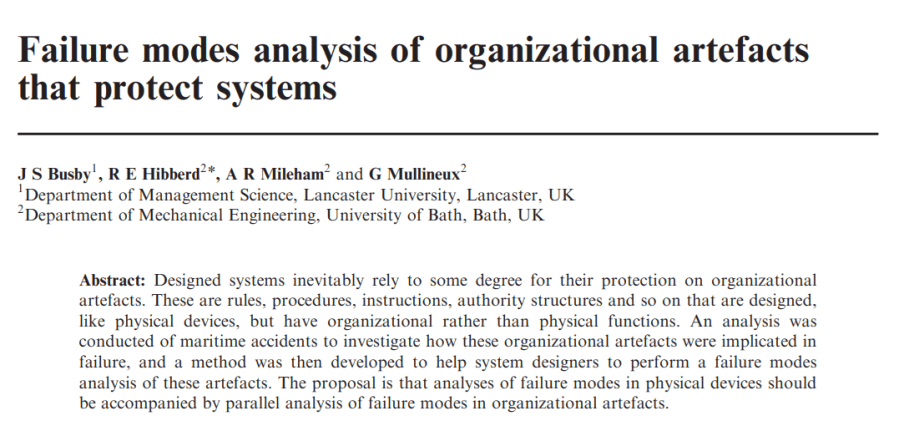
Failure modes analysis of organizational artefacts that protect systems
Really interesting 2004 paper discussing how to study the failures associated with organisational artefacts. Artefacts are “rules, procedures, instructions, authority structures and so on that are designed, like physical devices, but have organizational rather than physical functions”. It’s argued that studying failures of artefacts, like in FMEA, isn’t the same as physical failure modes, and… Continue reading Failure modes analysis of organizational artefacts that protect systems

Drifting into failure: Complexity theory and the management of risk
2013 paper from Dekker discussing drift into failure. Nothing new if you’ve read his 2011 book. Extracts: · “organizations do not just fail because of component breakage or linear propagations of breakdowns. Instead, failure breeds opportunistically, non-randomly, among the very structures designed to protect an organization from disaster” · “A common pattern seems to be a drift… Continue reading Drifting into failure: Complexity theory and the management of risk

The contribution of latent human failures to the breakdown of complex systems
What is the role of frontline people within complex system failures? For James Reason, it was often just providing the local triggers to “manifest systemic weaknesses created by fallible decisions made earlier”. This 1990 paper goes through his thinking of human performance in complex failure. It was meant to be a small post, but couldn’t… Continue reading The contribution of latent human failures to the breakdown of complex systems

Issues with defining critical controls & relying on injury measures, like TRIFR – Grosvenor Board of Inquiry
More extracts from the Anglo American Grosvenor board of inquiry. This focused on issues with defining critical controls / high potential incidents (HPI), and issues relying on injury measures, like TRIFR. Extracts: · The company standard didn’t require the business unit CEO to be notified of HPIs, and “whilst it prescribes a process of escalation in… Continue reading Issues with defining critical controls & relying on injury measures, like TRIFR – Grosvenor Board of Inquiry
 SafetyInsights.org