Is your work making you physically or mentally sick? This video unpacks a meta-analysis which analysed 72 studies on the links between psychosocial risks on health. Among other findings – established links were found between job strain and cardiovascular diseases and mental ill health. #psychosocial #risk #health #safety #hse #mentalhealth
Tag: psychosocial
Psychological Distress and Post-Traumatic Symptoms Following Occupational Accidents
What are the psychological consequences of physical work incidents? 38 occupationally injured persons matched against 38 none injured. Background: · Prior work “reported that 34.7% of injured workers with chronic pain achieved full criteria for PTSD, and 18.2% had partial PTSD” · “victims of work-related accidents showed clinically relevant psychopathological symptoms, including post-traumatic symptoms, anxiety, depression, anger, and… Continue reading Psychological Distress and Post-Traumatic Symptoms Following Occupational Accidents

Working Too Hard to Advise You Not to Work Too Hard: Psychosocial Risk Factors and Quality of Life Among Occupational Health and Safety Experts
OHS professionals exposed to several psychosocial risks in the course of their work, according to this study, amplified by the social interactivity of their role. This Turkish study surveyed 101 OHS experts (65 male, 36 female) on psychosocial factors, quality of life and more. Key findings: · While OHS professionals may help others with eliminating or… Continue reading Working Too Hard to Advise You Not to Work Too Hard: Psychosocial Risk Factors and Quality of Life Among Occupational Health and Safety Experts
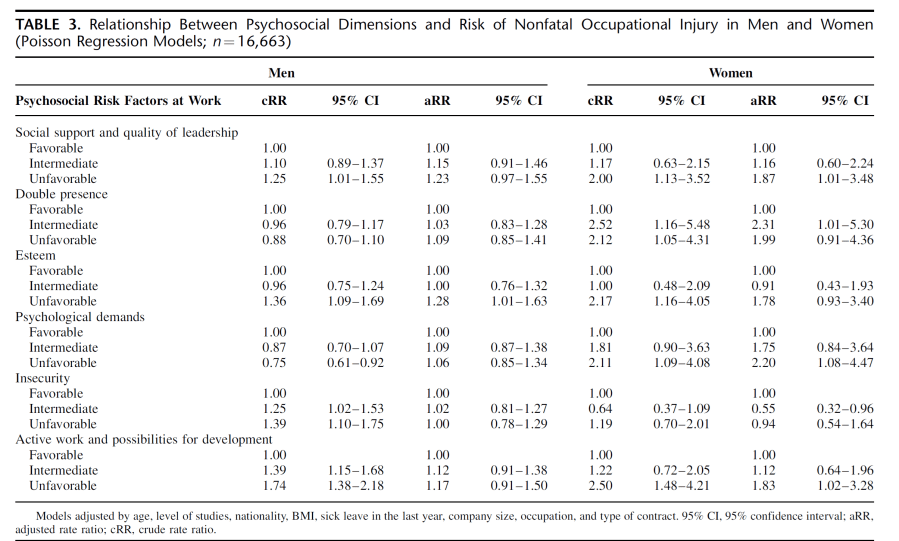
Exposure to Psychosocial Risk Factors at Work and the Incidence of Occupational Injuries: A Cohort Study in Spain
This study explored the links between psychosocial risk factors (PRF) on the incident of occupational injuries (OIs). Compared to many other studies, they used a dynamic cohort longitudinal design (>16k) participants over 1 year follow-up. The Copenhagen Psychosocial Questionnaire was used. For background: Findings: Why are PRF and OI potentially linked? They suggest: Limitations were… Continue reading Exposure to Psychosocial Risk Factors at Work and the Incidence of Occupational Injuries: A Cohort Study in Spain
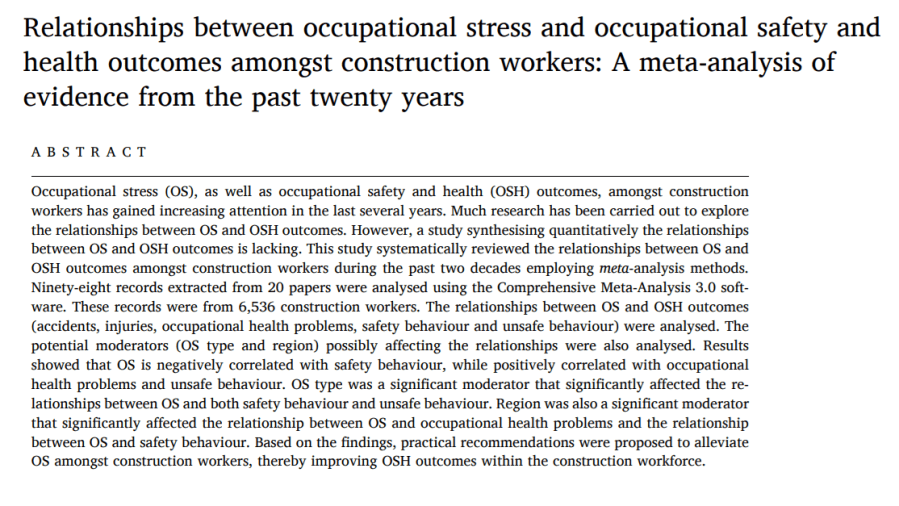
Relationships between occupational stress and occupational safety and health outcomes amongst construction workers: A meta-analysis of evidence from the past twenty years
This meta-analysis investigated the effects of occupational stress (OS) on safety and health outcomes in construction. 20 studies over 20 years, including >6k construction workers was included (not such a big sample given all of the research in construction safety, indicative of the relatively poorer quality of research that didn’t meet their inclusion criteria). [Trigger… Continue reading Relationships between occupational stress and occupational safety and health outcomes amongst construction workers: A meta-analysis of evidence from the past twenty years
How certification shifts work away from functional issues to rustling paperwork
Does certification, like under ISO 18001, or likely 45001, only have positive effects, or does it also introduce unintended byproducts, like a focus on managing the paperwork and not ‘real’ issues, and oversimplifying psychosocial issues? Safe AF podcast #9 explored the byproducts of certification – just 9 mins of your life. Links below. They observed… Continue reading How certification shifts work away from functional issues to rustling paperwork
Safe AF #9: How certified systems & auditing mask psychosocial factors
We design, implement and ISO-certify our safety systems with best intentions. We hope these systems help us to identify and address workplace hazards. However, is it possible that certified management systems can instead mask particular complex sociotechnical issues, simplifying psychosocial matters into neat, auditable matters, devoid of their depth and nuance? Can auditing transform functional… Continue reading Safe AF #9: How certified systems & auditing mask psychosocial factors

The Impact of Physical Hazards on Workers’ Job Satisfaction in the Construction Industry: A Case Study of Korea
This study explored how physical workplace hazards influence job satisfaction in construction, and how mental threats mediate the relationship, and how perceived job quality and security moderate the effects. 2,202 construction workers in Korea were surveyed. Key findings: · “exposure to physical hazards significantly contributes to mental stress, leading to reduced job satisfaction” · And “a heightened… Continue reading The Impact of Physical Hazards on Workers’ Job Satisfaction in the Construction Industry: A Case Study of Korea

Mini-Comp: Psychosocial Risks / Mental-Ill Health / Psychological Injury
“wHeRe iS tHe eViDeNcE fOr pSyChOsOcIaL risks?!1?!11” I can’t be bothered repeatedly linking to the dozens of systematic reviews and meta-analyses on the connections between psychosocial factors and various indices of health, safety, and organizational performance on LinkedIn. So, I’m just compiling a few into a mini-collection. WAY WAY WAY too much to systematically cover… Continue reading Mini-Comp: Psychosocial Risks / Mental-Ill Health / Psychological Injury

Leading safely: The impact of generalist CEOs on workplace safety
Does the skillset of the CEO influence workplace safety? Yes according to this study. In the lead-up to next week’s leadership research compendium, this study evaluated whether generalist or specialist CEOs have a greater impact on OSHA reported safety incidents (note the limitation). Generalists are CEOs with wider industry experience (worked in more industries) whereas… Continue reading Leading safely: The impact of generalist CEOs on workplace safety
 SafetyInsights.org