Not much to say – some extracts from a 2007 chapter from Erik Hollnagel, unpacking whether we really need “human error”? I knocked the summary up last night and will probably post in the next couple of weeks. Oh man, I need to give up on chapters…what a slog. He argues: · Human error “is not… Continue reading Hollnagel on “Human error”: error as cause, process or outcome
Tag: resilience engineering

Contextualising new safety paradigms: A study in a large Australian construction company
This study explored the presence, implementation, appetite and feasibility of 12 principles representing “new safety paradigms”. It involved focus groups with 53 participants and a cross-sectional survey of 514 employees. I’ve skipped HEAPS (actually, the entire results section – so check out the full paper). Background: · “The review by Karanikas et al. (2022) revealed… Continue reading Contextualising new safety paradigms: A study in a large Australian construction company
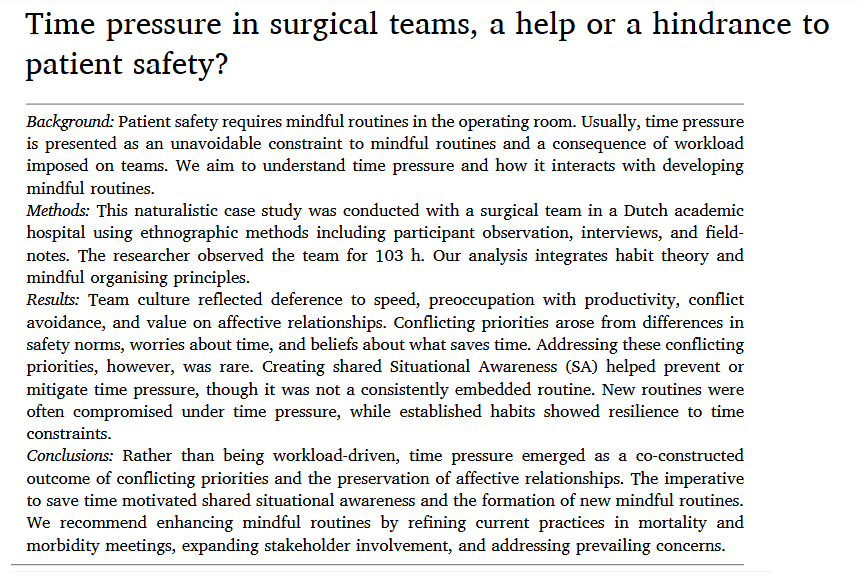
Time pressure in surgical teams, a help or a hindrance to patient safety?
I found this an interesting and brief read about the mindful routines of operating room staff, using a naturalistic decision making approach. Extracts: Ref: van Harten, A., Niessen, T. J., Koksma, J. J., Gooszen, H. G., & Abma, T. A. (2025). Heliyon. Shout me a coffee Study link: https://doi.org/10.1016/j.heliyon.2025.e41967 Shout me a coffee: https://buymeacoffee.com/benhutchinson LinkedIn post:… Continue reading Time pressure in surgical teams, a help or a hindrance to patient safety?
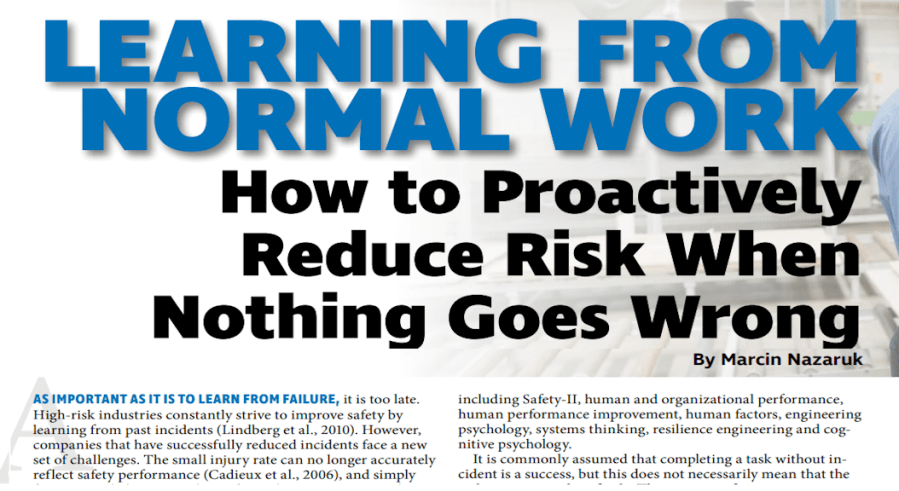
Learning from normal work: How to Proactively Reduce Risk When Nothing Goes Wrong
An interesting article from Marcin Nazaruk, exploring learning from everyday work. Skipping a bit, so check out the full article. First he says that while it’s important to learn from failure “it is too late”. For one, diminishing incident rates “can no longer accurately reflect safety performance … and simply focusing on behaviours and unsafe… Continue reading Learning from normal work: How to Proactively Reduce Risk When Nothing Goes Wrong
Procedure excellence: Changing paradigms to enable human reliability
This paper from Elliot Wolf-Stokes and Rob Fisher may interest peeps – around orientating towards operational excellence. Covers a lot of ground – systemic drivers to procedural departures, error drivers in written guidance, mental models, enablers of human reliability and more. I’ve skipped HEAPS, so just a few extracts (link to full paper in comments):… Continue reading Procedure excellence: Changing paradigms to enable human reliability
Foundations of Safety Science: Resilience Engineering and 3 analytical traps for resilience practitioners
Post 3 from ch.11 of the Foundations of Safety Science, exploring Resilience Engineering (RE) and the adaptive perspectives. This part focuses on 3 analytical traps for resilience practitioners/scholars to be cognisant of (you may recognise these from Johan Bergstrom’s youtube vid – link in comments). Extracts: · The first trap is the reductionist trap · Whereas “the… Continue reading Foundations of Safety Science: Resilience Engineering and 3 analytical traps for resilience practitioners
Foundation of Safety Science: Resilience Engineering and complex systems pt2
Post 2 from ch.11 of the Foundations of Safety Science, exploring Resilience Engineering (RE) and the adaptive perspectives. Some extracts: · RE sees failures not necessarily as breakdowns or malfunctioning of normal functions, but “the converse of the adaptations necessary to cope with the real world complexity” · Performance of individuals and organisations across all level “must… Continue reading Foundation of Safety Science: Resilience Engineering and complex systems pt2
Foundations of Safety Science: Resilience Engineering and safety as the presence of capacities
More extracts from Foundations of Safety Science, this time from Ch.11 on Resilience Engineering and the adaptive perspective. This is 1 of probably 2 or 3 more posts. Some extracts: These logics come from a wider body of safety science, which includes some intertwined positions, like: Parts 2 & 3…some other time. Ref: Dekker, S.… Continue reading Foundations of Safety Science: Resilience Engineering and safety as the presence of capacities
Escaping Failures of Foresight
An interesting discussion paper from David Woods, in response to a paper from Andrew Hopkins discussing process safety indicators (see my article from a few weeks back). ** I haven’t done a good job of this – so suggest you read the original paper. You might want a strong coffee. Woods takes a bit of… Continue reading Escaping Failures of Foresight
Interventions and measurements of highly reliable/resilient organization implementations: A literature review
This reviewed literature on High Reliability Organisations (HRO) and similar approaches in Resilience Engineering (RE) from 1981 to 2020 to determine its impact. 34 articles out of 1400 met inclusion. For background: · “There is a class of organizations that can do catastrophic harm to themselves and a larger public” and within this set, there’s… Continue reading Interventions and measurements of highly reliable/resilient organization implementations: A literature review
 SafetyInsights.org