Do you see procedures as concrete actions that specify the one correct way of working, or more as resources to shape work and sensitise people to risk? Let’s unpack the model 1 / model 2 perspective of rules and see which resonates best with workers. Today’s paper is Hendricks, J. W., & Peres, S. C.… Continue reading Safe As 30: A better way to think about procedures – resources for action
Tag: resilience engineering

The Folly of Safety-III
Hollnagel’s response to some of the recent (and somewhat bizarre) articles on ‘Safety-III’. Spoiler: It’s not charitable. I’m relying on a lot of direct quotes. Providing context, Hollnagel argues: · Introduction of Safety-I and Safety-II (SI / SII) to characterise two opposite means of safety was “met with surprisingly large interest” and “also with some… Continue reading The Folly of Safety-III
Designing for resilient performance & worker participation: design principles
This review explored how to design for worker participation, drawing on the design of resilient systems. Not much to say – the extracts cover core resilient design principles. Some extracts to contextualise the images: · Participation refers to “the worker’s influence in decision-making related to safety, involving information sharing between people” · “Design for resilient performance Design… Continue reading Designing for resilient performance & worker participation: design principles
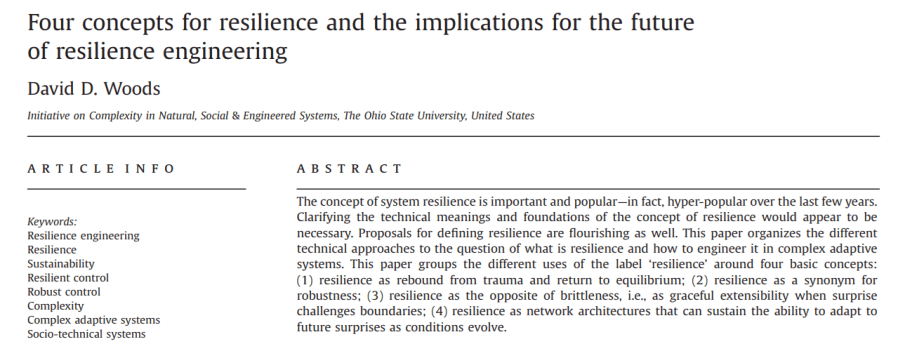
Four concepts for resilience and the implications for the future of resilience engineering
An interesting read from David Woods discussing four resilience concepts. Extracts:· While networks of interdependencies have created new value for stakeholders, it has “also created unanticipated side effects and sudden dramatic failures” · The first concept used to describe resilience is rebounding · Rebounding “begins with the question: why do some communities, groups, or individuals recover from traumatic… Continue reading Four concepts for resilience and the implications for the future of resilience engineering
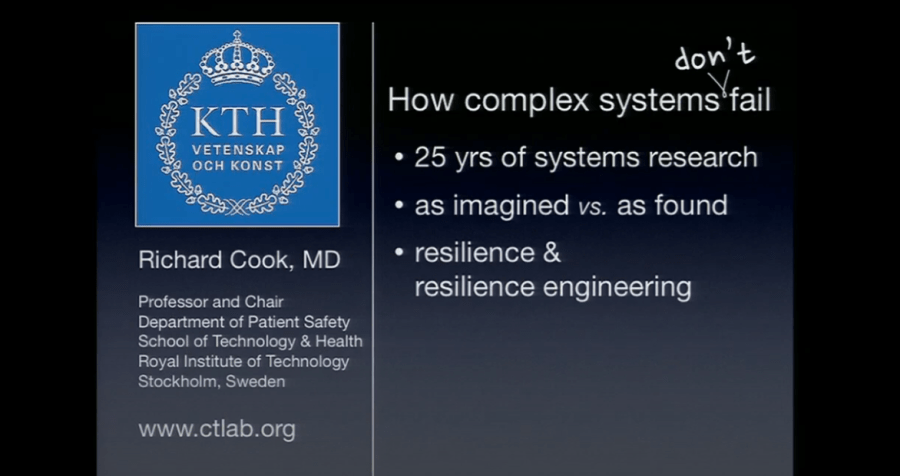
How complex systems (don’t) fail: YT video from late Richard Cook
A banger YT presentation from the late, great Richard Cook. He discusses ‘how complex systems fail’. Video link below. Some extracts: · “The surprise is not that there are so many accidents … The surprise is that there are so few” · “The normal world is not well-behaved … Even so, a lot of operational settings achieve… Continue reading How complex systems (don’t) fail: YT video from late Richard Cook
The human factor: Pursuing success and averting drift into failure – YT video, Sidney Dekker
A 2018 presentation from Sid Dekker on success and drift into failure. One of many such, and no particular reason why this one over any other. Sid starts with an example he heard, supporting the bad apple thesis: “just get rid of the nurses who make mistakes and all will be a lot safer” “Now… Continue reading The human factor: Pursuing success and averting drift into failure – YT video, Sidney Dekker

Compendium of Nancy Leveson: STAMP, STPA, CAST and Systems Thinking
Although I don’t often mention or post about Leveson’s work, she’s probably been the most influential thinker on my approach after Barry Turner. So here is a mini-compendium covering some of Leveson’s work. Feel free to shout a coffee if you’d like to support the growth of my site: Check out my YouTube channel: https://youtube.com/@safe_as_pod?si=sZmhFw3gB3ubXjzK… Continue reading Compendium of Nancy Leveson: STAMP, STPA, CAST and Systems Thinking

Root-Causal Factors: Uncovering the Hows & Whys of Incidents
This 2016 article from Fred Manuele explores some facets of causality in investigations. It’s based mainly on two key sources: Hollnagel’s 2004 ‘Barriers and accident prevention’ and Dekker’s 2006 ‘Field Guide to Understanding Human Error’. Won’t be much new for most but has some nice arguments from authors like Hollnagel, Dekker and Leveson. First he… Continue reading Root-Causal Factors: Uncovering the Hows & Whys of Incidents

Designing work systems for resilient performance: insights from resilience engineering
This explored Design for Resilient Performance (DfRP) via their framework. Not a summary – just a few extracts, but maybe I’ll summarise it in the future. Some extracts: · “Resilient performance (RP) is a socio-technical system’s ability to adjust its functioning prior to, during, or following changes and disturbances, thereby sustaining operations under both expected and… Continue reading Designing work systems for resilient performance: insights from resilience engineering
Resilience terminology and a visualisation of resilience/robustness in practice
This may interest people. It covers concepts of resilient performance within seaports. It’s a bit random (seaports), but otherwise gives a handy overview of resilience terms and applications. The first two images are just basic definitions. Extracts: · Image 3 represents resilience elements during disruptions – from pre-disruption, to the disruption, then post-disruption. · During pre-disruption, the… Continue reading Resilience terminology and a visualisation of resilience/robustness in practice
 SafetyInsights.org