
This systematic review of 28 studies explored the application of LLMs for lung cancer care and management. Probably few surprises here. And it’s focused mostly on LLMs, rather than specialised AI models. Extracts: · The review identified 7 primary application domains of LLMs in LC: auxiliary diagnosis, information extraction, question answering, scientific research, medical education, nursing… Continue reading Large Language Models in Lung Cancer: Systematic Review
Tag: technology
Safe As week in review: Ineffectiveness of individual mental health interventions / Fatigue risk via defences in depth / AI LLMs are BS’ing you
Safe As covered this week: 31: Do individual mental health interventions work? Maybe not. Do individual level mental health interventions, like personal resilience training, yoga, fruit bowls and training actually improve measures of mental health? This study suggests not. Using survey data from >46k UK workers, it was found that workers who participated in individual-level… Continue reading Safe As week in review: Ineffectiveness of individual mental health interventions / Fatigue risk via defences in depth / AI LLMs are BS’ing you
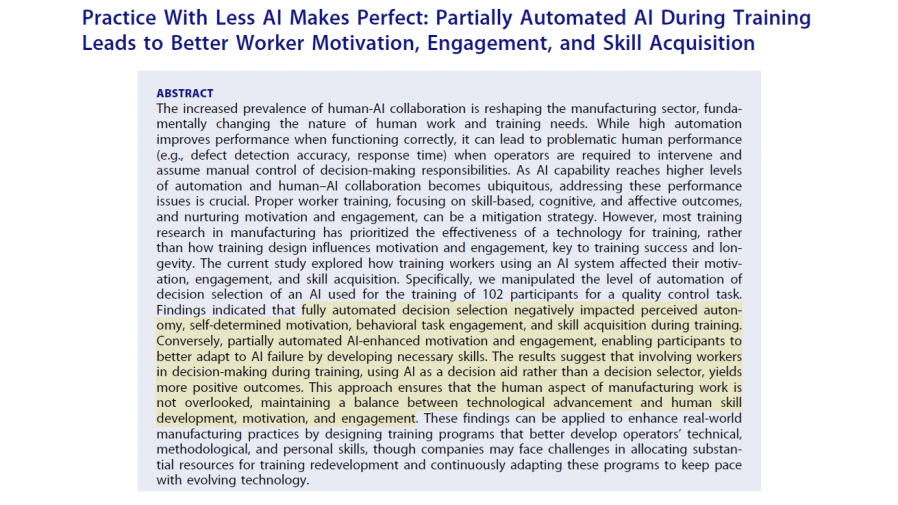
Practice With Less AI Makes Perfect: Partially Automated AI During Training Leads to Better Worker Motivation, Engagement, and Skill Acquisition
How does AI use in training improve, or impact, skill acquisition? This study manipulated training protocols with varying levels of AI decision-making automation, among 102 participants during a quality control task. Extracts: · “Partial automation led to the most positive outcomes” · “Participants who were trained with the fully automated version of the AIEDS had a significantly… Continue reading Practice With Less AI Makes Perfect: Partially Automated AI During Training Leads to Better Worker Motivation, Engagement, and Skill Acquisition

Safe As 33: Is ChatGPT bullsh** you? How Large Language models aim to be convincing rather than truthful
Large Language Models, like ChatGPT have amazing capabilities. But are their responses, aiming to be convincing human text, more indicative of BS? That is, responses that are indifferent to the truth? If they are, what are the practical implications? Today’s paper is: Hicks, M. T., Humphries, J., & Slater, J. (2024). ChatGPT is bullshit. Ethics and… Continue reading Safe As 33: Is ChatGPT bullsh** you? How Large Language models aim to be convincing rather than truthful
Can chatbots provide more social connection than humans?
Can chatbots provide more social connection than humans? Possibly, providing that they don’t “claim too much humanity”. Three study protocols with 801, 201 and 401 had participants engage with AI social chatbots. They note that the long-term consequences of social chatbot use is unknown, but is important to study since “hundreds of millions of people… Continue reading Can chatbots provide more social connection than humans?

Paradoxical safety leadership: Conceptualization and measurement
Should leaders embrace paradoxes and tensions? This study developed a paradoxical safety leadership (PSL) construct. Extracts: · PSL is a “multidimensional construct that consists of seemingly contradictory yet interrelated leader behaviors to meet competing goals and demands in safety management” · It integrates a “both-and approach to organizational tensions” to effectively manage “salient competing demands arising from… Continue reading Paradoxical safety leadership: Conceptualization and measurement

Safe As 25: Do workers in high-risk industries use and value procedures?
Are your safety procedures effective aids to help navigate safe and reliable work? Do you know? And, do your workers use and value those procedures? Today we’re uncovering the painful realisation of how a compliance culture can erode trust, disengage workers and leave you dangerously exposed when things go wrong. Today’s study is Peres, S.… Continue reading Safe As 25: Do workers in high-risk industries use and value procedures?
Safe As week in review – 22, 23, 24: Zombie leaders, Safety-II debriefs, and causal illusions of leadership styles
Safe As week in review: E22: Zombie leadership … being “dead ideas [about leadership] that still walk amongst us”. Zombie leadership is covered by several axioms: images 1 and 2. These dead ideas, being already dead can “absorb all kinds of damage and keep lumbering on towards their targets”; that is, difficult to slay. Zombie… Continue reading Safe As week in review – 22, 23, 24: Zombie leaders, Safety-II debriefs, and causal illusions of leadership styles

Endoscopist De-Skilling after Exposure to Artificial Intelligence in Colonoscopy: A Multicenter Observational Study
Does AI use contribute to de-skilling? Probably, according to this study of endoscopists. This study compared >1.4k patient outcomes who underwent non-AI assisted colonoscopy before and after AI implementation. Background: · A recent meta-analysis of 20 randomised trials “showed an absolute 8.1 % increase in ADR [Adenoma detection rate] with the use of AI during colonoscopy.5… Continue reading Endoscopist De-Skilling after Exposure to Artificial Intelligence in Colonoscopy: A Multicenter Observational Study

The impact of generative AI on critical thinking skills: a systematic review, conceptual framework and future research directions
The impact of generative AI on critical thinking skills: a systematic review, conceptual framework and future research directions How do generative AI (GenAI) models affect critical thinking skills? This systematic review unpacked 68 studies to explore the good and the bad. GenAI are “machine-learning algorithms, usually transformer-based large-language models (LLMs), that generate new text, code… Continue reading The impact of generative AI on critical thinking skills: a systematic review, conceptual framework and future research directions
 SafetyInsights.org