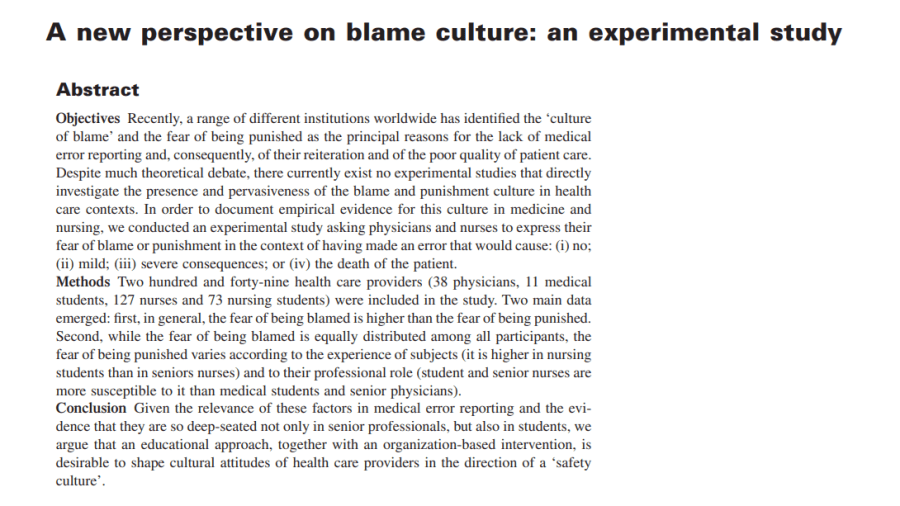

This study explored how fear of blame and punishment affects different healthcare professions, experience levels and gender.
249 healthcare practitioners were involved, and were asked how fear of blame or punishment resulting from an error which caused no, mild, severe or death of a patient.
Extracts:
· “blame culture can be defined as a set of norms and attitudes within an organization characterized by the unwillingness to take risk or accept responsibility for mistakes because of the fear of criticisms or management admonishments”
· “the fear of being blamed is higher than the fear of being punished”
· “while the fear of being blamed is equally distributed among all participants, the fear of being punished varies according to the experience of subjects”
· Fear of blame is higher in nursing students than senior nurses, and higher in student and senior nurses than medical students and senior physicians
· Fear of blame is higher in nurses compared to physicians
· “Having less authority compared with the physicians, nursing students and nurses are more vulnerable to disciplinary actions and punishment”
· “the fear of being blamed is assumed to do more harm than good, because it engenders feelings of inadequacy or fear of criticism and it is ultimately an important cultural barrier to incident reporting”
· “a widespread and pervasive culture of blame assumes that error reporting can cause criticism of the person who makes the error with a direct consequence of lost of professional reputation”
· “the problem of ‘blame’ is independent from the working experience of subjects (it equally affects students as well as expert physicians and nurses) and their education”
· “The fear of being blamed appears to be a very deep-seated cultural attribute in medicine, despite the perceived inevitability of errors that are considered”
· “it is possible that on experiencing fallability in clinical practice and the risks related to their profession, health care providers become even more vulnerable to the effect of the blame”
· “the fear of being punished, that is often included in the ‘blame culture’s’ theoretical definition, appears to be less pervasive compared with the fear of being criticized”
· “Punishment is more ‘tangible’ and quantifiable than blame and this could be the reason why we have found this difference related to the fear of being punished, but not blamed”
· “Confirming our expectations, increasing the severity of the possible consequences of errors on the patient’s safety, both the fear of being blamed and the fear of being punished increased in all participants”
· For gender, “this factor does not influence their fear of being blamed or punished, indicating that such characteristics of culture are equally deep-seated in males and females”
Ref: Gorini, A., Miglioretti, M., & Pravettoni, G. (2012). Journal of evaluation in clinical practice, 18(3), 671-675.

Shout me a coffee (one-off or monthly recurring)
LinkedIn post: https://www.linkedin.com/posts/benhutchinson2_this-study-explored-how-fear-of-blame-and-activity-7339407119454019584-

 SafetyInsights.org